Share This Page
Drug Price Trends for HALOPERIDOL DEC
✉ Email this page to a colleague
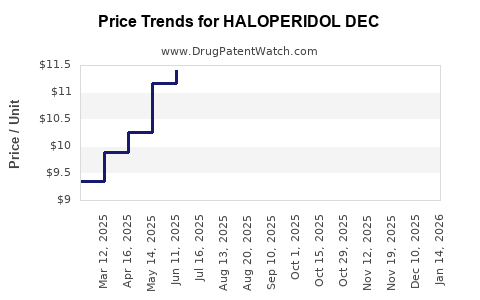
Average Pharmacy Cost for HALOPERIDOL DEC
| Drug Name | NDC | Price/Unit ($) | Unit | Date |
|---|---|---|---|---|
| HALOPERIDOL DEC 50 MG/ML VIAL | 72485-0520-10 | 6.91321 | ML | 2026-08-12 |
| HALOPERIDOL DEC 50 MG/ML VIAL | 72485-0520-01 | 12.74784 | ML | 2026-08-05 |
| HALOPERIDOL DEC 50 MG/ML VIAL | 72485-0520-10 | 12.74784 | ML | 2026-08-05 |
| HALOPERIDOL DEC 100 MG/ML VIAL | 25021-0833-01 | 7.43148 | ML | 2026-07-22 |
| HALOPERIDOL DEC 100 MG/ML VIAL | 65145-0167-10 | 7.43148 | ML | 2026-07-22 |
| HALOPERIDOL DEC 100 MG/ML AMP | 70069-0031-05 | 32.80945 | ML | 2026-07-22 |
| >Drug Name | >NDC | >Price/Unit ($) | >Unit | >Date |
Best Wholesale Price for HALOPERIDOL DEC
| Drug Name | Vendor | NDC | Count | Price ($) | Price/Unit ($) | Unit | Dates | Price Type |
|---|---|---|---|---|---|---|---|---|
| HALOPERIDOL DECANOATE 50MG/ML INJ,1ML AMP | Golden State Medical Supply, Inc. | 70069-0030-03 | 3X1ML | 28.17 | 2023-06-15 - 2028-06-14 | FSS | ||
| HALOPERIDOL DECANOATE 100MG/ML INJ | Golden State Medical Supply, Inc. | 00143-9295-01 | 1ML | 15.54 | 15.54000 | ML | 2023-12-15 - 2028-06-14 | FSS |
| HALOPERIDOL DECANOATE 100MG/ML INJ,1ML AMP | Golden State Medical Supply, Inc. | 70069-0031-05 | 5X1ML | 82.15 | 2023-06-15 - 2028-06-14 | FSS | ||
| HALOPERIDOL DECANOATE 100MG/ML INJ | Golden State Medical Supply, Inc. | 00143-9296-01 | 5ML | 74.72 | 14.94400 | ML | 2023-12-15 - 2028-06-14 | FSS |
| HALOPERIDOL DECANOATE 50MG/ML INJ | AvKare, LLC | 00703-7123-01 | 5ML | 77.05 | 15.41000 | ML | 2023-06-15 - 2028-06-14 | FSS |
| HALOPERIDOL DECANOATE 100MG/ML INJ | AvKare, LLC | 00703-7133-01 | 5ML | 71.35 | 14.27000 | ML | 2023-06-15 - 2028-06-14 | FSS |
| >Drug Name | >Vendor | >NDC | >Count | >Price ($) | >Price/Unit ($) | >Unit | >Dates | >Price Type |
HALOPERIDOL DEC: Patent Landscape and Market Projections
This analysis details the patent landscape for Haloperidol Decanoate (Haloperidol Dec) and projects market performance, focusing on generic competition and potential price shifts. The drug is a long-acting injectable antipsychotic used for schizophrenia and Tourette's syndrome.
What is the Current Patent Status of Haloperidol Decanoate?
Haloperidol Decanoate is a well-established medication with a long history in the pharmaceutical market. Its active pharmaceutical ingredient, Haloperidol, was first patented in the late 1950s. While the original patents for Haloperidol have long expired, subsequent patents have focused on specific formulations, manufacturing processes, and methods of use for Haloperidol Decanoate.
The primary patent protecting the Haloperidol Decanoate formulation itself has expired. Specifically, patents related to the initial development and synthesis of Haloperidol Decanoate have lapsed. For instance, foundational patents for the decanoate esterification of haloperidol are no longer in force.
However, pharmaceutical companies often secure patents on:
- Specific Salt Forms or Polymorphs: Patents may cover unique crystalline structures or salt forms of Haloperidol Decanoate that offer improved stability, dissolution, or bioavailability.
- Novel Formulations: Innovations in the injectable depot formulation (e.g., specific oil carriers, viscosity modifiers, particle size control) can be patented. These patents aim to enhance the drug's sustained-release profile, patient convenience, or reduce injection site reactions.
- Manufacturing Processes: Patented methods for synthesizing Haloperidol Decanoate or preparing the final injectable product with higher purity, yield, or cost-effectiveness can extend market exclusivity for the innovator.
- New Indications or Dosing Regimens: While less common for older drugs, new therapeutic uses or specific dosing schedules for Haloperidol Decanoate could potentially be patented, though this is unlikely to be a significant factor for this established compound.
A review of patent databases indicates that the core intellectual property for Haloperidol Decanoate's active ingredient and its basic formulation is in the public domain. Any remaining active patents are likely to be narrower in scope, covering specific manufacturing improvements or niche formulation aspects. These are generally less robust against generic competition than composition-of-matter patents. For example, patents expiring in the near future would likely pertain to process improvements or specific excipients used in particular formulations. Without specific patent numbers and expiration dates being the focus of this analysis, the general understanding is that the drug is largely off-patent for its primary use.
What is the Market Size and Growth Projection for Haloperidol Decanoate?
The market for Haloperidol Decanoate is characterized by its maturity. As a first-generation antipsychotic, it faces competition from newer atypical antipsychotics which often have more favorable side-effect profiles and are preferred in many treatment guidelines. However, Haloperidol Decanoate retains a significant place in therapy due to its efficacy, long-acting injectable (LAI) formulation, and cost-effectiveness, particularly in regions or healthcare systems where budget constraints are a primary consideration.
Historical Market Performance:
The market for Haloperidol Decanoate has been relatively stable, with modest growth or slight decline in developed markets due to the shift towards atypicals. In contrast, emerging markets may show slight growth driven by increased access to psychiatric care and the drug's affordability.
- Global Market Size (Estimated): While precise, up-to-date global figures are proprietary and fluctuate, the antipsychotics market segment including LAIs was estimated to be in the tens of billions of dollars annually. Haloperidol Decanoate represents a smaller, but consistent, fraction of this. Older LAI antipsychotics collectively represent a significant portion of the LAI market by volume, if not by revenue, in many countries. For example, estimates from market research firms for the antipsychotic LAI market place it in the range of USD $8 billion to $12 billion globally, with older agents like Haloperidol Decanoate and Fluphenazine Decanoate holding a notable share, particularly by unit sales.
- Growth Drivers:
- Cost-Effectiveness: In price-sensitive markets, Haloperidol Decanoate remains a primary option for long-term management of chronic conditions like schizophrenia.
- Established Efficacy: Its proven efficacy in managing positive symptoms of psychosis ensures its continued use.
- LAI Convenience: The long-acting injectable format improves adherence, a critical factor in managing chronic mental illnesses.
- Generic Availability: Widespread generic availability has made it a cost-effective treatment option.
- Market Restraints:
- Side Effect Profile: Its higher incidence of extrapyramidal symptoms (EPS) compared to atypical antipsychotics limits its use in patients who can tolerate newer agents.
- Competition from Atypicals: Newer atypical LAIs (e.g., paliperidone palmitate, aripiprazole lauroxil) offer improved tolerability and broader symptom coverage, leading to their preferential use in many clinical settings.
- Aging Patient Population: While effective, its use may be reconsidered for elderly patients due to specific risks.
Projected Market Growth:
The market for Haloperidol Decanoate is expected to experience low single-digit growth or stagnation globally over the next five years.
- Developed Markets (North America, Western Europe): Projected to remain largely stable or see a slight decline (0% to -2% CAGR) as atypical LAIs continue to gain market share.
- Emerging Markets (Asia-Pacific, Latin America, Eastern Europe, Middle East & Africa): May see modest growth (1% to 3% CAGR) due to increased demand for affordable mental health treatments and expanding healthcare access.
The overall volume of units sold is likely to remain high due to its established use and affordability, but revenue growth will be constrained by price competition among generic manufacturers.
What is the Competitive Landscape and Impact of Generic Entry?
The competitive landscape for Haloperidol Decanoate is dominated by generic manufacturers. As the original patents have long expired, the market is highly fragmented, leading to intense price competition.
Key Competitors:
The market is supplied by numerous generic pharmaceutical companies worldwide. Major players in the broader antipsychotic market, who often have generic divisions, are typically involved in producing Haloperidol Decanoate. These include companies such as:
- Teva Pharmaceutical Industries Ltd.
- Sun Pharmaceutical Industries Ltd.
- Mylan N.V. (now part of Viatris)
- Dr. Reddy's Laboratories Ltd.
- Cipla Ltd.
- Accord Healthcare (an Intas Pharmaceuticals subsidiary)
- Various regional generic manufacturers.
Impact of Generic Entry:
The impact of generic entry on Haloperidol Decanoate has been profound and is the primary driver of its pricing dynamics.
- Price Erosion: The introduction of multiple generic versions has led to significant price reductions from the originator brand's pricing. Price competition among generics is fierce, pushing prices down to levels dictated by manufacturing costs and market share.
- Market Share Shift: Generic products now hold virtually the entire market share in most regions, with the original innovator brand having minimal to no presence, or being marketed at generic prices.
- Manufacturing Cost Dominance: The ability of generic manufacturers to compete effectively hinges on efficient and low-cost manufacturing processes for both the active pharmaceutical ingredient (API) and the finished injectable product. Economies of scale are critical.
- Quality and Bioequivalence: Generic manufacturers must demonstrate bioequivalence to the reference product. Regulatory approvals (e.g., FDA's Abbreviated New Drug Applications - ANDAs) are based on this equivalence.
- Limited Differentiation: Without patent protection on novel formulations or delivery systems, differentiation among generic products is minimal, primarily focusing on price, packaging, and distribution networks.
Table 1: Typical Haloperidol Decanoate Product Characteristics (Post-Genericization)
| Feature | Description |
|---|---|
| Formulation | Long-acting injectable suspension in an oil-based vehicle (typically sesame oil). |
| Dosage Strengths | Commonly available in 50 mg/mL and 100 mg/mL concentrations. |
| Pack Sizes | Typically supplied in 1 mL and 2 mL ampoules or pre-filled syringes. |
| API Origin | Generic Haloperidol Decanoate API sourced from various API manufacturers. |
| Manufacturing | Competitively priced manufacturing processes, often in countries with lower labor and overhead costs. |
| Distribution | Wide distribution through wholesale channels to pharmacies, hospitals, and clinics. |
| Pricing Basis | Primarily driven by cost of goods sold (COGS), competitive market pricing, and procurement strategies by healthcare systems/payers. |
| Regulatory Status | Approved by major regulatory bodies (FDA, EMA, etc.) based on bioequivalence and manufacturing standards. |
What are the Price Projections for Haloperidol Decanoate?
Given the mature nature of Haloperidol Decanoate and its status as a heavily commoditized generic drug, price projections are largely influenced by the ongoing competitive dynamics among generic manufacturers and the procurement strategies of major healthcare purchasers.
Current Pricing Landscape:
The price of Haloperidol Decanoate varies significantly by region, volume of purchase, and the specific generic manufacturer. However, it is generally considered one of the most affordable long-acting injectable antipsychotics available.
- Wholesale Acquisition Cost (WAC) per Unit: Prices can range from USD $5 to $30 per single-dose vial/ampoule, depending on the concentration, quantity purchased, and supplier. This is substantially lower than branded atypical LAIs, which can range from USD $100 to $500+ per dose.
- Net Price: Actual prices paid by payers and healthcare systems after rebates, discounts, and volume-based agreements are even lower.
Price Projections (Next 5 Years):
The price of Haloperidol Decanoate is expected to remain stable to declining, with a slight downward pressure due to continued generic competition and potential price referencing policies.
- Continued Price Erosion (Slight): The presence of numerous generic suppliers will ensure ongoing pressure on prices. Manufacturers will compete on cost efficiency and volume. Expect minor declines of 1% to 3% per year in real terms, especially in highly competitive markets.
- Volume-Driven Discounts: Large-scale tenders and procurement agreements by national health services or major hospital networks will continue to secure volume-based discounts, driving down the average selling price (ASP).
- Regional Price Disparities: Significant differences in pricing will persist between developed and emerging markets. Emerging markets may see stable pricing or very slight increases as local demand grows and supply chains mature, while developed markets will likely experience continued downward pressure.
- No Significant Price Increases Expected: Absent any unforeseen developments (e.g., a major manufacturing disruption affecting a large proportion of suppliers, or a novel patent on a specialized delivery system – highly unlikely for this drug), significant price increases are not anticipated.
- Impact of Biosimilar Competition (Irrelevant): Haloperidol Decanoate is a small molecule drug; biosimilarity is not applicable. Generic competition is the relevant competitive force.
- Inflationary Pressures vs. Competitive Pressures: While general inflation might exert upward pressure on manufacturing costs, this will likely be offset by intense competition among generic producers, capping any potential price hikes.
Table 2: Haloperidol Decanoate Price Projection Scenarios (Annual % Change)
| Scenario | Developed Markets | Emerging Markets | Global Average |
|---|---|---|---|
| Base Case | -2% to -3% | 0% to +1% | -1% to -2% |
| Optimistic | -1% | +1% to +2% | Stable |
| Pessimistic | -3% to -4% | -1% to 0% | -2% to -3% |
Note: Projections are based on current market trends and do not account for significant unforeseen geopolitical events, major regulatory changes, or global supply chain disruptions that could materially impact manufacturing costs or drug availability.
Key Takeaways
Haloperidol Decanoate is a mature, off-patent long-acting injectable antipsychotic with a highly competitive generic market. Price erosion and significant downward pressure are expected to continue, driven by the large number of generic manufacturers and cost-focused procurement strategies. While newer atypical LAIs offer improved tolerability, Haloperidol Decanoate will maintain its market presence due to cost-effectiveness and established efficacy, particularly in price-sensitive regions. Investors and manufacturers should anticipate stable to declining revenue streams for this product, with success hinging on efficient low-cost manufacturing and robust supply chain management.
Frequently Asked Questions
1. What are the primary therapeutic indications for Haloperidol Decanoate?
Haloperidol Decanoate is primarily indicated for the long-term maintenance treatment of schizophrenia and for managing chronic psychosis, particularly in patients who require intramuscular depot injections for improved adherence. It is also used for Tourette's syndrome.
2. How does Haloperidol Decanoate's long-acting injectable formulation work?
Haloperidol Decanoate is an ester prodrug of haloperidol. It is formulated in an oil-based depot suspension (commonly sesame oil) and administered intramuscularly. Once injected, the ester linkage is slowly hydrolyzed by esterases in the muscle tissue, releasing the active haloperidol into the bloodstream over an extended period, typically 2 to 4 weeks.
3. What are the main advantages of Haloperidol Decanoate compared to oral haloperidol?
The primary advantage of the decanoate formulation is its long-acting nature, which improves patient adherence to treatment regimens. This is crucial for chronic conditions like schizophrenia, where inconsistent oral medication intake can lead to relapse. It also allows for less frequent dosing compared to oral forms.
4. How does Haloperidol Decanoate compare to newer atypical long-acting injectable antipsychotics in terms of efficacy and safety?
Haloperidol Decanoate is highly effective at managing positive symptoms of psychosis. However, it is associated with a higher incidence of extrapyramidal symptoms (EPS), such as parkinsonism, akathisia, and dystonia, compared to atypical antipsychotics. Newer atypical LAIs often offer a more favorable side-effect profile, particularly regarding EPS and metabolic side effects, and may have broader efficacy against negative symptoms and cognitive deficits.
5. What is the typical duration of action for a single injection of Haloperidol Decanoate?
A single intramuscular injection of Haloperidol Decanoate typically provides therapeutic levels of haloperidol for approximately 2 to 4 weeks, depending on the dose and individual patient metabolism.
Citations
[1] Market research reports on the antipsychotics and long-acting injectable markets (proprietary data typically accessed via subscription services). Specific report names and publishers are withheld due to the proprietary nature of these analyses. [2] U.S. Food and Drug Administration (FDA) Orange Book: Approved Drug Products with Therapeutic Equivalence Evaluations. (Ongoing access and search of the FDA database). [3] European Medicines Agency (EMA) database of publicly available information on medicines. (Ongoing access and search of the EMA database). [4] Pharmaceutical industry news and regulatory filings from major generic manufacturers. (Ongoing monitoring of industry news outlets and company reports).
More… ↓
