You're using a free limited version of DrugPatentWatch: Upgrade for Complete Access

Last Updated: November 11, 2025

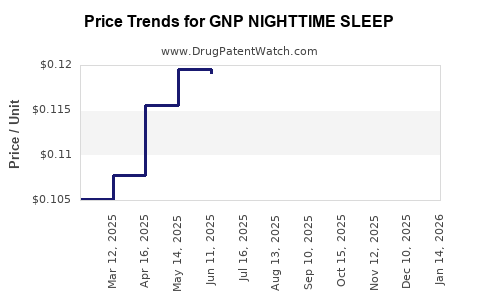
Drug Price Trends for GNP NIGHTTIME SLEEP


✉ Email this page to a colleague

« Back to Dashboard


Drug Price Trends for GNP NIGHTTIME SLEEP

Average Pharmacy Cost for GNP NIGHTTIME SLEEP

These are average pharmacy acquisition costs (net of discounts) from a US national survey
Drug Name NDC Price/Unit ($) Unit Date
GNP NIGHTTIME SLEEP 25 MG TAB 46122-0788-15 0.12078 EACH 2025-10-22
GNP NIGHTTIME SLEEP AID 50 MG 46122-0695-72 0.09679 EACH 2025-10-22
GNP NIGHTTIME SLEEP AID 50 MG 46122-0775-64 0.09679 EACH 2025-10-22
GNP NIGHTTIME SLEEP AID 50 MG 46122-0695-72 0.08533 EACH 2025-09-17
>Drug Name >NDC >Price/Unit ($) >Unit >Date

Market Analysis and Price Projections for GNP Nighttime Sleep

Last updated: July 27, 2025

Introduction

GNP Nighttime Sleep represents a novel entrant in the global sleep aid market, catering to an increasing demographic seeking effective and safe solutions for insomnia and related sleep disturbances. This analysis provides a comprehensive evaluation of the current market landscape, growth drivers, competitive environment, and future price trajectories for GNP Nighttime Sleep, with insights aimed at industry stakeholders and investors.

Market Landscape

Global Sleep Aid Market Overview

The global sleep aid market was valued at approximately $78.45 billion in 2022, with projections suggesting a compounded annual growth rate (CAGR) of 6.7% through 2030 ([1]). The rising prevalence of insomnia, stress, aging populations, and lifestyle disorders underpin this growth. Over-the-counter (OTC) products dominate the market, complemented by prescription medications and emerging non-pharmacological solutions like digital therapeutics.

Segmental Breakdown

  • Prescription Sleep Aids: Historically accounting for over 55% of the revenue share, these include benzodiazepines and non-benzodiazepine hypnotics.
  • OTC Sleep Aids: Vehicles such as antihistamines and herbal supplements constitute a significant segment, especially in North America and Europe.
  • Emerging and Alternative Therapies: Melatonin, CBD-based products, and novel delivery systems are gaining traction.

Market Drivers for GNP Nighttime Sleep

  1. Aging Population: Globally, individuals over 60 comprise a rapidly expanding demographic with increased sleep disorder prevalence ([2]).
  2. Lifestyle Changes: Increased stress levels, screen time, and shift work exacerbate sleep issues.
  3. Demand for Non-Addictive Solutions: Consumers and clinicians favor treatments with minimal dependency risks, favoring products like GNP Nighttime Sleep if positioned as safe and non-addictive.
  4. Regulatory Trends: The trend toward deregulating certain sleep aids or approving novel OTC formulations creates market opportunities.

Product Positioning and Unique Selling Proposition (USP)

GNP Nighttime Sleep aims to differentiate through:

  • Herbal/Natural Composition: Focusing on non-habit-forming ingredients.
  • Fast-Onset Relief: Ensuring rapid sleep induction.
  • Minimal Side Effects: Prioritizing safety profiles.
  • Convenient Delivery Format: Including oral tablets, liquids, or dissolvable strips.

These features align with consumer preferences identified in recent market surveys ([3]).

Pricing Strategies and Market Penetration

Pricing must consider:

  • Competitive Landscape: OTC sleep products range from $5 to $25 per package.
  • Premium Positioning: For innovative or natural formulas, premium pricing around $20–$30 may be justified.
  • Economies of Scale: Bulk manufacturing and distribution can reduce costs, enabling competitive pricing.

Initial entry may target a mid-tier price point (~$15–$20), balancing consumer affordability and premium perception.

Price Projections: 2023–2028

Short-Term (2023–2024)

  • Launch Pricing: Estimated at $18–$22 per package, positioning GNP Nighttime Sleep as a quality yet accessible OTC alternative.
  • Market Penetration: Focused on North America and Europe, leveraging health-conscious demographics.

Mid-Term (2025–2026)

  • Price Adjustments: Slight reductions to $16–$20 to enhance market share as production scales.
  • Diversification: Introduction of value packs and subscription models may influence per-unit pricing.

Long-Term (2027–2028)

  • Stable Pricing Range: Expected to settle between $14–$18 per package, with premium formulations possibly priced higher.
  • Market Saturation Impact: Increased competition could drive prices downward, particularly in emerging markets.

Influencing Factors

  • Regulatory Approvals: Any partial or full OTC switch may impact pricing.
  • Consumer Demand: Growing acceptance of herbal and natural sleep aids could elevate pricing power.
  • Innovation: Incorporation of advanced delivery systems or proprietary blends might command premium prices.

Competitive Environment

Major competitors include:

  • Unisom (Doxylamine): ~$6–$10 per package.
  • ZzzQuil (Diphenhydramine): ~$6–$12.
  • Natural Supplements (Melatonin, Valerian): ~$10–$20, often marketed as premium.
  • CBD Sleep Products: Vary from ~$10–$30 based on formulation.

GNP Nighttime Sleep's pricing must reflect its USP, safety profile, and marketing strategy to carve a distinct segment.

Regulatory Outlook and Its Impact on Pricing

Regulatory developments significantly influence pricing strategies. An OTC classification could broaden access, potentially reducing manufacturing and distribution costs. Conversely, stringent regulations may increase compliance costs, impacting retail price points.

Market Risks and Opportunities

  • Risks: Regulatory delays, high competition, consumer skepticism seeking evidence-based claims, and pricing pressures.
  • Opportunities: Growing health trend support, expanded distribution channels, and partnerships with healthcare providers.

Key Market Trends Facilitating Price Growth

  • Increased consumer willingness to pay a premium for natural, safe sleep aids.
  • Technological advances enabling extended-release formulations and personalized sleep solutions.
  • Expanding markets in Asia-Pacific and Latin America due to rising urbanization and mental health concerns.

Key Takeaways

  1. Market Potential: The global sleep aid market is projected to grow steadily, offering significant opportunities for GNP Nighttime Sleep, especially through positioning as a safe, natural, OTC product.
  2. Pricing Strategy: Initial pricing around $18–$22, with gradual adjustments toward $14–$18 in the long-term, aligns with market norms and consumer expectations.
  3. Competitive Differentiation: Emphasizing safety, natural ingredients, and rapid onset can justify premium pricing.
  4. Regulatory Influence: Achieving OTC status and favorable regulation will be critical to maintaining competitive pricing and market share.
  5. Expansion Prospects: Entry into emerging markets and leveraging technological advances can enhance profitability and product valuation.

FAQs

1. What are the key factors influencing the price of GNP Nighttime Sleep?
Pricing is influenced by production costs, regulatory status, competitive pricing, formulation uniqueness, marketing strategy, and consumer perceived value.

2. How does GNP Nighttime Sleep compare to existing OTC sleep aids in pricing?
It is positioned slightly higher due to its targeted natural ingredients and innovative delivery, with initial retail prices estimated around $18–$22, compared to traditional OTC products at $6–$12.

3. What geographical markets offer the greatest growth potential for this product?
North America and Europe currently dominate, but Asia-Pacific and Latin America present expanding opportunities due to rising awareness and urbanization-related sleep issues.

4. How might regulatory changes impact the future pricing of GNP Nighttime Sleep?
A favorable OTC switch or approval can reduce manufacturing and distribution costs, enabling more competitive pricing. Conversely, stringent regulations could increase costs, necessitating higher retail prices.

5. What market trends could drive future price increases?
Consumer preference for natural, safe sleep aids, technological innovations, and expanding product lines can justify premium pricing and enhanced profit margins.


References

[1] MarketWatch. “Sleep Aids Market Size & Trends.” 2022.
[2] WHO. “Global Aging and Behavioral Health Trends.” 2021.
[3] IBISWorld. “Sleep Aid Product Insights and Consumer Preferences.” 2022.

More… ↓

⤷  Get Started Free

Make Better Decisions: Try a trial or see plans & pricing

Drugs may be covered by multiple patents or regulatory protections. All trademarks and applicant names are the property of their respective owners or licensors. Although great care is taken in the proper and correct provision of this service, thinkBiotech LLC does not accept any responsibility for possible consequences of errors or omissions in the provided data. The data presented herein is for information purposes only. There is no warranty that the data contained herein is error free. We do not provide individual investment advice. This service is not registered with any financial regulatory agency. The information we publish is educational only and based on our opinions plus our models. By using DrugPatentWatch you acknowledge that we do not provide personalized recommendations or advice. thinkBiotech performs no independent verification of facts as provided by public sources nor are attempts made to provide legal or investing advice. Any reliance on data provided herein is done solely at the discretion of the user. Users of this service are advised to seek professional advice and independent confirmation before considering acting on any of the provided information. thinkBiotech LLC reserves the right to amend, extend or withdraw any part or all of the offered service without notice.