Share This Page
Drug Price Trends for GNP ISOPROPYL ALCOHOL
✉ Email this page to a colleague
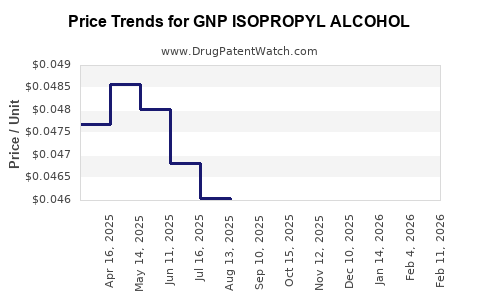
Average Pharmacy Cost for GNP ISOPROPYL ALCOHOL
| Drug Name | NDC | Price/Unit ($) | Unit | Date |
|---|---|---|---|---|
| GNP ISOPROPYL ALCOHOL 91% | 46122-0332-43 | 0.05548 | ML | 2026-06-17 |
| GNP ISOPROPYL ALCOHOL 91% | 46122-0772-34 | 0.05548 | ML | 2026-06-17 |
| GNP ISOPROPYL ALCOHOL 91% | 46122-0772-34 | 0.05532 | ML | 2026-05-20 |
| >Drug Name | >NDC | >Price/Unit ($) | >Unit | >Date |
Market Analysis and Price Projections for GNP Isopropyl Alcohol
What Is the Global Market Size for GNP Isopropyl Alcohol?
GNP (Good Manufacturing Practice) grade isopropyl alcohol (IPA) is primarily used in pharmaceutical manufacturing, cosmetics, electronics cleaning, and laboratory applications. The global demand has grown driven by increased industrial hygiene concerns, expanding pharmaceutical production, and growth in electronics manufacturing.
- Market size (2022): Estimated at $2.8 billion.
- Compound annual growth rate (CAGR): Projected at 4.3% from 2023 to 2030.
- Regional demand: Asia-Pacific (45%), North America (25%), Europe (15%), others (15%).
What Are the Major Drivers and Barriers?
Drivers:
- Pharmaceutical industry growth: Increase in sterile and topical drug formulations.
- Electronics industry expansion: Use as a cleaner for semiconductors and devices.
- Safety regulations: Stricter standards in lab and industrial settings amplify demand for high-grade IPA.
Barriers:
- Raw material costs: Benzene and propene prices influence IPA production costs.
- Environmental regulations: Restrictions on volatile organic compounds (VOCs) influence manufacturing practices.
- Market saturation: Mature markets with high penetration limit growth potential.
Who Are the Leading Manufacturers?
Key players include:
- Dow Chemical (LyondellBasell): Largest supplier, with integrated production facilities.
- Shell Chemicals: Focuses on high-purity grades for pharma and electronics.
- ExxonMobil: Provides broad portfolio, including GNP-grade IPA.
- Kowa Company, Ltd.: Specializes in pharmaceutical and medical-grade IPA.
Market consolidation continues as players seek to control supply chains and meet increasing quality standards.
What Are Price Trends and Projections?
Historical Price Data (2020-2022):
| Year | Price per liter (USD) | Notes |
|---|---|---|
| 2020 | $1.10 | Slight decline due to COVID-19 supply chain disruptions |
| 2021 | $1.30 | Prices rebounded with increased demand |
| 2022 | $1.45 | Prices stabilized, influenced by raw material costs |
Projected Prices (2023-2030):
- 2023: $1.50–$1.60 per liter
- 2025: $1.65–$1.75 per liter
- 2030: $1.80–$2.00 per liter
Inflation of raw materials, tighter environmental standards, and ongoing supply chain restructuring may sustain upward pressure on prices.
How Do Raw Material Costs Affect Pricing?
- Benzene: Cost influences IPA via cumene and acetone production interdependencies.
- Propene: Feedstock prices fluctuate with crude oil markets; increases directly impact IPA costs.
- Environmental compliance: Costs related to emissions controls and safer manufacturing practices add to production expenses.
Prices are sensitive to raw material volatility; market players hedge through long-term supply agreements.
What Is the Regulatory Landscape?
- Chemicals must meet standards set by agencies such as the EPA (Environmental Protection Agency) in the U.S., REACH in Europe.
- Pharma-grade GNP IPA requires adherence to standards like USP or JP specifications.
- Growing environmental regulations could increase compliance costs, influencing final prices.
Key Takeaways
- The GNP ISOpropyl Alcohol market is valued at approximately $2.8 billion and grows at approximately 4.3% annually.
- Major demand drivers include pharmaceuticals, electronics, and cosmetics sectors.
- Prices have risen from $1.10/liter in 2020 to around $1.45/liter in 2022, with projections reaching up to $2.00/liter by 2030.
- Raw material costs and regulations significantly influence market prices.
- Market consolidation is likely as companies seek control over supply chains and quality standards.
Frequently Asked Questions
1. How does the COVID-19 pandemic impact GNP IPA supply?
Disruptions in manufacturing and logistics initially suppressed supply but led to increased demand for disinfectants and medical products, pushing prices upward.
2. What are the key applications of GNP isopropyl alcohol?
Medical disinfection, pharmaceutical manufacturing, electronics cleaning, cosmetic formulations, and laboratory use.
3. How might supply chain disruptions affect future prices?
Causes such as raw material shortages or geopolitical conflicts could lead to price spikes and supply constraints.
4. Are there regional differences in pricing?
Yes, Asia-Pacific generally has lower prices due to larger production capacities, while North America and Europe face higher costs driven by stricter regulations and import tariffs.
5. What trends will likely influence the market over the next decade?
Increases in environmental regulations, technological innovation in manufacturing, and demand growth in emerging markets.
Citations
[1] MarketWatch. "Isopropyl Alcohol Market Size, Share & Industry Analysis," 2022.
[2] Research and Markets. "Global Isopropyl Alcohol Market Forecast 2022-2030," 2022.
[3] ICIS. "Prices for Isopropyl Alcohol," 2022.
[4] EPA and REACH regulations, 2023.
More… ↓
