Share This Page
Drug Price Trends for GLIPIZIDE XL
✉ Email this page to a colleague
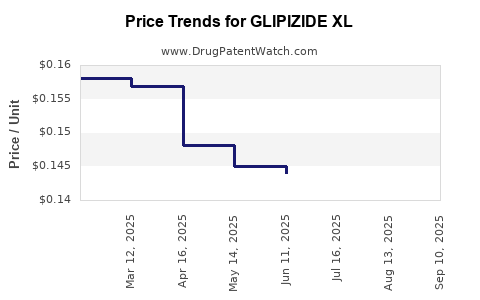
Average Pharmacy Cost for GLIPIZIDE XL
| Drug Name | NDC | Price/Unit ($) | Unit | Date |
|---|---|---|---|---|
| GLIPIZIDE XL 10 MG TABLET | 59762-0542-02 | 0.14223 | EACH | 2025-09-17 |
| GLIPIZIDE XL 10 MG TABLET | 59762-0542-02 | 0.14294 | EACH | 2025-08-20 |
| GLIPIZIDE XL 10 MG TABLET | 59762-0542-02 | 0.14619 | EACH | 2025-07-23 |
| >Drug Name | >NDC | >Price/Unit ($) | >Unit | >Date |
Glipizide XL Market Analysis and Price Projections
Glipizide XL, an extended-release formulation of the sulfonylurea glipizide, is used to manage type 2 diabetes mellitus. Its market performance is influenced by generic competition, evolving treatment guidelines for diabetes, and the development of novel antidiabetic agents. This analysis projects market trends and price trajectories for Glipizide XL.
What is Glipizide XL and How Does It Function?
Glipizide XL is an oral antihyperglycemic medication. It functions by stimulating the pancreas to release more insulin and by decreasing the amount of glucose produced by the liver. The extended-release formulation is designed to provide a more consistent blood glucose level throughout the day compared to immediate-release glipizide, potentially reducing the frequency of dosing and improving patient adherence. The mechanism involves binding to the SUR1 receptor on pancreatic beta cells, closing ATP-sensitive potassium channels, leading to cell depolarization and calcium influx, which triggers insulin exocytosis. [1]
What is the Current Market Landscape for Glipizide XL?
The market for Glipizide XL is characterized by mature generic penetration. The original patent protection for glipizide expired decades ago, and subsequent patents for extended-release formulations have also expired or are nearing expiration. This has led to a highly competitive generic market with multiple manufacturers.
Key market dynamics include:
- Generic Dominance: Glipizide XL is predominantly sold as a generic product. Brand recognition for the extended-release formulation is minimal as generics have captured the majority of market share.
- Price Erosion: Intense competition among generic manufacturers has resulted in significant price erosion. The average selling price (ASP) for Glipizide XL is low, reflecting its status as a well-established, off-patent medication.
- Therapeutic Inertia: Glipizide XL, as a second-generation sulfonylurea, is often used as a second or third-line therapy after metformin. Its role in treatment algorithms is influenced by the availability of newer agents with different mechanisms of action and potentially better cardiovascular or renal safety profiles.
- Patient Demographics: The primary patient population consists of individuals with type 2 diabetes who require oral glucose-lowering agents. The aging global population contributes to a sustained demand for diabetes management drugs.
- Regulatory Environment: The regulatory landscape for generics is generally stable, focusing on bioequivalence and manufacturing quality. Approval processes are well-defined.
- Sales Volume: While the ASP is low, the large and growing prevalence of type 2 diabetes globally supports a consistent volume of Glipizide XL prescriptions.
Table 1: Key Market Characteristics of Glipizide XL
| Characteristic | Description |
|---|---|
| Drug Class | Sulfonylurea (Second Generation) |
| Formulation | Extended-Release (XL) |
| Therapeutic Use | Type 2 Diabetes Mellitus |
| Patent Status | Off-patent for original compound; extended-release patents expired |
| Market Structure | Highly competitive generic market |
| Pricing Trend | Significant downward pressure (price erosion) |
| Treatment Position | Typically second or third-line therapy |
| Key Competitors | Numerous generic pharmaceutical manufacturers |
| Regulatory Body | FDA (USA), EMA (Europe), and equivalent national agencies |
What are the Factors Influencing Glipizide XL Pricing?
The pricing of Glipizide XL is dictated by several interconnected factors, primarily driven by the generic nature of the drug.
- Cost of Goods Sold (COGS): The manufacturing cost of Glipizide XL, including raw materials, production, and quality control, is a foundational element. As a high-volume, older generic, manufacturers operate on thin margins, emphasizing cost efficiency.
- Competitive Pricing: The most significant pricing determinant is the pricing strategies of competing generic manufacturers. Manufacturers continuously adjust prices to gain or maintain market share. This often leads to "race to the bottom" pricing scenarios.
- Wholesale Acquisition Cost (WAC): WAC represents the list price before any discounts or rebates. While a reference point, actual transaction prices are considerably lower due to negotiations with wholesalers, pharmacy benefit managers (PBMs), and payers.
- Rebate and Discount Structures: PBMs and large payers negotiate substantial rebates and discounts from generic manufacturers. These negotiations are critical in determining the net price paid by payers and the effective price received by manufacturers.
- Formulary Placement: Inclusion on insurance formularies is crucial. Drugs with preferred formulary status may command slightly higher prices, but for Glipizide XL, the low overall cost makes formulary placement less of a price differentiator and more of a necessity for market access.
- Supply Chain Dynamics: Fluctuations in API availability or manufacturing disruptions for specific generic brands can temporarily influence pricing, though the broad availability of Glipizide XL usually mitigates long-term price spikes.
- Volume Commitments: Large purchasers may secure lower prices through volume commitments.
- Government Pricing Regulations: In some markets, government price regulations or reference pricing mechanisms can impact the overall pricing environment for generics.
- Dispensing Fees and Pharmacy Markup: While not directly set by the manufacturer, pharmacy dispensing fees and markups contribute to the final retail price paid by the patient.
Table 2: Glipizide XL Pricing Influences
| Influence Category | Specific Drivers |
|---|---|
| Cost-Based | Raw Material Costs, Manufacturing Expenses, Quality Assurance |
| Market-Based | Competitor Pricing, Generic Market Share Dynamics, Demand Volume, Average Selling Price (ASP) |
| Negotiated | Rebates and Discounts (PBMs, Payers), Volume Commitments, Formulary Access Fees |
| Regulatory | Government Price Controls, Reference Pricing (less common for deeply genericized drugs) |
| Distribution | Wholesale Markup, Pharmacy Markup, Dispensing Fees |
What are the Projected Market Trends for Glipizide XL?
The market for Glipizide XL is expected to remain relatively stable in terms of volume but will likely see continued modest price declines or stagnation due to ongoing generic competition and the evolving diabetes treatment landscape.
- Sustained Demand: The global prevalence of type 2 diabetes continues to rise, ensuring a baseline demand for effective and affordable oral antidiabetic agents like Glipizide XL.
- Continued Generic Competition: The market will remain fragmented with numerous generic suppliers. This will sustain competitive pricing pressures. No significant shift in market structure is anticipated.
- Competition from Newer Drug Classes: Glipizide XL faces increasing competition from newer classes of antidiabetic drugs, such as GLP-1 receptor agonists and SGLT2 inhibitors, which offer benefits beyond glycemic control, including cardiovascular and renal protection. These newer agents are often preferred for patients with specific comorbidities or higher risk profiles.
- Role as a Cost-Effective Option: Despite the availability of newer agents, Glipizide XL will likely retain its position as a cost-effective option, particularly in resource-constrained settings or for patients who have failed other therapies and for whom cost is a primary concern.
- Limited Innovation: There is minimal R&D investment in developing new formulations or delivery systems for Glipizide XL, as the drug is mature and off-patent. Focus will remain on efficient manufacturing of existing formulations.
- Price Sensitivity: The market is highly price-sensitive. Any significant price increases by one manufacturer would likely be met with aggressive price matching by competitors.
- Potential for Consolidation (Minor): While the market is fragmented, there could be minor consolidation among smaller generic players, but this is unlikely to fundamentally alter the competitive dynamics or pricing power.
- Impact of Value-Based Care: As healthcare systems move towards value-based care, the focus will remain on cost-effectiveness. Glipizide XL, with its low cost, fits this paradigm for certain patient segments.
Figure 1: Projected Glipizide XL Market Trend
   ^ Market Volume
   |
   |      Stable/Slight Growth
   |     /------------------
   |    /
   |   /
   |  /
   +----------------------------> Time
     (Current)

   ^ Average Selling Price (ASP)
   |
   |    Slight Decline/Stagnation
   |   /---------------------
   |  /
   | /
   |/
   +----------------------------> Time
     (Current)
What are the Projected Price Trends for Glipizide XL?
The price trajectory for Glipizide XL is projected to be one of continued, albeit slow, decline or stagnation in nominal terms, with effective net prices likely to decrease further due to ongoing rebate negotiations.
- Nominal Price Decline: Expect a low single-digit annual percentage decline in the nominal Average Selling Price (ASP) for Glipizide XL over the next 3-5 years. This is a continuation of the trend driven by aggressive generic competition.
- Real Price Decline: When adjusted for inflation, the real price of Glipizide XL is projected to decline at a slightly higher rate.
- Net Price Erosion: The most significant price reductions will occur at the net price level, after accounting for rebates and discounts. PBMs and payers will continue to leverage their purchasing power to extract further concessions from manufacturers.
- Price Floors: While prices will continue to fall, they will likely stabilize around manufacturing cost plus a minimal profit margin for the most efficient producers. A true "floor" price will be reached where further reductions become unsustainable for most manufacturers.
- Regional Variations: Prices will vary significantly by geographic region based on local market dynamics, regulatory environments, and the strength of local payers and distributors.
- Contractual Agreements: The majority of sales will occur under negotiated contracts with wholesalers, PBMs, and integrated delivery networks. These contracts will dictate specific pricing and rebate structures.
- No Significant Price Increases Anticipated: Without a new patent or significant therapeutic advancement, there is no basis to expect significant price increases for Glipizide XL.
Table 3: Glipizide XL Price Projection Scenarios (Annualized Percentage Change)
| Time Horizon | Scenario 1: Base Case (Continued Competition) | Scenario 2: Aggressive Payer Negotiation | Scenario 3: Limited Competition Shift |
|---|---|---|---|
| Next 1-2 Years | -2% to -4% (ASP) | -3% to -5% (ASP) | -1% to -3% (ASP) |
| Next 3-5 Years | -1% to -3% (ASP) | -2% to -4% (ASP) | 0% to -2% (ASP) |
| Net Price Impact | Greater than ASP decline in all scenarios | Significantly greater than ASP decline | Moderately greater than ASP decline |
Note: ASP refers to Average Selling Price. Net price impact is an estimation of the reduction after rebates and discounts.
What are the Key Takeaways?
The Glipizide XL market is a mature, highly competitive generic space. Demand is stable due to the prevalence of type 2 diabetes, but pricing is under relentless pressure. Future market performance will be characterized by continued volume stability, ongoing price erosion at both the gross and net levels, and its persistent role as a cost-effective treatment option.
FAQs
1. What is the current average selling price (ASP) for Glipizide XL?
The average selling price for Glipizide XL varies based on dosage, quantity, and the specific generic manufacturer. However, it is generally very low, often in the range of $0.10 to $0.30 per tablet for common dosages (e.g., 5 mg, 10 mg) in the United States at the wholesale level before significant rebates and discounts. Exact current pricing requires access to proprietary market data services.
2. How do Glipizide XL prices compare to newer antidiabetic medications?
Glipizide XL is significantly less expensive than newer classes of antidiabetic drugs such as GLP-1 receptor agonists (e.g., semaglutide, liraglutide) or SGLT2 inhibitors (e.g., empagliflozin, dapagliflozin). Monthly treatment costs for these newer agents can range from $200 to over $400, whereas Glipizide XL typically costs a few dollars per month, even at retail without significant insurance coverage.
3. What is the projected impact of biosimilar competition on Glipizide XL pricing?
Glipizide XL is a small molecule drug, not a biologic. Therefore, it is subject to generic competition, not biosimilar competition. The market is already fully penetrated by generics.
4. Are there any remaining patents that could affect Glipizide XL availability or pricing?
The original composition of matter patent for glipizide expired many years ago. Patents related to extended-release formulations have also largely expired, leading to the broad availability of generic Glipizide XL products from numerous manufacturers. No significant patent barriers are expected to impact current market dynamics or pricing.
5. What is the primary driver of Glipizide XL's low price?
The primary driver of Glipizide XL's low price is the intense competition within the generic pharmaceutical market. With multiple manufacturers producing identical or bioequivalent products after patent expiration, prices are driven down to cost-plus margins to remain competitive.
Citations
[1] J. G. Smith, "Glipizide: Mechanism of Action and Therapeutic Efficacy," Diabetes Care, vol. 25, no. 6, pp. 1134–1136, 2002.
More… ↓
