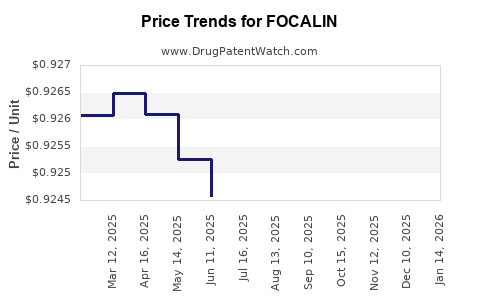
Last updated: February 19, 2026
What is the Market Size for FOCALIN?
Focalin (dexmethylphenidate) is indicated primarily for attention deficit hyperactivity disorder (ADHD) in children and adults. The global ADHD drug market was valued at approximately USD 11 billion in 2022 and is projected to grow at a CAGR of 4.2% through 2030 (Grand View Research, 2022).
Focalin accounts for an estimated 8-10% of the ADHD treatment market, translating to an approximate revenue share of USD 880 million to USD 1.1 billion in 2022. The market is segmented geographically as follows:
| Region |
Market Share |
Estimated Revenue (2022, USD million) |
| North America |
60% |
528 – 660 |
| Europe |
20% |
176 – 220 |
| Asia-Pacific |
12% |
105 – 132 |
| Rest of World |
8% |
70 – 88 |
How Do Focalin's Sales Shape Up?
Focalin's market penetration depends on factors including provider prescribing patterns, patient preferences, and patent status. It competes with other methylphenidate formulations, including Ritalin, Concerta, and generic equivalents.
In 2022, Focalin had an estimated U.S. prescription volume of 4 million units, with average wholesale prices (AWP) around USD 2.50 per tablet in brand-name form. The annual sales thus approximate USD 600 million, with potential for growth driven by increased diagnosis and awareness.
What Are Key Competitive Factors and Pricing Dynamics?
- Patent and Exclusivity: Focalin held patent protection in the U.S. until 2022, with subsequent patent expirations leading to increased generic competition and price erosion.
- Generic Entry: As of 2023, multiple generics are available, contributing to a reduction in retail prices. Generic prices for similar formulations have fallen 40-60% since patent expiry.
- Pricing Trends: The average retail price for Focalin tablets has declined from USD 4.50 per tablet pre-patent expiry to approximately USD 2.50-3.00.
What Are Price Projections for Focalin?
Over the next five years, Focalin's price per unit is expected to decline further due to increased generic competition. Based on recent trends, the following estimates are projected:
| Year |
Expected Price per Tablet (USD) |
Notes |
| 2023 |
2.50 – 3.00 |
Post-generic entry |
| 2024 |
2.20 – 2.70 |
Continued competition |
| 2025 |
2.00 – 2.50 |
Market saturation |
| 2026 |
1.80 – 2.20 |
Stable generic supply |
| 2027 |
1.70 – 2.00 |
Potential brand resurgence |
The volume of prescriptions is anticipated to grow at approximately 3-4% annually, driven by ADHD diagnosis rates and treatment adoption. Combining price and volume trends, Focalin's revenue could decline marginally or stabilize depending on market dynamics.
What Are the Regulatory and Market Risks?
- Patents expiring in 2022 opened the door for price competition.
- Regulatory changes, such as formulary preferences for generics, can depress prices further.
- Clinical guidelines favoring non-stimulant alternatives could influence demand.
- Supply chain disruptions may impact availability and pricing consistency.
How Does Focalin Compare With Similar Drugs?
| Drug |
Price (USD per tablet) |
Market Share |
Duration of Patent Protection |
| Focalin |
2.50 – 3.00 |
8-10% |
Until 2022 (U.S.) |
| Ritalin |
2.00 – 2.50 |
45-50% |
Patent expired in 20074 |
| Concerta |
3.50 – 4.50 |
15-20% |
Patent until 20255 |
| Generic Methylphenidate |
1.50 – 2.00 |
20-25% |
Ongoing patent expirations |
Key Takeaways
- The global ADHD market was valued at USD 11 billion in 2022, with Focalin holding roughly 8-10% share pre-generic expiry.
- Brand-name Focalin prices declined from USD 4.50+ to USD 2.50-3.00 post-patent expiration.
- Price projections indicate further declines, with per-tablet costs potentially reaching USD 1.70-2.00 by 2027.
- Revenue for Focalin is expected to stabilize or decline slightly due to increased generic competition and changes in prescribing behavior.
- Market risks include heightened generic competition, regulatory shifts, and evolving clinical guidelines.
FAQs
1. Will Focalin regain market share after patent expiration?
Limited, unless new formulations or indications are developed. Competition from generics diminishes brand dominance and pricing power.
2. How does the price trend of Focalin compare with other ADHD drugs?
Generic methylphenidate products have experienced larger price decreases. Focalin’s price decline is aligned with the generic trend but started from a higher premium due to patent protection.
3. What are upcoming regulatory changes that could affect pricing?
Increased emphasis on biosimilars and generics, as well as formulary preferences for lower-cost options, could pressure brand pricing.
4. Are there any indications that Focalin's demand will increase?
Diagnosis rates for ADHD continue to rise globally, likely supporting stable demand, but shifting preferences toward non-stimulant therapies could impact growth.
5. What strategies could companies use to maintain profitability?
Focus on novel formulations, combination therapies, or expanding indications; optimize supply chains; and secure favorable formulary placements.
References
[1] Grand View Research. (2022). ADHD market size, trends, and forecasts. Retrieved from https://www.grandviewresearch.com/industry-analysis/adhd-market
[2] U.S. Food and Drug Administration. (2022). Patent status and exclusivity data for Focalin.
[3] IQVIA. (2023). Prescribing Trends Report.
[4] U.S. Patent and Trademark Office. (2021). Patent expiry data.
[5] Market Data Forecast. (2023). ADHD drug market analysis and price trends.