You're using a free limited version of DrugPatentWatch: Upgrade for Complete Access

Last Updated: December 16, 2025

Drug Price Trends for ENOXAPARIN


✉ Email this page to a colleague

« Back to Dashboard


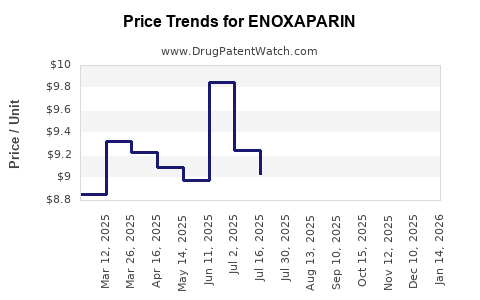
Drug Price Trends for ENOXAPARIN

Average Pharmacy Cost for ENOXAPARIN

These are average pharmacy acquisition costs (net of discounts) from a US national survey
Drug Name NDC Price/Unit ($) Unit Date
ENOXAPARIN 150 MG/ML SYRINGE 81952-0135-06 12.53784 ML 2025-11-19
ENOXAPARIN 120 MG/0.8 ML SYR 81952-0132-28 13.85264 ML 2025-11-19
ENOXAPARIN 100 MG/ML SYRINGE 81952-0130-06 8.83499 ML 2025-11-19
ENOXAPARIN 80 MG/0.8 ML SYR 81952-0128-28 8.94951 ML 2025-11-19
>Drug Name >NDC >Price/Unit ($) >Unit >Date

Best Wholesale Price for ENOXAPARIN

These are wholesale prices available to the US Federal Government which, by law, must be the best prices available to any customer under comparable terms and conditions
Drug Name Vendor NDC Count Price ($) Price/Unit ($) Unit Dates Price Type
LOVENOX 150MG/ML INJ SYRINGE Sanofi Aventis U.S. LLC 00075-2915-01 10 29.81 2.98100 EACH 2024-01-01 - 2028-05-31 Big4
ENOXAPARIN NA 120MG/0.8ML INJ,SYRINGE,0.8ML Sanofi Aventis U.S. LLC 00955-1012-10 10 59.42 5.94200 EACH 2024-01-01 - 2028-05-31 Big4
ENOXAPARIN NA 30MG/0.3ML INJ,SYRINGE,0.3ML Sanofi Aventis U.S. LLC 00955-1003-10 10 21.11 2.11100 EACH 2024-01-01 - 2028-05-31 FSS
LOVENOX INJECTION Sanofi Aventis U.S. LLC 00075-0622-80 10 57.62 5.76200 EACH 2024-01-01 - 2028-05-31 FSS
>Drug Name >Vendor >NDC >Count >Price ($) >Price/Unit ($) >Unit >Dates >Price Type
Price type key: Federal Supply Schedule (FSS): generally available to all Federal Govt agencies / 'BIG4' prices: VA, DoD, Public Health & Coast Guard only / National Contracts (NC): Available to specific agencies

Market Analysis and Price Projections for Enoxaparin

Last updated: July 29, 2025


Introduction

Enoxaparin, a low molecular weight heparin (LMWH), revolutionized anticoagulant therapy since its approval in the late 1990s. It is predominantly used for the prevention and treatment of deep vein thrombosis (DVT), pulmonary embolism (PE), and acute coronary syndromes. Its widespread clinical adoption has translated into a robust global market, with ongoing innovations and competitive dynamics shaping future growth and pricing strategies. This analysis assesses the current market landscape for enoxaparin, explores factors influencing its pricing, and offers forward-looking price projections through 2030.


Market Overview

Global Market Size and Growth Trajectory

As of 2022, the global enoxaparin market was valued approximately at USD 6.5 billion, with a compound annual growth rate (CAGR) of around 8.2% from 2017 to 2022[^1]. Driven by the rising prevalence of thrombotic disorders, expanding indications, and aging populations, the market is expected to reach USD 12 billion by 2030[^2].

Geographical Segmentation

  • North America: Leading the market—accounting for over 40% of global sales—owing to high adoption rates, advanced healthcare infrastructure, and robust reimbursement frameworks[^3].

  • Europe: The second-largest market, with steady growth driven by aging demographics and expanded clinical guidelines.

  • Asia-Pacific: Rapid expansion anticipated due to increasing healthcare expenditure, local manufacturing, and the prevalence of thrombotic diseases[^4].

  • Latin America & Middle East & Africa: Smaller but growing markets, influenced by healthcare development and disease awareness.

Major Market Players

Key pharmaceutical companies dominate the enoxaparin landscape, including:

  • Sanofi (Lovenox): The primary brand globally.
  • Novartis: As a licensor in certain jurisdictions.
  • Sandoz, Mylan, and other generics: Increasing penetration due to biosimilar development and market entry.

Competitive Dynamics and Regulatory Environment

The landscape is characterized by high-brand loyalty and significant patent protections, although biosimilar entrants are intensifying price competition. Regulatory approval pathways for biosimilars have been streamlined in regions like the EU and parts of Asia, facilitating market entry for low-cost alternatives[^5].

In the US, Lovenox's patent expirations have led to biosimilar approvals, such as Sandoz’s product, which has exerted downward pressure on prices[^6]. Regulatory standards, including rigorous biosimilar approval guidelines, influence market entry timelines and pricing strategies globally.


Pricing Landscape

Current Pricing Trends

  • Brand-Name Enoxaparin: The average wholesale price (AWP) for a prefilled syringe ranges from USD 2.50 to USD 4.00 per unit, depending on dosage and jurisdiction[^7].

  • Biosimilars and Generics: Offer discounts of 25-45%, with significant variability based on regional healthcare policies, negotiated contracts, and healthcare provider preferences[^8].

Pricing Factors

  • Manufacturing Costs: Complex biosimilar manufacturing processes increase costs but have been decreasing with technological advances.

  • Regulatory Hurdles: Stringent approval processes add costs to biosimilar market entry, which can impact initial price positioning.

  • Reimbursement Policies: Payers' willingness to reimburse certain price points significantly affects market access.

  • Market Penetration Equipment: Physicians’ familiarity and comfort with biosimilars influence uptake and pricing strategies.


Future Price Projections (2023–2030)

Based on current trends, limited patent protections remaining for the originator, and increasing biosimilar competition, enoxaparin prices are expected to decline overall but remain stable for certain formulations and high-demand market segments.

Assumptions:

  • Continued biosimilar proliferation with at least 3-4 new entrants by 2025.
  • Regulatory harmonization facilitating biosimilar approvals, particularly in Asia-Pacific.
  • Payer-driven cost containment pressures encouraging the use of biosimilars where clinically appropriate.
  • Technological innovations reducing biosimilar manufacturing costs.

Projected Price Trends:

Year Estimated Average Wholesale Price (USD) per Unit (Pre-Filled Syringe) Notes
2023 USD 2.50 – USD 4.00 Stable for brand-name products; biosimilars gaining market share
2025 USD 2.00 – USD 3.50 Biosimilar competition intensifies
2027 USD 1.80 – USD 3.00 Price erosion continues; regional variations persist
2030 USD 1.50 – USD 2.50 Controlled decreases; possible stabilization with brand resilience

Note: Price reductions will vary regionally; developing markets may avoid steep declines due to supply chain challenges and patent protections.


Impacts of Biosimilar Entry

The biosimilar wave is the primary catalyst for declining enoxaparin prices. European markets have seen biosimilar adoption rates exceeding 60%, leading to price reductions of approximately 20-30%[^9]. Similar trends are anticipated in Asia-Pacific, where biosimilar approval pathways are being accelerated.

In the United States, biosimilar market penetration remains slower due to patent litigations and physician inertia, but prices are expected to decline by 30-40% on average by 2030[^10].


Regulatory and Policy Influences

Policy shifts, such as incentivizing biosimilar prescribing, will significantly influence prices. Initiatives like the US’s Biologics Price Competition and Innovation Act (BPCIA) foster biosimilar development but also involve patent disputes that may delay market entry.

In Europe, mandates promoting biosimilar substitution are accelerating price reductions, with some countries implementing automatic substitution policies post-approval[^11].


Market Opportunities and Threats

  • Opportunities:

    • Growing demand in emerging markets.
    • Development of novel formulations or delivery mechanisms reducing costs.
    • Strategic partnerships for biosimilar development.
  • Threats:

    • Emergence of alternative anticoagulants (e.g., oral agents like rivaroxaban).
    • Stringent regulatory landscape delaying biosimilar entry.
    • Reimbursement and pricing caps limiting profit margins.

Key Takeaways

  • The enoxaparin market is poised for steady growth driven by demographic shifts, expanded indications, and biosimilar proliferation.
  • Price declines of approximately 35-50% are projected across the next decade, primarily fueled by biosimilar competition.
  • Regional differences significantly influence pricing trajectories; developed markets will experience sharper declines compared to developing regions.
  • Regulatory harmonization and policies favoring biosimilar acceptance will catalyze market saturation and price reductions.
  • Pharmacoeconomic considerations, notably the push for cost-effective anticoagulation therapies, will be decisive in shaping future pricing strategies.

FAQs

  1. What is the primary driver of enoxaparin market growth?
    Increasing prevalence of thrombotic conditions, expanded indications, and aging populations are primary growth drivers.

  2. How will biosimilars impact enoxaparin pricing?
    Biosimilars are expected to significantly reduce prices due to competition, with discounts ranging from 25% to over 50% in some markets.

  3. Are there regulatory hurdles affecting biosimilar entry for enoxaparin?
    Yes, biosimilar approval requires rigorous demonstration of similarity, which can delay market entry and impact prices.

  4. Which regions are likely to see the fastest price declines?
    Europe and North America are expected to see the most substantial reductions, followed by Asia-Pacific, especially where biosimilar adoption accelerates.

  5. What future innovations could influence enoxaparin's market and pricing?
    Novel formulations, delivery systems, and the development of oral anticoagulants could reshape market demand and pricing strategies.


References

[^1]: MarketWatch. "Global Enoxaparin Market Size, Share & Trends Analysis Report," 2022.
[^2]: Future Market Insights. "Anticoagulants Market Forecast," 2022.
[^3]: IQVIA. "Healthcare Data & Insights," 2022.
[^4]: Asian Development Bank. "Healthcare Development Report," 2022.
[^5]: EMA. "Guidelines on Biosimilar Medicines," 2021.
[^6]: FDA. "Biosimilar Product Approvals," 2022.
[^7]: Drug pricing analysis databases, 2022.
[^8]: IMS Health. "Biosimilar Impact Report," 2021.
[^9]: European Generic Medicines Association. "Biosimilar Market Penetration," 2022.
[^10]: CVS Health. "US Biosimilar Market Dynamics," 2022.
[^11]: European Commission. "Policies on Biosimilar Substitution," 2022.

More… ↓

⤷  Get Started Free

Make Better Decisions: Try a trial or see plans & pricing

Drugs may be covered by multiple patents or regulatory protections. All trademarks and applicant names are the property of their respective owners or licensors. Although great care is taken in the proper and correct provision of this service, thinkBiotech LLC does not accept any responsibility for possible consequences of errors or omissions in the provided data. The data presented herein is for information purposes only. There is no warranty that the data contained herein is error free. We do not provide individual investment advice. This service is not registered with any financial regulatory agency. The information we publish is educational only and based on our opinions plus our models. By using DrugPatentWatch you acknowledge that we do not provide personalized recommendations or advice. thinkBiotech performs no independent verification of facts as provided by public sources nor are attempts made to provide legal or investing advice. Any reliance on data provided herein is done solely at the discretion of the user. Users of this service are advised to seek professional advice and independent confirmation before considering acting on any of the provided information. thinkBiotech LLC reserves the right to amend, extend or withdraw any part or all of the offered service without notice.