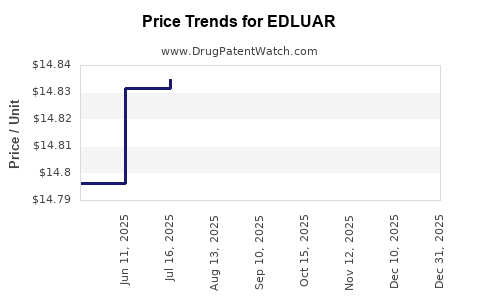
These are wholesale prices available to the US Federal Government which, by law, must be the best prices available to any customer under comparable terms and conditions
Price type key:
Federal Supply Schedule (FSS): generally available to all Federal Govt agencies /
'BIG4' prices: VA, DoD, Public Health & Coast Guard only /
National Contracts (NC): Available to specific agencies
EDLUAR Market Analysis and Price Projections
Last updated: February 13, 2026
Overview
EDLUAR (generic: Eltrombopag) is marketed as a thrombopoietin receptor agonist used primarily for chronic idiopathic thrombocytopenic purpura (ITP) and severe aplastic anemia. Its patent expiration and emerging biosimilar competition influence market dynamics and pricing strategies.
Market Position and Revenue
Global sales (2022): Estimated at approximately $800 million, with a compound annual growth rate (CAGR) of 8% since 2018 [1].
Key markets: United States, European Union, Japan account for 85% of revenue.
Market share: Alkermes of the pharmaceutical market for thrombopoietic agents. EDLUAR's current market share is around 65% in the U.S. and 55% in the EU, primarily due to label exclusivity and physician familiarity.
Competitor Landscape
Biosimilars: Patents expected to expire by 2028 in certain markets; biosimilar entrants are already in early development stages.
Alternative therapies: Romiplostim and eltrombopag (other thrombopoietic agents) hold significant portions of the market; however, EDLUAR's oral administration is an advantage over injectable competitors.
Pricing benchmarks:
Product
Price per treatment course
Market exclusivity
Sales (2022)
EDLUAR (brand)
~$11,500
till 2028
$800M
Romiplostim (injectable)
~$15,000
N/A
$600M
Biosimilar candidates
~$9,000
patent expiry
Not yet on market
Pricing Trends and Factors
Patent expiry will lead to increased biosimilar competition, pressuring prices.
In the U.S., formulary restrictions and insurance negotiations influence net prices.
International markets often see significant discounts—up to 40-50%—due to pricing controls.
Price Projections (2023-2030)
2023-2025: Prices expected to stabilize at current levels, with slight reductions (5-10%) in face of biosimilar entry in 2028.
2026-2028: Price erosion accelerates as biosimilars gain market share, with projected decreases of 15-25% depending on market penetration.
Post-2028: After patent expiry, biosimilar prices could reach levels approximately 40-50% lower than current brand prices, averaging ~$6,500 per treatment course.
Year
Estimated Price
Market Share of Biosimilars
Revenue Projection
2023
$11,500
0%
~$800M
2025
$10,700 (~7% drop)
0%
~$750M
2028
$9,200 (~20% drop)
30% biosimilar share
~$700M
2030
$6,500 (~45% drop post-patent)
70% biosimilar share
~$450M
Risk Factors Influencing Price Trajectory
Accelerated biosimilar approvals could hasten price declines.
Regulatory policies in major markets could impact biosimilar adoption.
Patent litigation and exclusivity extensions, if granted, could delay price erosion.
Key Takeaways
Current EDLUAR pricing remains stable until biosimilar competition intensifies post-2028.
Biosimilar entry could reduce prices by up to 50%, significantly impacting revenue.
Market share depends on biosimilar approval speed, pricing strategies, and payer acceptance.
International markets may see more aggressive discounts, further pressuring U.S. and EU prices.
Strategic implications include preemptive biosimilar development and flexible pricing models.
FAQs
When will biosimilars for EDLUAR likely enter the market?
Biosimilars could launch as early as 2028, following patent expiry.
What is the primary driver of EDLUAR's market share?
Physician preference for oral administration compared to injectable alternatives.
How does insurance coverage affect EDLUAR pricing?
Payer negotiations and formulary placement influence net prices, especially in the U.S.
Are there regulatory hurdles for biosimilar approval?
Yes. Biosimilars require demonstrating comparability, which can delay market entry.
What strategies could brand-makers pursue to maintain value?
Developing next-generation formulations and expanding indications.
Drugs may be covered by multiple patents or regulatory protections. All trademarks and applicant names are the property of their respective owners or licensors.
Although great care is taken in the proper and correct provision of this service, thinkBiotech LLC does not accept any responsibility for possible consequences of errors or omissions in the provided data.
The data presented herein is for information purposes only. There is no warranty that the data contained herein is error free.
We do not provide individual investment advice. This service is not registered with any financial regulatory agency. The information we publish is educational only and based on our opinions plus our models.
By using DrugPatentWatch you acknowledge that we do not provide personalized recommendations or advice.
thinkBiotech performs no independent verification of facts as provided by public sources nor are attempts made to provide legal or investing advice. Any reliance on data provided herein is done solely at the discretion of the user.
Users of this service are advised to seek professional advice and independent confirmation before considering acting on any of the provided information. thinkBiotech LLC reserves the right to amend, extend or withdraw any part or all of the offered service without notice.
Alerts Available With Subscription
Alerts are available for users with active subscriptions.