You're using a free limited version of DrugPatentWatch: Upgrade for Complete Access

Last Updated: December 15, 2025

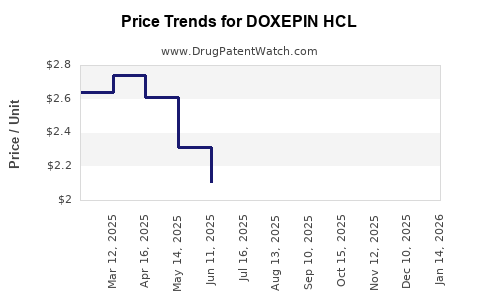
Drug Price Trends for DOXEPIN HCL


✉ Email this page to a colleague

« Back to Dashboard


Drug Price Trends for DOXEPIN HCL

Average Pharmacy Cost for DOXEPIN HCL

These are average pharmacy acquisition costs (net of discounts) from a US national survey
Drug Name NDC Price/Unit ($) Unit Date
DOXEPIN HCL 3 MG TABLET 51672-4246-02 2.08415 EACH 2025-11-19
DOXEPIN HCL 3 MG TABLET 00228-3315-03 2.08415 EACH 2025-11-19
DOXEPIN HCL 6 MG TABLET 72819-0162-03 1.98162 EACH 2025-11-19
DOXEPIN HCL 3 MG TABLET 27241-0280-30 2.08415 EACH 2025-11-19
>Drug Name >NDC >Price/Unit ($) >Unit >Date

Best Wholesale Price for DOXEPIN HCL

These are wholesale prices available to the US Federal Government which, by law, must be the best prices available to any customer under comparable terms and conditions
Drug Name Vendor NDC Count Price ($) Price/Unit ($) Unit Dates Price Type
DOXEPIN HCL 100MG CAP Golden State Medical Supply, Inc. 60429-0970-01 100 84.42 0.84420 EACH 2023-06-15 - 2028-06-14 FSS
DOXEPIN HCL 150MG CAP Golden State Medical Supply, Inc. 42799-0935-01 100 75.72 0.75720 EACH 2023-06-15 - 2028-06-14 FSS
DOXEPIN HCL 50MG CAP Golden State Medical Supply, Inc. 51672-4219-01 100 28.00 0.28000 EACH 2024-02-21 - 2028-06-14 FSS
DOXEPIN HCL 25MG CAP Golden State Medical Supply, Inc. 60429-0967-01 100 35.35 0.35350 EACH 2023-06-15 - 2028-06-14 FSS
>Drug Name >Vendor >NDC >Count >Price ($) >Price/Unit ($) >Unit >Dates >Price Type
Price type key: Federal Supply Schedule (FSS): generally available to all Federal Govt agencies / 'BIG4' prices: VA, DoD, Public Health & Coast Guard only / National Contracts (NC): Available to specific agencies

Market Analysis and Price Projections for Doxepin HCL

Last updated: July 27, 2025

Introduction

Doxepin Hydrochloride (HCL) is a tricyclic antidepressant (TCA) primarily used for depression, anxiety, and sleep disorders. Despite its longstanding presence in psychopharmacology, recent market dynamics, patent landscapes, manufacturing costs, and regulatory trends influence its current and future valuation. This analysis provides a comprehensive overview of the market size, competitive landscape, pricing trends, and future projections for Doxepin HCL, enabling stakeholders to make informed strategic decisions.

Market Overview

Pharmacological Profile and Therapeutic Applications

Doxepin HCL functions by inhibiting the reuptake of norepinephrine and serotonin, alleviating depressive symptoms and anxiety. It also exhibits significant antihistamine activity, making it effective in treating insomnia. The drug's multifaceted application has maintained consistent demand within psychiatric and sleep disorder markets. According to data from the World Health Organization (WHO) and IQVIA, antidepressant markets are anticipated to grow annually at approximately 3-4% due to increasing mental health awareness and rising prevalence of depression globally.

Geographical Market Dynamics

  • United States: The largest market, driven by high prescription rates, insurance coverage, and established clinical protocols.
  • Europe: Steady demand, with regulatory bodies like the EMA endorsing its off-label uses.
  • Emerging Markets (Asia-Pacific, Latin America): Rapid growth, fueled by expanding healthcare infrastructure and mental health awareness.

Regulatory and Patent Landscape

While doxepin was approved decades ago (FDA approval in 1969), recent patent expirations have led to an influx of generic manufacturers, intensifying price competition. Existing patents expiring in the early 2000s facilitated generic proliferation, which continues to exert downward pressure on market prices. No current patents restrict manufacturing, enabling large-scale generic production globally.

Market Size and Demand Projections

Current Market Size

The global antidepressant market was valued at approximately USD 15 billion in 2022, with tricyclic antidepressants accounting for a decreasing but still relevant segment. Doxepin's specific market share has declined due to the adoption of newer, more tolerable antidepressants (e.g., SSRIs and SNRIs). Nonetheless, due to its unique sleep-inducing properties, Doxepin HCL maintains niche demand — estimated at USD 200 million annually worldwide.

Growth Drivers

  • Increasing acknowledgment of sleep disorders, especially insomnias resistant to conventional therapy.
  • Off-label uses in dermatology (e.g., pruritus management).
  • Cost-effectiveness of generics in comparison to newer agents.
  • Expansion into emerging markets with rising healthcare investments.

Challenges

  • Competition from newer antidepressants with better side-effect profiles.
  • Concerns over tricyclic-related toxicity, especially in elderly populations.
  • Stiff price competition among generic manufacturers.

Forecast (2023-2030)

Considering current demand, patent expirations, and expanding sleep disorder treatment markets, the Doxepin HCL segment is projected to grow at a CAGR of approximately 2-3%. The niche market is expected to expand marginally to USD 250-300 million by 2030, primarily driven by emerging markets and sleep disorder therapies, provided no significant regulatory barriers emerge.

Pricing Analysis

Historical Price Trends

Generic Doxepin HCL prices have historically declined due to increased competition. In the US, average wholesale prices for the 25 mg capsule fell from approximately USD 0.50 per capsule in 2015 to roughly USD 0.20 in 2022. Similar trends are observed in Europe and Asia, facilitated by mass manufacturing.

Pricing Drivers

  • Manufacturing costs: With the commoditization of the active pharmaceutical ingredient (API), marginal costs are low.
  • Market competition: Excess supply maintains pricing pressures.
  • Regulatory requirements: Costs associated with Good Manufacturing Practices (GMP) compliance influence the final price.
  • Insurance reimbursement: Subsidized and insurance-covered prescriptions tend to depress retail prices.

Future Price Trajectory

The price decline is expected to plateau given the stable demand in niche markets such as sleep disorder treatment and dermatology. Nonetheless, prices may slightly stabilize or increase in certain regions due to logistical supply chain constraints or regulatory compliance costs.

  • Projected USD per capsule (2023-2030): Expected to stabilize around USD 0.15-0.25, with minor regional variations.
  • Unit price inflation: Likely minimal, barring raw material scarcity or unexpected regulatory changes.

Competitive Landscape & Pricing Strategies

The market is saturated with numerous generic manufacturers, including Teva, Sandoz, Mylan, and local producers. Entry barriers remain low, promoting intense price competition. Strategic focus on manufacturing efficiency and quality assurance will allow firms to maintain margins amid price pressures. Some companies may explore differentiated formulations (e.g., sustained-release versions), which could command premium prices, though such innovations in Doxepin HCL are currently limited.

Regulatory Trends and Impact

Increasing emphasis on safety profiles has led to the recommendation of SSRIs and SNRIs as first-line treatments. However, Doxepin’s role persists in specific niches, such as patients intolerant to newer agents or requiring sleep aid. Regulatory hurdles—such as stricter control over off-label uses—may influence future demand but are unlikely to substantially disrupt existing markets for Doxepin HCL.

Concluding Price Outlook and Market Strategy

Given the mature stage of Doxepin HCL’s lifecycle, the market will likely remain characterized by high generic competition and stable demand within niche markets. Price projections suggest sustained but modest decline, with eventual stabilization influenced by regional factors and potential formulation innovations.

Key Takeaways

  • The global market for Doxepin HCL is mature, with current demand anchored by niche sleep and dermatological applications.
  • Market growth remains modest at approximately 2-3% CAGR until 2030, supported by emerging markets’ expanding healthcare infrastructure.
  • Prices have declined substantially over the past decade, stabilizing around USD 0.15-0.25 per capsule, akin to general generic antidepressant trends.
  • Competitive pressures and regulatory constraints will shape pricing strategies; companies should focus on manufacturing efficiencies and potential formulation advances.
  • The future of Doxepin HCL is predominantly influenced by the evolving landscape of mental health and sleep disorder treatments, with little expectation for substantive price increases absent significant innovation or regulatory change.

FAQs

1. Is Doxepin HCL still widely prescribed?
Yes, particularly for sleep disorders and certain depressive or anxiety conditions, especially when patients are intolerant to newer antidepressants.

2. What factors influence Doxepin HCL pricing?
Manufacturing costs, market competition, regulatory compliance, and regional healthcare policies primarily drive pricing.

3. How does patent expiry affect Doxepin HCL market dynamics?
Patent expiration has led to an influx of generics, intensifying competition and reducing prices.

4. Are there new formulations of Doxepin HCL?
Currently, innovations are limited; most formulations are generic capsules. However, sustained-release variants could command higher prices if developed.

5. What is the outlook for companies manufacturing Doxepin HCL?
They should focus on cost efficiencies, exploring niche formulation development, and expanding presence in emerging markets to maintain profitability amid stable demand and competitive pressures.


Sources:
[1] IQVIA. Global Pharmaceutical Market Reports. 2022.
[2] World Health Organization. Mental Health Atlas 2021.
[3] U.S. Food and Drug Administration (FDA). Drug Approvals and Patents.
[4] Market Research Future. Antidepressant Market report 2022.

More… ↓

⤷  Get Started Free

Make Better Decisions: Try a trial or see plans & pricing

Drugs may be covered by multiple patents or regulatory protections. All trademarks and applicant names are the property of their respective owners or licensors. Although great care is taken in the proper and correct provision of this service, thinkBiotech LLC does not accept any responsibility for possible consequences of errors or omissions in the provided data. The data presented herein is for information purposes only. There is no warranty that the data contained herein is error free. We do not provide individual investment advice. This service is not registered with any financial regulatory agency. The information we publish is educational only and based on our opinions plus our models. By using DrugPatentWatch you acknowledge that we do not provide personalized recommendations or advice. thinkBiotech performs no independent verification of facts as provided by public sources nor are attempts made to provide legal or investing advice. Any reliance on data provided herein is done solely at the discretion of the user. Users of this service are advised to seek professional advice and independent confirmation before considering acting on any of the provided information. thinkBiotech LLC reserves the right to amend, extend or withdraw any part or all of the offered service without notice.