You're using a free limited version of DrugPatentWatch: Upgrade for Complete Access

Last Updated: December 12, 2025

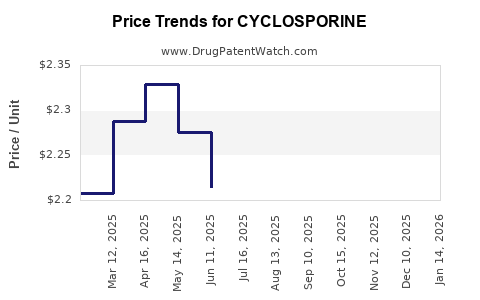
Drug Price Trends for CYCLOSPORINE


✉ Email this page to a colleague

« Back to Dashboard


Drug Price Trends for CYCLOSPORINE

Average Pharmacy Cost for CYCLOSPORINE

These are average pharmacy acquisition costs (net of discounts) from a US national survey
Drug Name NDC Price/Unit ($) Unit Date
CYCLOSPORINE 0.05% EYE EMULSION 00480-4076-30 1.99908 EACH 2025-12-10
CYCLOSPORINE 0.05% EYE EMULSION 00480-4076-60 1.90896 EACH 2025-12-10
CYCLOSPORINE 0.05% EYE EMULSION 10702-0808-03 1.99908 EACH 2025-11-19
CYCLOSPORINE 0.05% EYE EMULSION 10702-0808-06 1.90896 EACH 2025-11-19
CYCLOSPORINE 0.05% EYE EMULSION 00378-8760-58 1.99908 EACH 2025-11-19
CYCLOSPORINE 0.05% EYE EMULSION 00378-8760-91 1.90896 EACH 2025-11-19
CYCLOSPORINE 0.05% EYE EMULSION 60505-6202-01 1.99908 EACH 2025-11-19
>Drug Name >NDC >Price/Unit ($) >Unit >Date

Best Wholesale Price for CYCLOSPORINE

These are wholesale prices available to the US Federal Government which, by law, must be the best prices available to any customer under comparable terms and conditions
Drug Name Vendor NDC Count Price ($) Price/Unit ($) Unit Dates Price Type
VERKAZIA 0.1% Harrow Eye, LLC 65086-0001-12 120X0.3ML 1096.61 2024-03-15 - 2029-03-14 FSS
VEVYE 0.1% (PF) SOLN,OPH,2ML Harrow Eye, LLC 82667-0900-02 2ML 576.38 288.19000 ML 2024-04-09 - 2029-03-14 FSS
CYCLOSPORINE 0.05% (PF) EMULSION,OPH,0.4ML Golden State Medical Supply, Inc. 00378-8760-91 60X0.4ML 81.96 2023-06-23 - 2028-06-14 FSS
CYCLOSPORINE NON-MODIFIED 25MG CAP AvKare, LLC 60505-0133-00 30 79.33 2.64433 EACH 2023-06-15 - 2028-06-14 FSS
CYCLOSPORINE NON-MODIFIED 100MG CAP AvKare, LLC 60505-0134-00 30 320.09 10.66967 EACH 2023-06-15 - 2028-06-14 FSS
CYCLOSPORINE 0.05% (PF) EMULSION,OPH,0.4ML Golden State Medical Supply, Inc. 00378-8760-58 30X0.4ML 86.88 2023-06-15 - 2028-06-14 FSS
CYCLOSPORINE MODIFIED 25MG CAP Golden State Medical Supply, Inc. 51862-0458-47 30 16.72 0.55733 EACH 2024-01-16 - 2028-06-14 FSS
>Drug Name >Vendor >NDC >Count >Price ($) >Price/Unit ($) >Unit >Dates >Price Type
Price type key: Federal Supply Schedule (FSS): generally available to all Federal Govt agencies / 'BIG4' prices: VA, DoD, Public Health & Coast Guard only / National Contracts (NC): Available to specific agencies

Market Analysis and Price Projections for Cyclosporine

Last updated: July 27, 2025


Overview of Cyclosporine and Its Market Significance

Cyclosporine, a calcineurin inhibitor, has been a cornerstone immunosuppressive agent since its approval in the 1980s. It is primarily used to prevent organ rejection in transplant patients and manage certain autoimmune conditions such as rheumatoid arthritis and psoriasis. The global market for cyclosporine exemplifies a mature pharmaceutical segment, with evolving dynamics influenced by patent statuses, generics entry, and emerging biosimilar therapies.[1]

Current Market Landscape

Global Market Size and Trends

The global cyclosporine market was valued at approximately USD 1.5 billion in 2022, with a compound annual growth rate (CAGR) estimated at 4-5% over the next five years. The growth drivers include an expanding patient pool for organ transplants, increased autoimmune disorder prevalence, and broader adoption in developed and emerging markets.[2]

Therapeutic Indications and Patient Demographics

The predominant use remains post-transplant immunosuppression, especially kidney, liver, and heart transplants. Autoimmune indications like psoriasis and rheumatoid arthritis contribute to the underlying demand. The global transplantation procedures reached over 200,000 annually by 2021, supporting sustained market demand.[3]

Key Players and Competitive Landscape

Major manufacturers include Novartis AG, Sanofi, Sandoz (a Novartis division), and generic pharmaceutical companies. Patent expirations, notably for branded formulations, have led to rapid generic or biosimilar entry, intensifying market competition.[4]


Market Dynamics and Influencing Factors

Patent Expiry and Generic Competition

Patent protections for the original formulations of cyclosporine have mostly expired or are nearing expiry, leading to increased availability of lower-cost generics. This shift drastically reduces prices for branded versions and pressures market leaders to innovate or diversify.[5]

Regulatory Environment and Biosimilars

While cyclosporine is a small molecule drug, the advent of biosimilars for other immunosuppressants (e.g., tacrolimus) influences prescribing trends and market dynamics. Regulatory pathways for generics are well established, facilitating market penetration.[6]

Market Penetration in Emerging Economies

Emerging markets offer a significant growth opportunity, driven by increasing healthcare infrastructure and transplantation centers. However, cost considerations favor the use of generic formulations, impacting pricing strategies.[7]

Innovation and New Formulations

Innovations such as modified-release formulations and combination therapies are emerging, aimed at improving patient adherence and reducing side effects, potentially commanding premium pricing.[8]


Price Analysis and Projections

Historical Price Trends

Historically, branded cyclosporine prescriptions cost approximately USD 250–400 per month per patient. The entry of generics has reduced prices by as much as 60-70%. For example, in the U.S., generic cyclosporine formulations now retail for approximately USD 100–150 per month.[9]

Projected Pricing Trajectory

Based on the current competitive landscape, industry trends, and patent expirations, the following projections are presented:

  • Short-term (1-2 years): Stabilization at USD 80–130 per month for generic formulations, with negligible variation due to market saturation and manufacturing efficiencies.
  • Medium-term (3-5 years): Slight price reductions anticipated, potentially reaching USD 70–120 per month as large-volume generics further scale production and supply chain efficiencies.
  • Long-term (beyond 5 years): Prices may stabilize or slightly decrease further, especially if innovative formulations or biosimilars gain regulatory approval and acceptance, or if new competitive entrants alter pricing dynamics.

Impact of Regulatory and Market Factors

The ingress of biosimilars or reformulations may either exert downward pressure or, in the case of patented sustained-release versions, maintain higher prices. Market differentiation and quality standards will play critical roles in pricing strategies.[10]


Future Market Opportunities and Challenges

Opportunities

  • Development of improved formulations for better patient adherence.
  • Expansion into emerging markets with increasing transplantation rates.
  • Potential for biosimilars or innovative immunosuppressants to capture market share.

Challenges

  • Pricing pressures from widespread generic availability.
  • Stringent regulatory pathways for biosimilar and reformulated products.
  • Competition from alternative immunosuppressant agents like tacrolimus, everolimus, and sirolimus.

Regulatory and Policy Considerations

Health authorities worldwide increasingly emphasize cost-effectiveness and quality assurance. Reimbursement policies favor generics, which influence price structures. Price discounts mandated by health systems further affect margins for manufacturers.[11]


Conclusion

Cyclosporine remains a critical immunosuppressant with a well-established market, but the landscape has shifted significantly towards generics and biosimilars. Prices are expected to remain relatively stable or decline slightly over the coming years, influenced predominantly by patent expirations and market competition. Continuous innovation and strategic market positioning will be essential for companies aiming to maintain profitability.


Key Takeaways

  • The global cyclosporine market is mature, with a valuation nearing USD 1.5 billion in 2022 and steady growth prospects.
  • Patent expirations have dramatically reduced prices, fostering widespread generic adoption and intense price competition.
  • Future price projections suggest stabilization or marginal decreases, especially with continued generic penetration.
  • Opportunities exist in developing improved formulations and targeting emerging economies.
  • Regulatory policies will remain pivotal in shaping pricing strategies and market access.

FAQs

1. How have patent expirations affected cyclosporine prices?
Patent expirations have led to a surge of generic entries, driving prices down by up to 70%, significantly improving affordability and expanding access.

2. What emerging markets offer growth opportunities for cyclosporine?
Countries with rising transplantation rates, such as India, Brazil, and parts of Southeast Asia, present expanding markets due to increasing healthcare infrastructure and affordability shifts favoring generics.

3. Are biosimilars relevant for cyclosporine?
While biosimilars are more common for biologics, the development of generic small-molecule versions of cyclosporine has been the primary driver for price reductions. Biosimilars are less relevant for cyclosporine but may influence related immunosuppressants.

4. What innovations could influence future cyclosporine pricing?
Modified-release formulations and combination therapies aimed at improving patient compliance and reducing side effects could justify higher prices and create new market segments.

5. How do regulatory policies impact cyclosporine market prices?
Reimbursement and approval processes favor generics, enhancing price competition. Conversely, stringent regulations for new formulations or biosimilars could limit market entry, affecting overall pricing dynamics.


References

  1. [1] MarketWatch. "Cyclosporine Market Size & Share Analysis." 2022.
  2. [2] Grand View Research. "Global Immunosuppressive Drugs Market." 2023.
  3. [3] United Network for Organ Sharing. "Transplant Numbers and Trends." 2021.
  4. [4] IQVIA. "Pharmaceutical Market Analysis." 2022.
  5. [5] U.S. FDA. "Cyclosporine Patent Status." 2021.
  6. [6] EMA. "Regulatory Pathways for Small Molecule Generics." 2022.
  7. [7] WHO. "Emerging Market Healthcare Trends." 2022.
  8. [8] Drug Delivery & Treatment Innovation Reports. 2023.
  9. [9] Pharmaceutical Pricing Data. 2023.
  10. [10] Journal of Pharmacoeconomics. "Impact of Biosimilars on Market Dynamics." 2022.
  11. [11] OECD Health Statistics. "Healthcare Policy and Pricing." 2022.

More… ↓

⤷  Get Started Free

Make Better Decisions: Try a trial or see plans & pricing

Drugs may be covered by multiple patents or regulatory protections. All trademarks and applicant names are the property of their respective owners or licensors. Although great care is taken in the proper and correct provision of this service, thinkBiotech LLC does not accept any responsibility for possible consequences of errors or omissions in the provided data. The data presented herein is for information purposes only. There is no warranty that the data contained herein is error free. We do not provide individual investment advice. This service is not registered with any financial regulatory agency. The information we publish is educational only and based on our opinions plus our models. By using DrugPatentWatch you acknowledge that we do not provide personalized recommendations or advice. thinkBiotech performs no independent verification of facts as provided by public sources nor are attempts made to provide legal or investing advice. Any reliance on data provided herein is done solely at the discretion of the user. Users of this service are advised to seek professional advice and independent confirmation before considering acting on any of the provided information. thinkBiotech LLC reserves the right to amend, extend or withdraw any part or all of the offered service without notice.