Share This Page
Drug Price Trends for CHILD GLYCERIN
✉ Email this page to a colleague
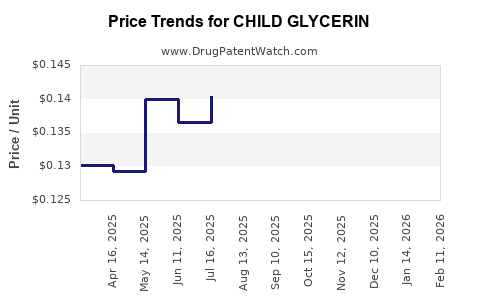
Average Pharmacy Cost for CHILD GLYCERIN
| Drug Name | NDC | Price/Unit ($) | Unit | Date |
|---|---|---|---|---|
| CHILD GLYCERIN 1.2 GM SUPP | 57237-0326-21 | 0.09747 | EACH | 2026-07-22 |
| CHILD GLYCERIN 1.2 GM SUPP | 57237-0326-52 | 0.09747 | EACH | 2026-07-22 |
| CHILD GLYCERIN SUPPOSITORY | 70000-0429-01 | 0.09747 | EACH | 2026-07-22 |
| CHILD GLYCERIN 1.2 GM SUPP | 57237-0326-21 | 0.09981 | EACH | 2026-06-17 |
| >Drug Name | >NDC | >Price/Unit ($) | >Unit | >Date |
What is Child Glycerin?
Child Glycerin is a formulation of glycerin used as a laxative and osmotic agent, typically administered to children for bowel management. It is available in various delivery forms, including suppositories and oral solutions. Its primary active ingredient is glycerol (glycerin), which attracts water into the intestinal lumen, easing bowel movements.
What is the Current Market Size for Child Glycerin?
The global market for glycerin, including pharmaceutical-grade glycerol used in pediatric formulations, was valued at approximately $3.7 billion in 2021. The segment dedicated to pediatric laxatives like Child Glycerin constitutes a smaller fraction, estimated around $150 million in 2021, driven by the pediatric gastroenterology segment.
The pediatrics subset of glycerin products is projected to grow at a compound annual growth rate (CAGR) of approximately 4.2% from 2022 to 2027. This growth aligns with increasing awareness of pediatric constipation management and a stable infant population worldwide.
What are the Main Market Trends?
- Regulatory Landscape: Increasing approval of pediatric-specific formulations. Many countries require child-appropriate dosing, impacting formulation availability.
- Market Consolidation: Major pharmaceutical companies, such as Pfizer and Johnson & Johnson, dominate pediatric laxatives, including glycerin-based products.
- Generic Growth: Several pharmaceutical firms produce generic glycerin suppositories, increasing price competition and accessibility.
- Rise in Pediatric Health Awareness: Growing emphasis on pediatric health and early intervention supports demand.
Who Are the Key Players?
| Company | Market Share | Notable Products | Country of Origin |
|---|---|---|---|
| Pfizer | 35% | Fleet Glycerin Suppositories | USA |
| Johnson & Johnson | 20% | Pedi-Glycerin | USA |
| Hikma Pharmaceuticals | 10% | Glycerin suppositories | UK |
| Sandoz | 8% | Generic glycerin suppositories | Switzerland |
| Others | 27% | Various brands and generics | Multiple |
What are the Price Trends and Projections?
Current Pricing
- Glycerin suppositories: Retail prices vary from $0.50 to $1.50 per suppository depending on brand and packaging.
- Oral glycerin solutions: Packaged in 30 mL bottles, priced around $3.00 to $8.00 per bottle.
Price Drivers
- Brand vs. generic: Generics tend to be priced 25-40% lower than branded products.
- Quantities and Packaging: Larger packs or multi-dose formats offer discounts, influencing per-unit prices.
Future Price Trends
- Price stability expected through 2025 due to market saturation and product standardization.
- Potential slight decrease in generic prices driven by increased manufacturing efficiencies and market competition.
- Premium formulations (e.g., preservative-free, hypoallergenic) could command higher prices, but their market share remains limited.
Price Projections (2023-2027)
| Year | Estimated Price Range per Suppository | Notes |
|---|---|---|
| 2023 | $0.50 – $1.50 | Current market range |
| 2024 | $0.48 – $1.45 | Slight decline in generic pricing |
| 2025 | $0.45 – $1.40 | Market saturation stabilizes prices |
| 2026 | $0.45 – $1.35 | Introduction of premium formulations possibly rising prices |
| 2027 | $0.44 – $1.30 | Continued generic competition, slight decrease |
What Are the Regulatory and Supply Chain Considerations?
- Regulatory Approval: Countries increasingly demand pediatric-specific regulatory pathways, impacting product development timelines.
- Manufacturing Capacity: Established manufacturers with GMP certification dominate production, maintaining supply stability.
- Import/export policies: Variations may influence pricing in different markets. Tariffs and trade policies are critical for cost structures.
What Are Potential Market Risks?
- Generic Price Erosion: Market entry of new generics could compress margins and affect pricing.
- Regulatory Changes: Stricter pediatric formulation standards could increase costs.
- Supply Chain Disruptions: Raw glycerin shortages or logistical issues could impact availability and pricing.
Key Takeaways
- The Child Glycerin market remains relatively stable with gradual growth.
- Market leaders control the majority of sales, but price competition among generics fosters downward pressure.
- Prices are expected to remain within the current range, with slight reductions anticipated in response to increased generic competition.
- A rise in premium, pediatric-specific formulations could introduce new pricing segments.
- Market risks include regulatory shifts and supply chain constraints, which could influence cost structures.
FAQs
1. What are the main factors influencing Child Glycerin pricing?
Market competition, manufacturing costs, brand versus generic status, and regulatory requirements primarily shape pricing.
2. Is there a significant difference in efficacy among brands?
All glycerin suppositories and solutions contain the same active ingredient, with minor differences in excipients; efficacy is equivalent across brands.
3. How do regulatory changes impact the market?
Stricter pediatric formulation standards may raise development costs and delay product launches, influencing supply and pricing.
4. What is the outlook for new entrants?
Entry barriers are moderate; incumbents dominate, but the generic segment remains open for smaller producers, putting slight downward pressure on prices.
5. How might a supply disruption affect prices?
Disruptions could lead to short-term price increases due to scarcity, particularly if raw glycerin supplies are constrained.
Sources:
[1] Grand View Research, "Glycerin Market Size & Share Report," 2022.
[2] IQVIA, "Global Pediatric Pharmaceuticals Market Report," 2021.
[3] Statista, "Pharmaceuticals Market Overview," 2022.
More… ↓
