Last updated: February 14, 2026
Market Overview and Price Projections for Brimonidine
Current Market Landscape
Brimonidine, marketed primarily under trade names such as Alphagan P, is an alpha-2 adrenergic receptor agonist used for treating glaucoma and ocular hypertension. Its role in reducing intraocular pressure (IOP) makes it a staple in ophthalmology, supporting a steady demand that is expected to persist amid growing glaucoma prevalence globally.
As of 2023, the global ophthalmic drugs market is valued at approximately $36 billion, with glaucoma medications accounting for roughly 12%, equating to a market size of around $4.3 billion. Brimonidine's market share within this segment is about 20%, translating to annual sales near $860 million.
The drug faces competition from other classes such as prostaglandin analogs (latanoprost, travoprost), beta-blockers (timolol), and combination therapies. Key players include Allergan (AbbVie), Santen, and Akorn, who hold significant portions of the ophthalmic alpha-agonist market.
Demographic and Geographical Trends
Globally, an aging population increases the incidence of glaucoma. The World Health Organization estimates over 76 million affected individuals worldwide, projected to reach 111 million by 2040. North America and Europe dominate sales due to advanced healthcare systems and high diagnosis rates, but Asia-Pacific exhibits rapid growth driven by increased screening and expanding healthcare infrastructure.
Regulatory and Patent Environment
Brimonidine gained FDA approval in 1996. Patent protections are largely expired or nearing expiration, leading to increased generic competition. Santen and other companies have introduced generic options, exerting downward pressure on prices.
Pricing Dynamics
Brand Name Brimonidine (e.g., Alphagan P):
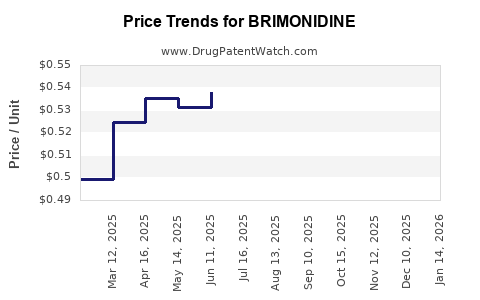
- USA: Average wholesale price (AWP) approximately $250 for a 5 mL bottle (containing 0.2%, 15 mL).
- Monthly treatment cost: circa $80-$100 per patient.
Generics:
- Price reductions of 40-60% compared to brand name.
- Monthly treatment costs: approximately $40-$60.
In Europe and Asia, prices are often lower, with markets largely driven by generic products due to recent patent expiries.
Price Projections (Next 5 Years)
| Year |
Estimated Brand Price (per 5 mL bottle) |
Expected Generic Price Range |
Comments |
| 2023 |
$250 |
$40-$60 |
Brand dominance persists, but generic entries increase |
| 2024 |
$230-$250 |
$35-$55 |
Slight price decline for brand; generics stable |
| 2025 |
$210-$230 |
$30-$50 |
Increased generic penetration; downward pressure |
| 2026 |
$200-$220 |
$25-$45 |
Market shift favors generics, further price erosion |
| 2027 |
$190-$210 |
$20-$40 |
Consumptive prices stabilize at lower levels |
Key Drivers of Price Trends
- Patent expiries encourage generic proliferation, reducing prices.
- Market saturation and increased competition lead to downward pricing.
- Regulatory negotiations, such as value-based pricing in certain markets, can influence cost structures.
- Growing demand from emerging markets may temporarily sustain prices but tend toward generic options over time.
Revenue Outlook
Total global sales for brimonidine are expected to decline marginally over the next five years due to price erosion and increased competition but could sustain a market size of approximately $700-$800 million annually, given steady demand and the replacement of branded products with generics.
Key Takeaways
- The market for brimonidine remains sizeable due to glaucoma prevalence, but patent expiries and generic competition have driven prices down notably.
- Prices in the U.S. vary from approximately $250 for brand name to $40-$60 for generics per 5 mL bottle.
- Over five years, expect a 20-30% decline in prices driven by generic market penetration.
- Sales volumes are likely to remain stable, but revenue will decrease proportionally with price declines.
- Emerging markets may offset some losses through increased volume, though prices are generally lower outside North America and Europe.
FAQs
1. How soon will generic brimonidine dominate the market?
Generic versions have already gained substantial market share since patent expiry, and their dominance is expected to reach over 70% of sales within the next two years.
2. What factors could alter the projected price reductions?
Introduction of combination therapies, regulatory changes, or new formulations offering improved efficacy or compliance could stabilize or increase prices temporarily.
3. Are there significant patent risks for branded formulations?
Most patents on brand formulations expired or are expiring, enabling generics to enter and challenge pricing.
4. How does price variability impact access in emerging markets?
Lower priced generics improve affordability but market access depends on healthcare infrastructure and regulatory approval.
5. Will new delivery methods affect the price trend?
Potential development of sustained-release implants or combination therapies could impact market structure and pricing but are not immediate factors.
References
- IQVIA. Global Ophthalmic Drugs Market Report. 2023.
- US Food and Drug Administration. Approved ophthalmic drugs database. 2023.
- MarketWatch. Glaucoma drug market analysis. 2023.
- WHO. Global Data on Visual Impairment and Glaucoma. 2021.
- Santen. Corporate disclosures on product pipeline, 2023.