Share This Page
Drug Price Trends for ACETAMINOPHEN PM CAPLET
✉ Email this page to a colleague
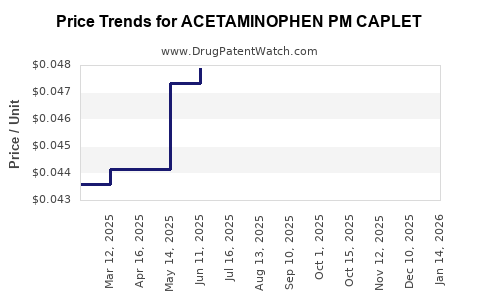
Average Pharmacy Cost for ACETAMINOPHEN PM CAPLET
| Drug Name | NDC | Price/Unit ($) | Unit | Date |
|---|---|---|---|---|
| ACETAMINOPHEN PM CAPLET | 00904-6731-51 | 0.04519 | EACH | 2026-07-22 |
| ACETAMINOPHEN PM CAPLET | 70000-0411-01 | 0.04519 | EACH | 2026-07-22 |
| ACETAMINOPHEN PM CAPLET | 70000-0411-02 | 0.04519 | EACH | 2026-07-22 |
| >Drug Name | >NDC | >Price/Unit ($) | >Unit | >Date |
Market Analysis and Price Projections for Acetaminophen PM Caplet
Overview
Acetaminophen PM Caplet combines acetaminophen, a pain reliever and fever reducer, with an antihistamine (diphenhydramine) designed for nighttime symptom relief. It is marketed primarily as a sleep aid that addresses pain, fever, and insomnia concurrently. Its adoption depends on consumer preferences for OTC sleep aids, pain management options, and the regulatory environment.
Market Size and Segmentation
The global OTC sleep aid market was valued at approximately $5 billion in 2022, with analgesics like acetaminophen accounting for nearly 40% of the OTC analgesic sector, estimated at $10 billion. Acetaminophen PM Caplet specifically targets the segment seeking combined pain and sleep relief.
In the U.S., the OTC analgesics market registers about $4 billion annually, with an estimated 70% of consumers aged 25-54 using OTC sleep aids at least once annually. The OTC sleep aid segment is growing at an annual rate of 4%, driven by an aging population and increasing awareness of over-the-counter options for insomnia.
Key Players
Major brands include Tylenol PM (Johnson & Johnson), Advil PM (Pfizer), and store brands. Johnson & Johnson holds approximately 60% of the acetaminophen-based sleep aid market.
Regulatory and Safety Considerations
Potential barriers include:
- FDA warnings on acetaminophen's hepatotoxicity at high doses.
- Precautionary advisories for combination products with antihistamines, especially in older adults.
- Increasing preference for non-sedating, natural sleep aids.
Pricing Dynamics
Current retail prices for Acetaminophen PM Caplet range from $7 to $12 per 20-count package, reflecting brand premiums and store discounts. Store brands sell for $4 to $8 per 20-count.
Pricing factors include:
- Brand positioning.
- Consumer willingness to pay for sleep aid combined with analgesic benefits.
- Supply chain costs, which are relatively stable owing to generic manufacturing.
Price Projections
Short-term (1-2 years):
- Price stability expected with minor fluctuations (~2%) as market shifts toward generics and store brands continue.
- Price range likely remains $4 to $12 per 20-count package.
Mid-term (3-5 years):
- Entry of new formulations or branded generics could induce marginal price reductions, potentially around 5–10%.
- Supplier competition may drive prices downward, especially for unbranded products.
Long-term (5+ years):
- Price trends may stabilize or increase slightly due to inflation, safety regulations, and consumer demand for combination OTC products.
- Average retail price for comparable products might settle near $6 to $8 per 20-count.
Price Factors to Watch
- Regulatory actions affecting formulation or labeling.
- Consumer trends favoring non-drowsy or natural alternatives.
- Patent expirations and market entries of generics.
- Supply chain disruptions influencing costs.
Market Entry and Competitive Strategies
- Emphasizing safety and efficacy can justify premium pricing for branded products.
- Offering value packs or subscription models may attract repeat consumers.
- Developing formulations with reduced sedative effects could expand market reach and permit premium pricing.
Summary
Acetaminophen PM Caplet faces a stable market with moderate growth prospects. Existing brands dominate, with price points primarily influenced by brand loyalty, safety perceptions, and consumer trends. Price projections suggest minor downward pressure over the next five years, with potential stabilization.
Key Takeaways
- Market value approximated at $4-$12 per 20-count package, with significant competition from store brands.
- Growth rates remain modest; prices unlikely to change drastically short-term.
- Long-term price stability is plausible amid regulatory and consumer behavior shifts.
- The market is constrained by safety concerns and consumer demand for safer, non-sedating options.
- Entry into the market requires compliance with evolving safety regulations and effective differentiation.
5 FAQs
1. What factors influence the pricing of Acetaminophen PM Caplet?
Brand recognition, formulation costs, safety regulations, and the competitive landscape all influence pricing. Brand loyalty allows premium pricing, while entry of generics can reduce costs.
2. How does regulatory scrutiny impact the market?
Safety warnings on acetaminophen, especially regarding hepatotoxicity, lead manufacturers to include clear labeling. Such regulations can influence formulation choices and marketing strategies, possibly affecting pricing.
3. What are the primary consumer segments for this product?
Adults aged 25-54 seeking combined pain relief and sleep aid; seniors concerned with insomnia and mild pain; occasional users preferring OTC solutions over prescription drugs.
4. Are there any upcoming innovations that could affect prices?
Development of non-sedating or natural formulations could alter price points, especially if they gain consumer acceptance. No major innovations expected within the next 2 years.
5. What are potential risks for market growth?
Safety concerns related to acetaminophen, regulatory restrictions, and competition from natural sleep aids or non-pharmacological options could hamper growth.
Sources
[1] IBISWorld. OTC Sleep Aids Market Report, 2022.
[2] Statista. OTC Analgesics Market Revenue, 2022.
[3] U.S. FDA. Warnings on Acetaminophen, 2021.
[4] MarketWatch. OTC Sleep Aid Trends, 2022.
[5] Johnson & Johnson Annual Report, 2022.
More… ↓
