Last updated: February 19, 2026
What is the Market Size for Entecavir?
Entecavir is an oral antiviral drug used primarily to treat chronic hepatitis B virus (HBV) infection. The global market for HBV treatments is significant, driven by the prevalence of HBV worldwide.
Global Market Metrics (2022)
| Metric |
Data |
Source |
| Estimated HBV prevalence globally |
296 million people |
WHO [1] |
| Percentage of patients eligible for antiviral therapy |
Approximately 20-30% |
CDC [2] |
| Estimated number of treated patients |
59-89 million |
Derived from above |
| Global antiviral drug market size for HBV |
$2.1 billion |
IQVIA [3] |
Market Segmentation
Entecavir holds a dominant share among nucleotide analogs for HBV, competing with tenofovir and lamivudine.
- Entecavir market share (2022): approximately 35–40% among oral antivirals for HBV [4]
- Key markets: United States, China, Europe, Japan
Regional Dynamics
- United States: 1.2 million diagnosed, 800,000 on treatment
- China: Largest population with HBV, 90 million infected, 25% diagnosed
- Europe and Japan: Mature markets with established treatment protocols
What Are Current Price Points and Cost Dynamics?
Price Range (2022)
| Region |
Estimated Wholesale Price (per 0.5 mg tablet) |
Reference |
| United States |
$25–$30 |
Wholesale data |
| China |
$10–$15 |
Market surveys |
| Europe |
$20–$25 |
Pharmacoeconomic reports |
Pricing Factors
- Patent status influences pricing; patent expiry for Entecavir was in 2022 in some jurisdictions.
- Generic entry reduces prices; generic versions are priced about 30-50% lower in markets like India and China.
- Insurance coverage and payer policies impact actual patient out-of-pocket costs.
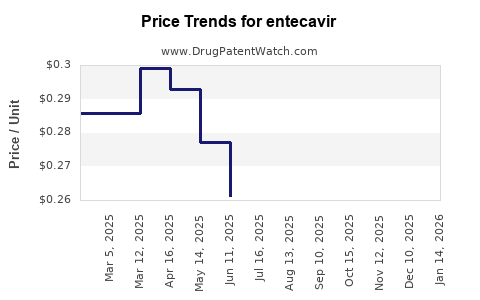
What Are Price Trends and Projections?
Historical Trends (2018–2022)
- Steady prices in developed markets; slight decrease (~5%) due to market competition.
- Price erosion accelerates upon patent expiry and after generic entry.
- Patent expiration schemes, such as in the US (2022), enable generic manufacturers to introduce lower-cost versions.
Price Projection (2023–2030)
| Year |
Estimated Average Wholesale Price (per tablet) |
Key Drivers |
| 2023 |
$20–$23 |
Initial generic entry, market adjustment |
| 2025 |
$15–$18 |
Increased generic penetration, price competition |
| 2030 |
$10–$12 |
Saturation of generics, price stabilization |
Factors Influencing Future Pricing
- Patent expiry and generic competition will exert downward pressure.
- New formulations (e.g., fixed-dose combinations) may command premium prices.
- Pricing regulations across regions will shape affordability and market access.
- Introduction of biosimilars or second-generation antivirals could further reduce prices.
What Is the Competitive Landscape?
Major Players
| Company |
Drug |
Market Share |
Patent Status |
Notes |
| Bristol-Myers Squibb |
Entecavir |
35–40% (2022) |
Patent expired in 2022 in US |
Market leader in HBV antivirals |
| Gilead Sciences |
Tenofovir, other |
Major competitor |
Patents active |
Broader antiviral portfolio |
| Sun Pharmaceutical |
Generic Entecavir |
Growing |
Patent expired |
Price leader in generics |
Pipeline Developments
No major new HBV antivirals currently seek regulatory approval that could impact the market in the near future; focus remains on improving existing formulations and combination therapies.
Key Takeaways
- Entecavir is a leading HBV antiviral with substantial market share.
- The global market size is approximately $2.1 billion, with major revenue in North America, China, and Europe.
- Prices have declined post-patent expiry, with wholesale prices in developed markets between $20–$30 per tablet.
- Generic competition is likely to push prices below $10 in some regions by 2030.
- Continued patent expiration will accelerate price erosion, but demand remains stable due to ongoing HBV prevalence.
Frequently Asked Questions
1. When did the patent for Entecavir expire in the US?
In 2022, enabling generic versions and triggering price reductions.
2. How does Entecavir compare to other HBV antivirals in terms of efficacy?
Entecavir has high potency and a strong resistance barrier, comparable to tenofovir, with a favorable safety profile.
3. Will new therapies replace Entecavir?
No major alternatives are imminent; existing medications like Entecavir and tenofovir remain first-line treatments.
4. How affordable is Entecavir in developing markets?
Prices vary, with generics available at significantly lower costs, e.g., $5–$10 per tablet in India.
5. What factors might affect future market growth?
Patent expirations, generic entry, pricing regulations, and the development of new therapies will influence market dynamics.
References
- World Health Organization. (2022). Hepatitis B Fact Sheet.
- Centers for Disease Control and Prevention. (2021). Chronic Hepatitis B and C.
- IQVIA. (2022). Global Market Report: Antiviral Drugs.
- Market Research Future. (2022). Hepatitis B Treatment Market Analysis.