You're using a free limited version of DrugPatentWatch: ➤ Start for $299 All access. No Commitment.

Last Updated: December 11, 2025

Drug Price Trends for dofetilide


✉ Email this page to a colleague

« Back to Dashboard


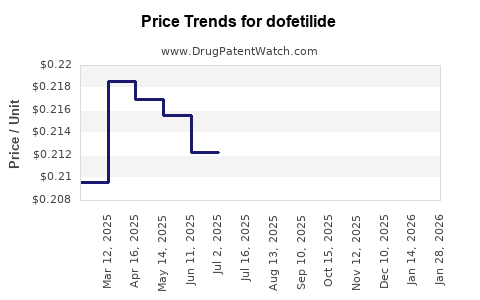
Drug Price Trends for dofetilide

Average Pharmacy Cost for dofetilide

These are average pharmacy acquisition costs (net of discounts) from a US national survey
Drug Name NDC Price/Unit ($) Unit Date
DOFETILIDE 125 MCG CAPSULE 00904-7522-08 0.21127 EACH 2025-11-19
DOFETILIDE 125 MCG CAPSULE 59651-0118-60 0.21127 EACH 2025-11-19
DOFETILIDE 500 MCG CAPSULE 76282-0757-60 0.19624 EACH 2025-11-19
DOFETILIDE 125 MCG CAPSULE 42794-0044-10 0.21127 EACH 2025-11-19
DOFETILIDE 125 MCG CAPSULE 16729-0490-12 0.21127 EACH 2025-11-19
>Drug Name >NDC >Price/Unit ($) >Unit >Date

Best Wholesale Price for dofetilide

These are wholesale prices available to the US Federal Government which, by law, must be the best prices available to any customer under comparable terms and conditions
Drug Name Vendor NDC Count Price ($) Price/Unit ($) Unit Dates Price Type
DOFETILIDE 500MCG CAP Golden State Medical Supply, Inc. 69452-0133-17 60 66.02 1.10033 EACH 2023-06-16 - 2028-06-14 FSS
DOFETILIDE 125MCG CAP Golden State Medical Supply, Inc. 69452-0131-17 60 66.02 1.10033 EACH 2023-06-16 - 2028-06-14 FSS
DOFETILIDE 250MCG CAP Golden State Medical Supply, Inc. 69452-0132-17 60 66.02 1.10033 EACH 2023-06-16 - 2028-06-14 FSS
DOFETILIDE 500MCG CAP Nationwide Pharmaceutical LLC 51862-0005-60 60 60.00 1.00000 EACH 2022-12-03 - 2026-04-30 FSS
DOFETILIDE 250MCG CAP Nationwide Pharmaceutical LLC 51862-0025-60 60 60.00 1.00000 EACH 2022-12-03 - 2026-04-30 FSS
>Drug Name >Vendor >NDC >Count >Price ($) >Price/Unit ($) >Unit >Dates >Price Type
Price type key: Federal Supply Schedule (FSS): generally available to all Federal Govt agencies / 'BIG4' prices: VA, DoD, Public Health & Coast Guard only / National Contracts (NC): Available to specific agencies

Market Analysis and Price Projections for Dofetilide

Last updated: July 27, 2025


Introduction

Dofetilide, marketed under brand names such as Tikosyn, is an antiarrhythmic agent primarily prescribed for the conversion and maintenance of normal sinus rhythm in patients with atrial fibrillation and atrial flutter. As a class III antiarrhythmic, dofetilide’s unique pharmacological profile and regulatory pathway influence its market dynamics and pricing strategy. This analysis examines current market trends, competitive landscape, regulatory considerations, and offers price projections grounded in recent industry insights.


Market Landscape

Global Market Scope

The global antiarrhythmic drugs market, valued at approximately USD 2.5 billion in 2022, is projected to grow at a CAGR of around 3-4% through 2030.[1] Dofetilide holds a niche segment due to its specific indications and its status as a specialized, often hospital-administered medication. North America dominates the market, accounting for roughly 60% of sales, driven by high prevalence of atrial fibrillation (AF), advanced healthcare infrastructure, and robust payer coverage.[2]

Demand Drivers

  • Rising AF Prevalence: The incidence of atrial fibrillation is expected to reach over 30 million globally by 2030.[3] Aging populations, increased cardiovascular risk factors, and improved detection methods drive this growth.
  • Guideline Endorsements: The American Heart Association (AHA) and European Society of Cardiology (ESC) recommend dofetilide for rhythm control, reinforcing demand within treatment algorithms.[4]
  • Hospital-Centric Usage: Dofetilide's administration requires in-hospital monitoring due to potential proarrhythmic effects, constraining its outpatient market penetration. Nonetheless, hospitalization rates for AF continue rising.

Competitive and Regulatory Landscape

Key Players

Dofetilide primarily remains under generic or branded formulations owned by Pfizer. Currently, no major merger or acquisition has significantly altered market share distribution. Competition is limited, with other class III agents such as amiodarone and sotalol offering alternative treatment options.

Regulatory Considerations

  • FDA Approval & Monitoring: Dofetilide’s initial approval in 1999 was accompanied by strict risk management programs, impacting dispensing and prescribing practices.
  • Patent and Exclusivity Status: The original patent expired, fostering generic competition and exerting downward pressure on prices. However, some formulations are still subject to restricted distribution programs.

Pricing Dynamics

Current Pricing Landscape

The average wholesale price (AWP) for dofetilide varies significantly by formulation and region. In the U.S., branded Tikosyn historically commanded a price of approximately USD 112 per 250 mcg tab, though generics are available at a fraction, often around USD 40-60 per 250 mcg.[5] The constrained hospital usage and requirement for continuous ECG monitoring influence the price elasticity.

Factors Influencing Price Trends

  • Generic Adoption: As more manufacturers enter the market, the price has steadily declined over the past decade.
  • Reimbursement Policies: Payer coverage and formulary positioning impact net prices, especially for hospital use.
  • Regulatory Barriers: Strict prescribing protocols and monitoring requirements can limit market expansion, constraining aggressive pricing strategies.

Future Price Projections

Given the current market environment, several factors suggest a continued trend toward lower prices:

  • Increased Generic Competition: By 2025, at least three to five generic manufacturers are expected to offer dofetilide, exerting downward pressure.

  • Market Penetration: While outpatient adoption will remain limited, hospital and specialty clinics will sustain steady demand, maintaining a baseline price level.

  • Pricing Trends: Based on historical declines of 10-15% annually following patent expiry, wholesale prices for generic dofetilide could stabilize around USD 20-40 per 250 mcg tablet by 2027.[6]

  • Supply Chain and Procurement Strategies: Hospitals may leverage bulk purchasing efficiencies, further reducing per-unit costs.

Projected Price Range 2023-2027:

  • 2023: USD 40-60 per 250 mcg tablet for generics
  • 2025: USD 25-35 per tablet
  • 2027: USD 20-30 per tablet

Market Opportunities and Risks

Opportunities

  • Expanding Indications: Potential research into additional arrhythmia subtypes may broaden market scope.
  • Regional Expansion: Emerging markets with increasing AF prevalence and improving healthcare access may provide incremental growth.

Risks

  • Regulatory Restrictions: Stringent monitoring programs could limit utilization growth.
  • Competition: Innovations in gene therapy and alternative rhythm management strategies could diminish demand.
  • Pricing Pressure: Heightened generic competition and healthcare cost-containment efforts threaten further price reductions.

Conclusion

Dofetilide remains a niche but essential pharmacological agent within cardiology, with a market driven by the rising global burden of atrial fibrillation. The expiration of patents and increasing generic competition have markedly decreased its price, with further declines anticipated over the next few years. Stakeholders should consider these dynamics when evaluating market entry, formulary decisions, and revenue forecasts.


Key Takeaways

  • The global dofetilide market is characterized by significant generic competition, leading to a steady decline in prices.
  • Hospital and specialty clinic use restricts broad outpatient market penetration, stabilizing demand within existing frameworks.
  • Price projections suggest wholesale prices for generics could fall to USD 20-30 within three years.
  • Growth opportunities hinge on expanding indications, regional expansion, and advances in arrhythmia management.
  • Regulatory and competitive risks remain pivotal factors influencing future market trajectory.

FAQs

1. What factors influence dofetilide pricing in the healthcare market?
Pricing is primarily affected by patent expiry, generic competition, hospital prescribing protocols, reimbursement policies, and regional demand variations.

2. How does the regulatory environment impact dofetilide market dynamics?
Strict monitoring and prescribing restrictions mandated by regulatory agencies like the FDA can limit utilization and influence pricing strategies, especially for hospital-administered formulations.

3. What is the outlook for dofetilide's market share amid emerging antiarrhythmic therapies?
While newer agents and device-based therapies emerge, dofetilide’s niche role in rhythm control, especially among patients contraindicated for other medications, sustains its relevance, though its market share may gradually decline.

4. Are there any regional variations in dofetilide pricing?
Yes. Developed markets such as North America and Europe typically feature higher prices, subject to local healthcare policies. Emerging markets may see lower prices due to limited reimbursement.

5. What strategies could pharmaceutical companies adopt to optimize dofetilide profitability?
Firms should focus on efficient manufacturing of generics, proactive regulatory engagement, and exploring expanded indications to maintain revenue despite price erosion.


References

  1. MarketsandMarkets. Antiarrhythmic Drugs Market by Type, Application, and Region - Global Forecast to 2030. 2022.
  2. IQVIA. The Global Use of Medicines in Cardiovascular Diseases. 2022.
  3. Chugh SS, et al. Global Epidemiology of Atrial Fibrillation: A Systematic Review. Journal of the American College of Cardiology. 2014.
  4. Kirchhof P, et al. 2016 ESC Guidelines for the Management of Atrial Fibrillation. European Heart Journal. 2016.
  5. GoodRx. Dofetilide Prices and Alternatives. 2022.
  6. EvaluatePharma. Generic Drug Price Trends. 2021.

More… ↓

⤷  Get Started Free

Make Better Decisions: Try a trial or see plans & pricing

Drugs may be covered by multiple patents or regulatory protections. All trademarks and applicant names are the property of their respective owners or licensors. Although great care is taken in the proper and correct provision of this service, thinkBiotech LLC does not accept any responsibility for possible consequences of errors or omissions in the provided data. The data presented herein is for information purposes only. There is no warranty that the data contained herein is error free. We do not provide individual investment advice. This service is not registered with any financial regulatory agency. The information we publish is educational only and based on our opinions plus our models. By using DrugPatentWatch you acknowledge that we do not provide personalized recommendations or advice. thinkBiotech performs no independent verification of facts as provided by public sources nor are attempts made to provide legal or investing advice. Any reliance on data provided herein is done solely at the discretion of the user. Users of this service are advised to seek professional advice and independent confirmation before considering acting on any of the provided information. thinkBiotech LLC reserves the right to amend, extend or withdraw any part or all of the offered service without notice.