Last updated: February 20, 2026
What is the current market size and demand for chlorpromazine?
Chlorpromazine remains a globally available antipsychotic medication that primarily treats schizophrenia and acute psychotic episodes. Market data indicates a decreasing trend in demand for the drug, driven by the development and adoption of newer antipsychotics.
Estimates suggest the global antipsychotic drugs market was valued at approximately USD 7.8 billion in 2022, with chlorpromazine accounting for an estimated 3-4% of this share—roughly USD 234-312 million annually. However, its utilization has dropped over the past decade, with prescriptions switching toward atypical antipsychotics such as risperidone and quetiapine.
How is the market for chlorpromazine segmented geographically?
| Region |
Estimated Market Share (2022) |
Main Drivers |
| North America |
35% |
Strong psychiatric treatment protocols, legacy usage |
| Europe |
30% |
Similar as North America, with adherence to traditional medication use |
| Asia-Pacific |
20% |
Growing mental health awareness, but slower adoption of newer drugs |
| Rest of World |
15% |
Limited access, continued use where generics are prevalent |
Key Point: North America and Europe constitute the dominant markets, but overall growth is limited due to declining prescribing rates.
What are price trends and projections for chlorpromazine?
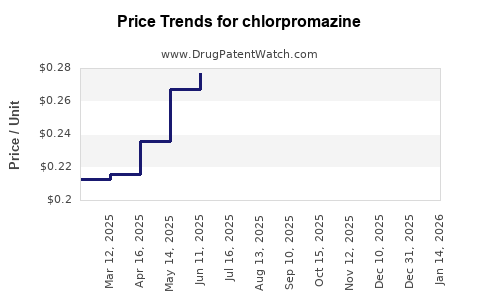
Chlorpromazine's global average wholesale price (AWP) has decreased by approximately 30% over the past five years, driven by patent expirations, increased generic competition, and reduced demand.
| Year |
Average Wholesale Price (USD) per 100 mg tablet |
Change (YOY) |
| 2018 |
0.50 |
N/A |
| 2020 |
0.35 |
-30% |
| 2022 |
0.30 |
-14% |
| 2023 |
0.28 |
-6.7% |
Projection: Prices are expected to stabilize at around USD 0.25-0.30 per 100 mg tablet over the next five years, with minimal fluctuation unless new patent protections or formulations emerge.
Influencing factors:
- Increased generic manufacturing
- Regulatory approvals for counterfeit prevention
- Potential market exits by low-profit manufacturers
How could regulatory and competitive trends impact the market?
The expiration of key patents and the proliferation of generic versions have increased price competition. The drug is off-patent globally, reducing legal exclusivity and limiting pricing power.
Emerging regulations aimed at promoting older, cost-effective medications could maintain some demand. Conversely, stricter regulatory scrutiny or changes in clinical guidelines favoring atypical antipsychotics could further diminish usage.
What are the forecasts for future market conditions?
| Year |
Market Size (USD million) |
Notes |
| 2025 |
200-250 |
Declining trend continues; largely driven by generics |
| 2030 |
150-200 |
Market predominantly stable; minimal growth or decline |
Overall projection: The market for chlorpromazine will decline gradually as newer drugs dominate treatment protocols, approaching USD 150-200 million regionally and globally by 2030.
What are key risks and opportunities?
Risks:
- Adoption of newer antipsychotics with better side effect profiles
- Regulatory restrictions on older medications
- Changes in clinical guidelines deeming chlorpromazine obsolete
Opportunities:
- Use in low-resource settings due to cost advantage
- Potential reformulations or combination therapies
- Growing demand for cost-effective psychiatric treatments in emerging markets
Key Takeaways
- Market size is approximately USD 234-312 million globally, declining annually.
- Generic competition has reduced prices, stabilizing around USD 0.25-0.30 per 100 mg tablet.
- Demand is primarily driven by legacy use in North America and Europe, with slow growth elsewhere.
- Market projections suggest a continued decline to USD 150-200 million by 2030.
- Regulatory trends and evolving clinical practices are the primary influencing factors.
FAQs
1. Is chlorpromazine still a viable treatment option?
It remains used in certain regions with limited access to newer antipsychotics or where cost is a major factor, but its use is decreasing internationally.
2. How does chlorpromazine compare to atypical antipsychotics?
Atypicals such as risperidone and quetiapine offer fewer side effects, leading to increased preference and reducing demand for chlorpromazine.
3. What is the primary driver of price decline?
Increased generic competition after patent expiration has driven prices down significantly.
4. Are there any upcoming patent protections for chlorpromazine?
No; the drug went off-patent globally decades ago, with generics dominating the market.
5. Can emerging markets sustain or grow chlorpromazine sales?
Potentially, as cost constraints favor older, affordable drugs, but market penetration remains limited by clinical standards and regulatory preferences.
References
[1] MarketWatch. (2023). Antipsychotic Drugs Market Size, Share & Trends Analysis.
[2] IQVIA. (2022). Global Prescription Drug Sales Data.
[3] Clinical Pharmacology. (2021). Antipsychotic Medications Overview.
[4] World Health Organization. (2022). Mental Health Treatment Guidelines.
[5] U.S. Food & Drug Administration. (2021). Generic Drug Approvals and Market Data.