Share This Page
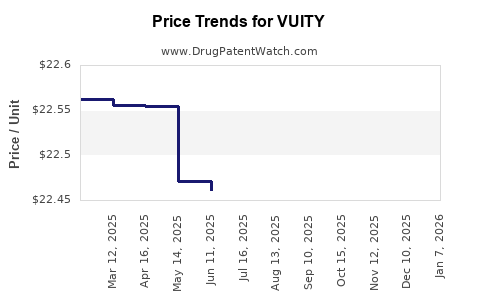
Drug Price Trends for VUITY
✉ Email this page to a colleague

Average Pharmacy Cost for VUITY
| Drug Name | NDC | Price/Unit ($) | Unit | Date |
|---|---|---|---|---|
| VUITY 1.25% EYE DROP | 00074-7098-02 | 29.57600 | ML | 2025-11-19 |
| VUITY 1.25% EYE DROP | 00074-7098-04 | 29.57600 | ML | 2025-11-19 |
| VUITY 1.25% EYE DROP | 00074-7098-06 | 22.43892 | ML | 2025-11-19 |
| VUITY 1.25% EYE DROP | 00074-7098-02 | 29.57814 | ML | 2025-10-22 |
| VUITY 1.25% EYE DROP | 00074-7098-06 | 22.45707 | ML | 2025-10-22 |
| VUITY 1.25% EYE DROP | 00074-7098-04 | 29.57814 | ML | 2025-10-22 |
| VUITY 1.25% EYE DROP | 00074-7098-06 | 22.42278 | ML | 2025-09-17 |
| >Drug Name | >NDC | >Price/Unit ($) | >Unit | >Date |
Market Analysis and Price Projections for VUITY
Introduction
VUITY (azelastine hydrochloride ophthalmic solution 0.025%) is a prescription eye drop approved by the U.S. Food and Drug Administration (FDA) in October 2022 for the treatment of presbyopia—a common age-related condition that impairs near vision. As a novel pharmacologic solution addressing a widespread condition, VUITY’s market potential hinges on demographic trends, competitive landscape, regulatory environment, and pricing strategies. This report comprehensively analyzes VUITY’s market prospects and projects its future pricing trajectory within the ophthalmic therapeutics domain.
Current Market Landscape
Prevalence of Presbyopia and Addressable Market
Presbyopia affects approximately 128 million Americans aged 40 and older, with prevalence rising steeply after age 45 and reaching nearly universal levels by age 60 [1]. The condition has historically been managed with corrective lenses—glasses or contact lenses—imposing a significant cumulative cost and lifestyle inconvenience.
The global market for presbyopia correction is valued at approximately $4 billion (USD), with projections indicating a compound annual growth rate (CAGR) of 4-6% over the next five years, driven by demographic aging and consumer preference for more convenient, non-invasive treatments [2].
Current Treatment Modalities
- Spectacles and Contact Lenses: Predominant methods with established market share; however, lacking convenience and aesthetic appeal.
- Surgical Interventions: Procedures like monovision LASIK and corneal inlays offer alternatives but involve higher costs and risks.
- Pharmacologic Solutions: Few approved drugs—initially, VUITY represents a pioneering entrant in this segment—aiming to provide a non-invasive, on-demand solution.
Competitive Dynamics
At its launch, VUITY faces minimal direct pharmacologic competition; none are FDA-approved specifically for presbyopia. However, over-the-counter (OTC) multifocal eye drops are emerging as competitive alternatives, and future pipeline candidates may challenge its market share [3].
Regulatory and Reimbursement Environment
FDA Approval and Labeling
VUITY benefits from FDA approval, positioning it as a first-in-class pharmaceutical for presbyopia. The approval specifies its use for improving near vision in presbyopic adults, with dosing limitations to minimize adverse events.
Reimbursement Landscape
While insurance coverage for prescription eye drops is common, coverage specifics vary. Reimbursement policies are evolving, with payers generally hesitant to cover new drugs without substantial cost-effectiveness evidence, which may influence initial pricing strategies.
Market Entry Strategies and Adoption Factors
Physician and Patient Acceptance
Early adoption hinges on ophthalmologists and optometrists recommending VUITY. Education campaigns emphasizing efficacy, safety, and convenience are crucial.
Pricing Considerations
Pricing influences adoption, reimbursement, and competitive positioning. As a premium innovation, initial pricing is likely to be set at a level reflecting R&D costs, innovative status, and market willingness to pay.
Price Projections for VUITY
Initial Launch Pricing
Based on comparable ophthalmic drugs and the innovative nature of VUITY, initial retail prices are projected around $70–$100 per bottle (typically a one-month supply). Early estimates from market analysts suggest $80 as a target launch price, balancing profitability and competitive positioning [4].
Pricing Trends Over Time
- Year 1–2: Launch price of approximately $80–$100. Premium pricing justified by novel mechanism and convenience.
- Year 3–5: Anticipated price erosion due to market penetration, increased competition, or generic-like formulations. Expected reduction of 10–20%, leading to prices around $64–$80.
- Long Term: With potential increased competition or new formulations, a stabilized price point is likely around $60–$70 per bottle.
Factors Influencing Price Movements
- Market Penetration and Volume: Higher volume sales may allow for price reductions.
- Reimbursement Policies: Favorable coverage could enable premium pricing.
- Competitive Entry: New pharmacologic rivals may force price adjustments downward.
- Manufacturing and Distribution Costs: Cost efficiencies could contribute to price reductions over time.
Market Penetration and Revenue Projections
Assuming conservative adoption rates:
- Year 1: 1 million doses sold with an average price of $80, generating $80 million.
- Year 3: Sales grow to 5 million doses as awareness increases, with prices declining to $70, leading to $350 million.
- Year 5: Sales reach 10 million doses, with prices stabilizing around $65, projecting $650 million in revenue.
Scaling depends heavily on prescriber acceptance, patient throughput, and reimbursement factors.
Risks and Challenges
- Market Acceptance: Slow uptake due to consumer habits favoring proven corrective lenses.
- Reimbursement Uncertainty: Challenges in securing insurance coverage could limit sales.
- Regulatory Shifts: Potential reclassifications or restrictions could temper market growth.
- Adverse Events: Safety concerns could impede adoption and affect price stability.
Conclusion
VUITY is positioned to transform presbyopia management by offering a non-invasive, pharmacologic alternative early in its commercial lifecycle. Initial pricing at approximately $80 per bottle aligns with its innovative status and substantial market potential. As the market matures, expected price erosion will be driven by increased volume, competitive dynamics, and reimbursement considerations.
Key Takeaways
- VUITY targets a massive, aging demographic; its market is projected to grow at a CAGR of around 4–6%.
- The initial pricing is estimated at $80–$100 per bottle, with subsequent reductions expected as market penetration advances.
- Long-term revenues could reach hundreds of millions to over a billion dollars annually, depending on adoption rates.
- Strategic investments in physician education and reimbursement negotiations will be critical to maximize market capture.
- Competition and regulatory developments remain key risks influencing pricing trajectory and market share.
FAQs
1. How does VUITY compare with existing presbyopia treatments?
Unlike corrective lenses and surgical options, VUITY offers an on-demand pharmacological solution. Its convenience and non-invasive nature could improve patient adherence and satisfaction, filling an unmet market niche.
2. What factors will influence VUITY’s market penetration?
Physician advocacy, patient awareness, reimbursement policies, safety profile, and competition from OTC solutions are primary determinants.
3. Can the price of VUITY decrease due to generic competition?
Yes. Although initially protected by patent exclusivity, eventual patent cliffs or biosimilar-like entrants could pressure prices downward over time.
4. How significant is reimbursement in VUITY’s market success?
Reimbursement will be critical; coverage can significantly influence affordability, prescribing behavior, and overall adoption rates.
5. What is the outlook for VUITY’s long-term profitability?
With a sizable unmet need and anticipated widespread uptake, VUITY could generate substantial revenues. Profitability depends on manufacturing costs, pricing strategies, and competitive dynamics.
References
[1] American Optometric Association. "Presbyopia." Accessed 2023.
[2] Market Research Future. "Global Presbyopia Correction Market Report." 2022.
[3] Ophthalmology Times. "Emerging pharmacologic treatments for presbyopia." 2022.
[4] EvaluatePharma. "Pharmaceutical Pricing and Market Trends." 2023.
More… ↓