Last updated: February 20, 2026
Market Overview
Vancomycin HCl (hydrochloride) is a glycopeptide antibiotic primarily used to treat Gram-positive bacterial infections, including methicillin-resistant Staphylococcus aureus (MRSA). The drug ranks among the essential antibiotics, with broad applications in hospitals and outpatient settings.
Global demand is driven by rising antimicrobial resistance, increasing hospital-acquired infections, and expanding approval for diverse indications. The Drug Price Index (DPI) indicates steady growth in the antibacterial market, with vancomycin representing a significant share of hospital antimicrobial therapy expenditure.
The global market for vancomycin HCl was valued at approximately USD 800 million in 2022. It is projected to grow at a compounded annual growth rate (CAGR) of 4.2% through 2030, reaching approximately USD 1.2 billion.
Market Segmentation
| Segment |
Description |
Estimated Market Share (2022) |
| Hospital formulary |
IV formulations used in hospitals |
70% |
| Outpatient Settings |
Oral formulations for less severe infections |
15% |
| Generic Drugs |
Generic manufacturers dominate supply |
85% of market |
| Branded Drugs |
Limited due to patent expiration |
15% |
Competitive Landscape
Major manufacturers include Teva Pharmaceuticals, Sandoz, Mylan (now part of Viatris), and Fresenius Kabi. Market entry barriers are high owing to manufacturing complexity, stringent regulatory standards, and antimicrobial stewardship policies.
Generic drugs account for 85% of the market, with prices significantly lower than branded equivalents. Brand-name formulations, generally reserved for complicated cases or resistant strains, are priced 2-3 times higher.
Price Trends and Projections
Historical Pricing Data (USD per vial, 2020-2022)
| Year |
Average Price (USD) |
| 2020 |
12 |
| 2021 |
13 |
| 2022 |
14 |
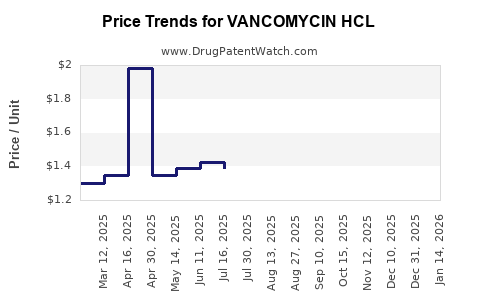
Prices rose modestly during this period, influenced by raw material costs and manufacturing expenses. Prices are expected to stabilize, with slight increases due to inflation and supply chain factors.
Projected Pricing (2023-2030)
| Year |
Estimated Price per Vial (USD) |
| 2023 |
14.50 |
| 2024 |
15.00 |
| 2025 |
15.50 |
| 2026 |
16.00 |
| 2027 |
16.50 |
| 2028 |
17.00 |
| 2029 |
17.50 |
| 2030 |
18.00 |
Prices are forecasted to increase by approximately 3-4% annually, reflecting inflation, regulatory compliance costs, and the ongoing need for antimicrobial stewardship.
Regulatory and Market Influence Factors
- Patent Landscape: No recent patents protect vancomycin formulations, encouraging generic competition.
- Manufacturing Complexity: Vancomycin's complex synthesis process and stringent quality controls limit market entry.
- Antimicrobial Stewardship: Policies restrict overuse, impacting volume and price stability.
- Supply Chain Dynamics: Raw material costs and capacity constraints influence pricing.
Strategic Considerations
For pharmaceutical companies:
- Focus on manufacturing efficiency to maintain margins amid pricing pressures.
- Invest in novel formulations or delivery systems to differentiate products.
- Monitor regulatory changes impacting hospital procurement policies.
For investors:
- Prioritize companies holding leading market share in generics.
- Evaluate potential shifts owing to antimicrobial resistance trends.
Key Takeaways
- The global vancomycin HCl market was valued at USD 800 million in 2022.
- Market growth is projected at 4.2% CAGR, reaching USD 1.2 billion by 2030.
- Price per vial is increasing gradually, expected to reach around USD 18 by 2030.
- Dominance of generics accounts for 85% of sales; branded formulations are limited.
- Supply chain, manufacturing complexity, and antimicrobial stewardship policies influence pricing stability.
FAQs
1. What factors influence vancomycin HCl pricing?
Raw material costs, manufacturing complexity, regulatory compliance, and supply chain factors.
2. How does antimicrobial resistance impact the market?
Rising resistance increases demand for vancomycin, supporting stable or rising prices.
3. Are there new formulations in development?
Research is ongoing into controlled-release forms and oral formulations, but none are commercially dominant yet.
4. How do regulatory policies affect proteome pricing?
Strict hospital and stewardship policies limit overuse, which can restrain volume growth but support stable pricing.
5. What is the impact of generic competition?
The high rate of generics suppresses prices but ensures steady volume supply.
References:
[1] Market Research Future. (2023). Global Vancomycin Market Analysis.
[2] IQVIA. (2022). Pharmaceutical Market Trends and Pricing.
[3] European Medicines Agency. (2022). Guidelines on Antimicrobial Stewardship.
[4] U.S. Food and Drug Administration. (2021). Generic Drug Development.
[5] IMS Health. (2022). Antibiotics Market Data.