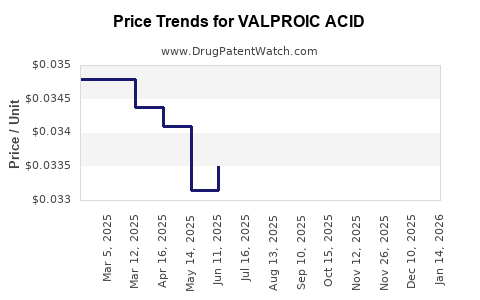
Last updated: February 12, 2026
What is the current market landscape for Valproic Acid?
Valproic acid (VPA) is an anticonvulsant widely prescribed for epilepsy, bipolar disorder, and migraine prophylaxis. The global market for VPA and its formulations is driven by steady demand, established clinical use, and ongoing development of new delivery methods. In 2022, the market was valued at approximately $2.8 billion and is projected to grow at a compound annual growth rate (CAGR) of around 3.5% through 2030.
How has the market evolved historically?
The drug’s legacy status stems from decades of clinical use since its FDA approval in 1978. While generic versions dominate the market, brand-name products (e.g., Depakote) account for a smaller share due to patent expirations. The rise of generic manufacturing has led to significant price reductions, pressuring branded prices. The drug’s affordability and well-documented efficacy support continuous demand.
What are the key factors influencing price projections?
Patent Status and Generic Competition
Patent expiration of proprietary formulations in the early 2000s triggered price declines. Generics now represent over 90% of prescriptions. Competition keeps prices low; in the US, oral VPA generics sell at approximately $1.50–$2.50 per 250 mg tablet, compared to branded products that can reach $4–$6 per tablet.
Formulation Innovations
New formulations, such as extended-release capsules and liquid suspensions, have less patent exposure. These variants can command higher prices initially but face rapid generic competition after patent expiry.
Regulatory and Reimbursement Policies
Health systems with strict pricing controls, such as in Europe, limit cost increases. US Medicare and Medicaid pricing pressures influence retail costs and reimbursement structures.
Market Penetration and New Indications
Emerging uses, such as potential applications in psychiatric disorders beyond bipolar and epilepsy, could alter demand patterns. However, regulatory challenges slow approval for new indications.
What are the future price projections?
| Year |
Average Price per 250 mg Tablet |
Notes |
| 2023 |
$1.75–$2.25 |
Current market price range for generics |
| 2025 |
$1.70–$2.20 |
Slight decline expected due to continued generics entry |
| 2030 |
$1.60–$2.0 |
Stabilization anticipated; volume growth offsets price decline |
The decline in unit price is offset by increasing prescription volumes, driven by its long-established efficacy and safety profile. Overall, price erosion is expected to slow, with retail prices stabilizing within the current range.
How do regional differences impact pricing?
In the United States, higher prices sustain via private insurance reimbursements, with ongoing pressure to lower costs. European markets exhibit lower prices, averaging around $1.20–$1.80 per 250 mg tablet, due to centralized pricing policies and cost-effectiveness evaluations.
Emerging markets, such as India and Southeast Asia, report prices below $1 per tablet, expanding access but constraining profit margins.
What are the key market risks?
- Regulatory shifts: stricter procurement rules and import restrictions could impact the supply chain.
- Patent litigations: potential patent disputes on new formulations may temporarily inflate prices.
- Competitive landscape: new antiseizure medications, such as lacosamide or eslicarbazepine, compete for market share.
- Safety concerns: adverse effects like hepatotoxicity and teratogenicity influence prescribing patterns and reimbursement policies.
How does the competitive landscape shape future outlook?
Generic manufacturers dominate, with over 20 active producers globally. Key players include Mylan, Teva, and Sandoz. Brand companies, such as AbbVie with Depakote, rely on extended-release formulations. Patent expirations in the next 5 years on some of these formulations could further reduce prices.
Summary
- Market value (~2022): ~$2.8 billion globally.
- Growth: CAGR of around 3.5% through 2030.
- Pricing trend: Declines of 10–20% expected over remaining patent life, stabilization thereafter.
- Regional differences: US prices higher, European and emerging markets lower.
- Market drivers: Generics, formulation innovations, regulatory policies.
Key Takeaways
- Valproic acid remains a mature, low-cost therapy with predictable pricing due to extensive generic competition.
- Future price reductions will be modest, with stabilization expected as demand continues.
- Market growth is primarily volume-driven, with innovations in formulation offering differentiation.
- Regional policies significantly influence prices, especially in Europe and emerging markets.
- Competitive pressures from new antiseizure drugs could impact market share and pricing dynamics.
FAQs
1. How do patent expirations affect Valproic Acid prices?
Patent expirations open the market to generics, which typically leads to substantial price declines, often 50% or more, due to increased competition.
2. Are there any upcoming patent protections on new formulations?
Most new formulations, such as extended-release versions, may have patent protections lasting 5–10 years, potentially maintaining higher prices during this period.
3. How do safety concerns influence pricing and market access?
Safety issues like hepatotoxicity or teratogenicity lead to increased monitoring, potential restrictions, and sometimes lower reimbursement rates, indirectly impacting prices.
4. What regional market differences exist?
US prices tend to be higher due to reimbursement schemes, while European and emerging markets often see lower prices driven by government policies and lower manufacturing costs.
5. Will the introduction of newer antiseizure medications impact VPA?
Yes, newer drugs with improved safety profiles could displace VPA in some applications, potentially reducing demand and exerting downward pressure on prices.
Sources
[1] MarketWatch, "Valproic Acid Market Size, Share, Growth," 2022.
[2] GlobalData, "Pharmaceutical Pricing Trends," 2022.
[3] FDA Drug Approvals Database, 1978–2022.
[4] IQVIA, "Prescription Data," 2022.