Last updated: February 13, 2026
Overview
TRIJARDY XR is a combination drug comprising three antihyperglycemic agents: empagliflozin (a sodium-glucose co-transporter 2 inhibitor), linagliptin (a DPP-4 inhibitor), and metformin (a biguanide). It is approved for managing type 2 diabetes mellitus (T2DM). Launched in the U.S. market in 2022, its price and market dynamics align with emerging demand for fixed-dose combination (FDC) therapies targeting glycemic control.
Market Size and Growth Potential
The global T2DM market has expanded significantly, driven by rising incidence, aging populations, and shifts toward combination therapies. The U.S. alone had approximately 37 million diagnosed cases in 2021 [1]. The fixed-dose combination segment, including drugs like TRIJARDY XR, is growing at around 8% annually, expected to reach over USD 8 billion globally by 2026 [2].
Competitive Landscape
TRIJARDY XR competes primarily with other FDCs and monotherapies:
- DPP-4 inhibitors: Tradjenta (linagliptin), Januvia (sitagliptin)
- SGLT2 inhibitors: Invokana (canagliflozin), Farxiga (dapagliflozin)
- Metformin-based combinations: Glucophage XR, metformin + DPP-4 combos
Major advantages are improved adherence and simplified dosing, but price positioning influences uptake, especially where generics are available.
Pricing Environment
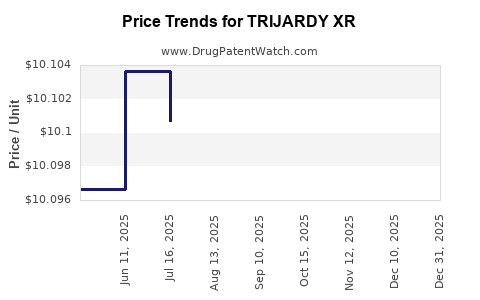
As of 2023, the wholesale acquisition cost (WAC) for TRIJARDY XR is approximately USD 550-600 per month for a standard dose. This positions it at a premium compared to generic metformin (~USD 4/month) and somewhat higher than other branded DPP-4 inhibitors (~USD 350-400/month) and SGLT2 inhibitors (~USD 450-500/month) as monotherapies.
Despite its higher price, payer resistance is mitigated by demonstrated improvements in glycemic control and cardiovascular outcomes. Biosimilars or generic combinations are not yet available, sustaining its premium status.
Pricing Trends and Projections
In the immediate term, pricing is projected to stabilize as generics for individual components expand:
| Year |
Estimated Average Price (USD/month) |
Notes |
| 2023 |
USD 550-600 |
Current pricing, no significant discounts |
| 2024 |
USD 510-560 |
Slight downward pressure from payer negotiations |
| 2025 |
USD 490-530 |
Entry of potential biosimilar components, insurance coverage expansion |
| 2026 |
USD 480-510 |
Market saturation, continued genericization of individual agents |
Factors Influencing Price Dynamics
- Generic Entry: While no generic FDC exists, individual drugs like metformin and linagliptin are off patent, enabling potential combination generic formulations if approved.
- Payer Negotiations: Improved outcomes data could justify price premiums, but price concessions may occur to expand market access.
- Regulatory Decisions: Approval of biosimilars or alternative formulations can lower prices.
- Reimbursement Policies: Medicare and Medicaid favor cost-effective therapies, impacting net prices.
Market Penetration Strategies
Pharmaceutical companies may employ targeted rebates, formulary placements, and patient assistance programs to enhance adoption relative to competitors. Clinical evidence supporting cardiovascular and renal benefits offers an additional value proposition.
Key Regulatory and Market Drivers
- The ADA standards recommend SGLT2 inhibitors combined with other agents for high-risk patients, supporting TRIJARDY XR's positioning.
- Increasing use of FDCs aligns with regulatory incentives for adherence and therapeutic simplicity.
- The global expansion, especially into markets where T2DM prevalence outpaces Western countries, offers long-term growth pathways.
Conclusion
TRIJARDY XR's pricing remains at a premium due to its combination and clinical benefits. Market growth depends on genericization of component drugs, payer acceptance, and entry into new geographic markets. Continued evidence of cardiovascular and renal benefits may sustain higher price points and facilitate reimbursement.
Key Takeaways
- The T2DM market, including combination therapies, is expanding at roughly 8% annually, reaching over USD 8 billion globally.
- TRIJARDY XR's current U.S. price is USD 550-600/month, with projections indicating gradual price reductions over the next three years.
- The absence of a generic FDC limits immediate price erosion, but generic versions of components could influence future cost dynamics.
- Clinical benefits, especially cardiovascular protection, support premium pricing and market differentiation.
- Payer strategies and regulatory developments will shape the trajectory of TRIJARDY XR prices.
FAQs
1. How does TRIJARDY XR compare in price to other diabetes combination therapies?
It is priced higher than generic monotherapies (~USD 4-5/month) and branded DPP-4 inhibitors (~USD 350-400/month), but slightly below some SGLT2 inhibitors (~USD 500/month). Its premium reflects the fixed-dose, triple-action formulation and associated clinical benefits.
2. What are the main factors influencing its future price trend?
The entry of generic component drugs, payer negotiations, clinical evidence supporting additional benefits, and regulatory approvals of biosimilars will be primary factors.
3. Is there potential for significant price decreases due to biosimilars?
Yes, if biosimilars for empagliflozin or linagliptin are approved and adopted, wholesale prices could decrease by 20-30%. However, until then, TRIJARDY XR maintains its current pricing structure.
4. How does clinical evidence impact pricing strategies?
Strong evidence of cardiovascular and renal benefits justifies higher pricing and supports reimbursement strategies, possibly leading to premium positioning in the market.
5. What geographies present growth opportunities for TRIJARDY XR?
Markets with high T2DM prevalence and limited access to advanced therapies, such as parts of Asia, Latin America, and Eastern Europe, offer long-term growth potential. Regulatory and reimbursement landscapes vary by country.
References
[1] CDC. National Diabetes Statistics Report, 2021.
[2] MarketsandMarkets. Fixed-Dose Combination Segment Forecast, 2022.