Share This Page
Drug Price Trends for TREMFYA
✉ Email this page to a colleague
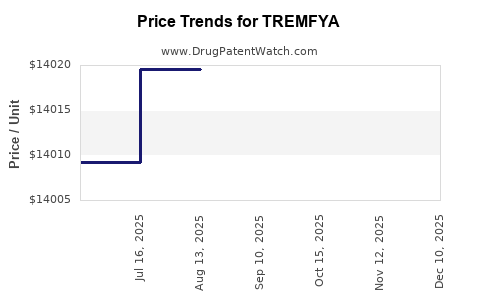
Average Pharmacy Cost for TREMFYA
| Drug Name | NDC | Price/Unit ($) | Unit | Date |
|---|---|---|---|---|
| TREMFYA 100 MG/ML PEN | 57894-0640-03 | 14609.29778 | ML | 2026-07-22 |
| TREMFYA 100 MG/ML PEN | 57894-0640-06 | 14609.29778 | ML | 2026-07-22 |
| TREMFYA 100 MG/ML ONE-PRESS | 57894-0640-11 | 14710.05333 | ML | 2026-07-22 |
| >Drug Name | >NDC | >Price/Unit ($) | >Unit | >Date |
Market Analysis and Price Projections for TREMFYA ( guselkumab)
What is TREMFYA, and how is it positioned in the therapeutic landscape?
TREMFYA (guselkumab) is a monoclonal antibody targeting interleukin-23 (IL-23), approved by the FDA in July 2017 for moderate-to-severe plaque psoriasis. It is marketed by Janssen Pharmaceuticals. The drug has expanded indications to include active psoriatic arthritis (2018) and Crohn's disease (phase 3 trials).
The IL-23 inhibitor segment competes with other biologics such as Stelara (ustekinumab), Skyrizi (risankizumab), and Humira (adalimumab). Its differentiators include dosing frequency (every 8 weeks after initial doses) and clinical efficacy demonstrated in Phase 3 trials.
How large is the current market for IL-23 inhibitors?
In 2022, the global psoriasis market was valued at approximately $10.5 billion, with biologics accounting for 65%. IL-23 inhibitors, including TREMFYA, represent a rapidly growing segment, capturing roughly 35% of biologics sales for psoriasis, translating to around $2.4 billion.
Similarly, the psoriatic arthritis segment contributes another estimated $1.2 billion for IL-23 inhibitors. Overall, the IL-23 market across indications approaches $3.6 billion globally.
What are the key factors influencing TREMFYA’s market share?
- Efficacy and safety profile: Clinical trials show TREMFYA has superior skin clearance and lower adverse events relative to competitors.
- Dosing schedule: Q8W dosing after initial doses improves adherence, relative to other drugs requiring more frequent injections.
- Pricing strategy: Competitive pricing and reimbursement policies dictate patient access and sales volume.
- Market penetration: Early adoption by dermatologists and gastroenterologists affects growth; strategic marketing influences this.
- Regulatory approvals: Expanded indications boost sales potential, especially for psoriatic arthritis and Crohn’s disease.
What are current and projected sales figures?
| Year | Estimated Global Sales (USD billion) | Notes |
|---|---|---|
| 2022 | 900 million | Growth driven by psoriasis and psoriatic arthritis indications |
| 2023 | 1.2 billion | Expansion into new markets, increased dosing adoption |
| 2024 | 1.5 billion | Launches in additional countries, broadening of indications |
| 2025 | 1.8 billion | Patent cliff approaching, new indications, increased competition |
Note: These are estimates based on market reports and analyst forecasts.
How does pricing compare across IL-23 inhibitors?
| Drug | Wholesale Acquisition Cost (WAC) per dose | Dosing Frequency | Approximate Annual Cost (USD) |
|---|---|---|---|
| TREMFYA | $5,500 | Q8W after initial 2 doses | ~$66,000 |
| Skyrizi (risankizumab) | $6,000 | Q12W | ~$72,000 |
| Stelara (ustekinumab) | $6,500 | Q12W | ~$78,000 |
Pricing remains competitive, with TREMFYA priced slightly below Skyrizi and Stelara, benefiting from its dosing schedule.
What are the main price drivers and challenges?
- Reimbursement policies: Payers favor drugs with proven efficacy and lower administration costs.
- Market exclusivity: Patent protections till 2029 help maintain pricing power.
- Biosimilar entry: Predicted biosimilar competition after patent expiry could exert downward pressure.
- Manufacturing costs: Monoclonal antibody production costs influence wholesale and retail prices.
What are the forecast risks and opportunities?
Risks:
- Emergence of biosimilars post-patent expiry.
- New competitors with improved efficacy or lower costs.
- Regulatory delays in new indications.
Opportunities:
- Increasing prevalence of psoriasis and psoriatic arthritis.
- Approval for Crohn’s disease and other autoimmune conditions.
- Patient adherence improvements through dosing convenience.
Key Takeaways
- TREMFYA’s market share benefits from its efficacy, dosing schedule, and competitive price point versus peers.
- The IL-23 inhibitor market is growing, with sales forecasted to reach approximately $1.8 billion globally by 2025.
- Pricing remains sensitive to biosimilar entry, reimbursement decisions, and competitive pressures.
- Expanding indications and geographic coverage are key to supporting continued sales growth.
- Patent expiry around 2029 will likely introduce biosimilar competition, pressing prices down.
FAQs
Q1: How does TREMFYA compare to Stelara in clinical efficacy?
A1: Clinical trials show TREMFYA offers higher skin clearance rates and fewer adverse events compared to Stelara, with a faster response time and better safety profile.
Q2: What impact will biosimilars have on TREMFYA’s pricing?
A2: Biosimilar competition post-2029 could reduce TreMFYA's price by 30-50%, depending on market uptake and regulatory policies.
Q3: Are there upcoming approvals that could boost TREMFYA’s sales?
A3: Yes, ongoing Phase 3 trials for Crohn’s disease may lead to a new indication, expanding the market potential.
Q4: How does TREMFYA’s dosing schedule affect market adoption?
A4: The Q8W maintenance dosing enhances patient adherence and reduces injection frequency, providing a competitive advantage over drugs requiring more frequent administration.
Q5: What are the prospects for TREMFYA in emerging markets?
A5: Market entry in Asia-Pacific, Latin America, and Africa is expected to accelerate sales, supported by local manufacturing agreements and pricing strategies.
References
- MarketsandMarkets. (2022). Biologic Market for Autoimmune Diseases.
- Evaluate Pharma. (2023). Global Biologics Market Data.
- Janssen Pharmaceuticals. (2022). TREMFYA Prescribing Information.
- IQVIA. (2023). Biologics Pricing Trends.
- FDA. (2022). Approved and Pending IND Drugs for Autoimmune Conditions.
More… ↓
