Last updated: July 27, 2025
Introduction
Torsemide, a potent loop diuretic primarily prescribed for edema associated with congestive heart failure, liver disease, and renal impairment, has seen a steady increase in global demand. Its unique pharmacokinetic profile, compared to other loop diuretics like furosemide, positions it favorably in specific therapeutic niches. As healthcare systems evolve and the market for cardiovascular and renal medications expands, an in-depth market analysis paired with strategic price projections becomes vital for stakeholders—including pharmaceutical companies, investors, and healthcare providers.
Market Overview
Global Market Size and Growth Drivers
The global diuretics market was valued at approximately USD 1.8 billion in 2022, with loop diuretics accounting for a significant share [1]. Factors fueling the growth include the rising prevalence of chronic heart failure, hypertension, and renal diseases. Specifically, torsemide’s segment is anticipated to grow at a compounded annual growth rate (CAGR) of about 4.5% over the next five years, driven by its superior bioavailability and longer duration of action compared to traditional loop diuretics like furosemide.
Regional Market Dynamics
-
North America: Leads the market due to high healthcare expenditure, extensive adoption in clinical practice, and a robust pipeline of innovations. The US accounts for over 50% of the global torsemide market share.
-
Europe: Presents a significant but slower-growing market due to stringent drug approval processes and prevalent generic use.
-
Asia-Pacific: Exhibits rapid growth potential, owing to increasing rates of cardiovascular diseases and expanding healthcare infrastructure. Countries like China and India emerge as key markets.
-
Latin America and Middle East: Moderate growth prospects, primarily through regional generic manufacturers and healthcare expansion.
Competitive Landscape
The market features predominantly generic manufacturers with limited patented formulations of torsemide. Major players include Sun Pharmaceutical Industries, Hikma Pharmaceuticals, and Aurobindo Pharma. Patent expiration of brand-name drugs has facilitated market penetration by generics, reducing prices but expanding distribution.
Current Pricing Landscape
Pricing Structure
Brand-name torsemide formulations generally retail at higher prices ($0.50-$1.00 per tablet) compared to generics, which can be priced as low as $0.10-$0.30 per tablet. Distribution channels influence prices, with hospital formulary negotiations and pharmacy markups playing critical roles.
Pricing Trends
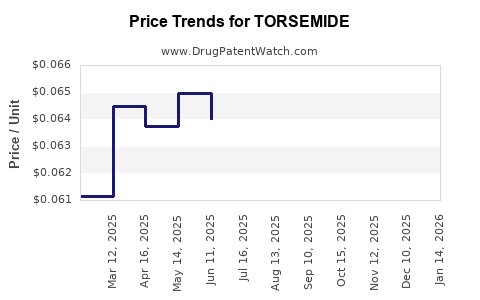
Over the past five years, prices have declined roughly 15-20% due to increased generic competition and healthcare cost containment strategies. Notably, the availability of high-burity generics has contributed to consumer savings and broader accessibility.
Future Price Projections
Factors Influencing Price Trends
-
Generic Market Penetration: As patents expire, increased competition is expected to sustain pressure on prices.
-
Regulatory Environment: Stringent regulations or biosimilar developments could influence costs.
-
Market Demand: Rising prevalence of target indications can support stable or increasing prices, especially for branded formulations with superior bioavailability.
-
Manufacturing Costs: Advances in manufacturing efficiencies and raw material procurement will play roles in possible price reductions.
Projected Price Trajectory (2023-2028)
By 2028, average per-tablet costs are expected to stabilize between $0.12 to $0.25 for generics, with branded options maintaining higher prices (around $0.80-$1.20). Over this period, continued generic penetration will uphold downward pressure, although premium formulations utilizing improved delivery mechanisms (e.g., controlled-release formulations) could command premium pricing.
Impact of Emerging Trends
-
Biosimilars and Similar Technologies: While not directly applicable to small molecules like torsemide, innovation in delivery systems, such as transdermal patches or injectables under development, could alter future pricing benchmarks.
-
Pricing Policies: Globally, healthcare reforms emphasizing price containment and reimbursement policies may further influence drug prices, especially in Europe and emerging economies.
Market Opportunities and Challenges
Opportunities
- Expansion into underserved markets via generic formulations.
- Development of combination therapies for hypertension and heart failure.
- Innovative drug delivery systems enhancing patient adherence.
Challenges
- Patent expirations leading to fierce price competition.
- Regulatory hurdles impacting launch timelines.
- Price sensitivity in emerging markets.
Conclusion
Torsemide’s market is set for modest expansion driven by rising cardiovascular and renal disease prevalence. Price pressures from generic competition will persist, with a trend toward stabilization at lower per-unit costs. Strategic positioning—whether through brand differentiation, formulation innovation, or market entry—will determine profitability and growth potential.
Key Takeaways
- The global torsemide market is experiencing steady growth, primarily fueled by increasing demand for effective diuretics in managing chronic heart failure.
- Price decline has been observed due to generic competition, with future projections indicating stabilization at lower price points.
- Emerging markets represent significant growth opportunities, though price sensitivity and regulatory hurdles remain challenges.
- Innovation in drug delivery and combination therapies could create premium segments, offsetting downward pricing trends.
- Stakeholders should monitor patent expirations and regulatory shifts to optimize market entry and pricing strategies.
FAQs
1. What factors primarily influence torsemide pricing?
Market competition from generics, regulatory policies, manufacturing costs, and demand for specialized formulations significantly impact torsemide prices.
2. How does torsemide compare to other loop diuretics in market value?
While traditional loop diuretics like furosemide dominate due to older patent status, torsemide’s favorable pharmacokinetics provides niche advantages, supporting a growing but smaller market segment.
3. Are there any significant patent protections on torsemide formulations?
Most patent protections have expired, leading to widespread generic manufacturing and competitive pricing.
4. What emerging markets offer the most potential for torsemide growth?
Asia-Pacific regions, particularly China and India, offer robust growth prospects owing to increasing cardiovascular disease prevalence and expanding healthcare access.
5. How might healthcare reforms impact torsemide pricing in the future?
Reforms advocating for price containment and cost-effective therapy can lead to further price reductions, especially in public healthcare systems and regulated markets.
Sources:
[1] Global Market Insights, “Diuretics Market Size and Trends,” 2022.