You're using a free limited version of DrugPatentWatch: Upgrade for Complete Access

Last Updated: December 18, 2025

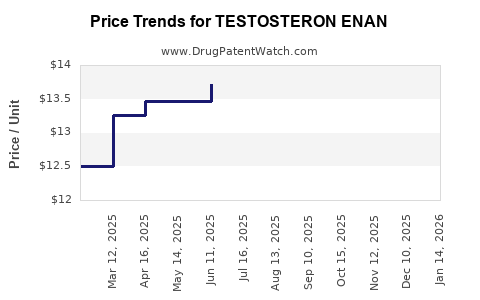
Drug Price Trends for TESTOSTERON ENAN


✉ Email this page to a colleague

« Back to Dashboard


Drug Price Trends for TESTOSTERON ENAN

Average Pharmacy Cost for TESTOSTERON ENAN

These are average pharmacy acquisition costs (net of discounts) from a US national survey
Drug Name NDC Price/Unit ($) Unit Date
TESTOSTERON ENAN 1,000 MG/5 ML 00143-9750-01 14.24854 ML 2025-12-17
TESTOSTERON ENAN 1,000 MG/5 ML 00143-9750-01 14.13867 ML 2025-11-19
TESTOSTERON ENAN 1,000 MG/5 ML 00143-9750-01 13.94771 ML 2025-10-22
TESTOSTERON ENAN 1,000 MG/5 ML 00143-9750-01 13.87860 ML 2025-09-17
TESTOSTERON ENAN 1,000 MG/5 ML 00143-9750-01 13.85487 ML 2025-08-20
>Drug Name >NDC >Price/Unit ($) >Unit >Date

Market Analysis and Price Projections for Testosterone Enanthate

Last updated: July 28, 2025

Introduction

Testosterone Enanthate (TESTOSTERON ENAN) is a widely prescribed form of testosterone used primarily for hormone replacement therapy (HRT) in men with hypogonadism, as well as for certain reproductive disorders. Its strong market presence, long-standing clinical use, and evolving regulatory landscape position it as a notable product in the pharmaceutical and biosciences sectors. This analysis delves into the current market landscape, competitive environment, regulatory considerations, and future price projections for Testosterone Enanthate.


Market Overview

Global Market Size and Growth

The global anabolic steroids and testosterone replacement therapy (TRT) market is projected to expand steadily, driven by increasing awareness of hormonal deficiencies, aging populations, and rising prevalence of hypogonadism [1]. According to industry reports, the TRT market alone is expected to grow at a Compound Annual Growth Rate (CAGR) of approximately 7.3% from 2022 to 2028, reaching an estimated $2.5 billion in global revenue by 2028 [2].

Testosterone Enanthate constitutes a significant segment of this market, accounting for nearly 55–60% of global testosterone prescriptions, owing to its efficacy and long-acting profile. The compound’s popularity stems from its relatively infrequent injections (every 1-2 weeks) and predictable pharmacokinetics.

Regional Market Dynamics

  • North America: Leading market due to high healthcare spending, widespread awareness, and well-established regulatory frameworks. The U.S. dominates, with an estimated 65% market share within the global TRT segment [3].

  • Europe: Rapid adoption driven by aging populations and increased focus on quality of life. Regulatory pathways are well-established, but pricing pressures are intense.

  • Asia-Pacific: Fastest-growing region attributed to growing healthcare investments, rising awareness, and expanding prescription base, potentially doubling market share by 2030 [4].


Competitive Landscape

Major Players

  • Pfizer: One of the earliest and most dominant manufacturers of testosterone enanthate formulations, with extensive branding and distribution networks.

  • Novartis: Offers testosterone enanthate as part of its hormonal therapy portfolio.

  • Mylan (now part of Viatris): Produces generic testosterone enanthate, focusing on cost-sensitive markets.

  • Sandoz: Provides biosimilar versions, increasing market flexibility.

Generic and Biosimilar Impact

The patent expiry of branded testosterone enanthate products (e.g., Pfizer’s Depo-Testosterone) has catalyzed a proliferation of generic versions, significantly reducing prices and increasing market accessibility. Biosimilars are expected to further influence pricing dynamics, particularly in Europe and emerging markets.

Regulatory Environment

Regulatory agencies, including the FDA (U.S.) and EMA (Europe), require rigorous bioequivalence and safety assessments for generics and biosimilars. Pricing and reimbursement policies are closely linked to regulatory approval status, impacting market accessibility and product pricing.


Pricing Trends and Forecasts

Current Pricing Landscape

  • Branded Products: In the U.S., a 10 mL vial of Depo-Testosterone (200 mg/mL) retails at approximately $150–$200, translating to roughly $15–$20 per mL [5].

  • Generic Products: Prices have decreased substantially, with generic testosterone enanthate vials available for as low as $50–$80 per 10 mL vial, depending on supplier and formulation.

  • Biosimilar Market: Biosimilar testosterone enanthate products are priced approximately 20–30% lower than branded offerings.

Factors Influencing Future Prices

  • Patent Expiry and Generic Entry: Anticipated patent cliffs (expected around 2025–2027) are likely to drive generic competition, aligning prices downward.

  • Regulatory Changes: Tightened regulations around hormone therapies may impact manufacturing costs and, consequently, prices.

  • Market Demand: Aging global populations and increasing acceptance of TRT will sustain demand but may be tempered by institutional payers' cost-containment efforts.

  • Manufacturing Costs: Advances in synthesis technology and scalable manufacturing processes will help decrease costs, enabling more competitive pricing.

Projected Price Trajectory

Based on current trends:

  • Short-term (2023–2025): Prices will stabilize, with modest reductions due to existing generic competition. Branded prices may maintain premiums, especially in markets with less generic penetration.

  • Mid-term (2026–2030): Substantial price reductions are anticipated, potentially by 25–40%, as biosimilar options and increased competition mature. Expected to see prices as low as $30–$50 per 10 mL vial in large-volume markets.

  • Long-term (>2030): Market saturation with biosimilars and market maturity may drive prices near production costs, with variability depending on regional regulations and reimbursement policies.


Supply Chain and Market Risks

  • Regulatory Delays: Lengthy approval processes for new formulations or biosimilars can delay price declines.

  • Market Saturation: Excess supply may lead to further downward pressure, risking profitability for some manufacturers.

  • Reimbursement Policies: Shift toward value-based care and strict reimbursement policies may influence pricing, especially in Medicare/Medicaid markets.

  • Potential for Off-Patent Manufacturing: Increased competition could lead to manufacturing oversupply, potentially affecting prices and profit margins.


Strategic Outlook

Manufacturers must navigate patent cliffs, regulatory environments, and evolving payer landscapes. Emphasis on developing cost-effective biosimilars, optimizing manufacturing efficiencies, and securing regulatory approvals will be key. For healthcare providers and payers, balancing affordability with quality of care will determine market dynamics.


Key Takeaways

  • The global testosterone therapy market is growing at a CAGR of over 7%, with Testosterone Enanthate comprising a leading segment.

  • Patent expirations and biosimilar entries are expected to significantly reduce prices, especially from 2025 onwards.

  • Current prices for testosterone enanthate vary from $50–$80 per 10 mL vial for generics, with branded formulations costing up to $200.

  • Regional disparities influence pricing, with North America leading, and Asia-Pacific exhibiting the fastest growth.

  • Strategic investments in biosimilar development and navigating regulation will be critical for market players.


Frequently Asked Questions (FAQs)

1. When is the patent for the leading branded Testosterone Enanthate product set to expire?
Most patents for pioneer products like Pfizer’s Depo-Testosterone are expected to expire between 2025 and 2027, opening the market to generics and biosimilars.

2. How will biosimilars impact the pricing of Testosterone Enanthate?
Biosimilars are projected to reduce prices by 20–30%, increase market competition, and improve access, especially in regions with active biosimilar regulatory pathways.

3. What are the primary drivers for increased demand in testosterone therapy?
An aging global population, increased awareness of hypogonadism, and expanding guidelines for TRT contribute to rising demand.

4. How do regulatory differences across regions influence Testosterone Enanthate pricing?
Stringent approval processes and reimbursement policies, particularly in Europe and North America, can sustain higher prices, whereas emerging markets may see lower prices due to less regulation.

5. What strategies should manufacturers adopt to stay competitive?
Investing in biosimilar development, optimizing manufacturing to reduce costs, and engaging with regulatory authorities early are crucial, alongside dynamic pricing strategies aligned with patent and market conditions.


References

  1. [1] MarketWatch. "Global Testosterone Market Size and Forecast." 2022.
  2. [2] Grand View Research. "Testosterone Replacement Therapy Market Size, Share & Trends." 2023.
  3. [3] IQVIA. "U.S. Testosterone Prescriptions Data." 2022.
  4. [4] Frost & Sullivan. "Asia-Pacific Hormonal Therapy Market Outlook." 2022.
  5. [5] GoodRx. "Testosterone Enanthate Price Comparison." 2023.

More… ↓

⤷  Get Started Free

Make Better Decisions: Try a trial or see plans & pricing

Drugs may be covered by multiple patents or regulatory protections. All trademarks and applicant names are the property of their respective owners or licensors. Although great care is taken in the proper and correct provision of this service, thinkBiotech LLC does not accept any responsibility for possible consequences of errors or omissions in the provided data. The data presented herein is for information purposes only. There is no warranty that the data contained herein is error free. We do not provide individual investment advice. This service is not registered with any financial regulatory agency. The information we publish is educational only and based on our opinions plus our models. By using DrugPatentWatch you acknowledge that we do not provide personalized recommendations or advice. thinkBiotech performs no independent verification of facts as provided by public sources nor are attempts made to provide legal or investing advice. Any reliance on data provided herein is done solely at the discretion of the user. Users of this service are advised to seek professional advice and independent confirmation before considering acting on any of the provided information. thinkBiotech LLC reserves the right to amend, extend or withdraw any part or all of the offered service without notice.