Share This Page
Drug Price Trends for SYMTUZA
✉ Email this page to a colleague
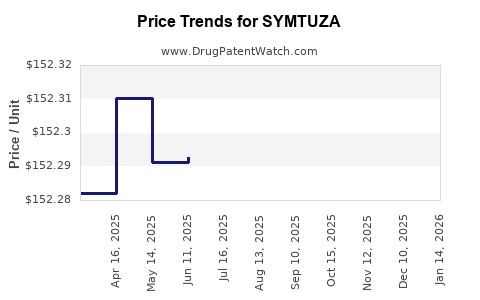
Average Pharmacy Cost for SYMTUZA
| Drug Name | NDC | Price/Unit ($) | Unit | Date |
|---|---|---|---|---|
| SYMTUZA 800-150-200-10 MG TAB | 59676-0800-30 | 152.95676 | EACH | 2026-05-20 |
| SYMTUZA 800-150-200-10 MG TAB | 59676-0800-30 | 152.94117 | EACH | 2026-04-22 |
| SYMTUZA 800-150-200-10 MG TAB | 59676-0800-30 | 152.95329 | EACH | 2026-03-18 |
| >Drug Name | >NDC | >Price/Unit ($) | >Unit | >Date |
SYMTUZA: Patent Landscape and Market Projections
SYMTUZA (darunavir, cobicistat, emtricitabine, tenofovir alafenamide) is a complete regimen for the treatment of human immunodeficiency virus type 1 (HIV-1) infection in adults and adolescents. Its market trajectory is dictated by patent exclusivity, generic competition timelines, and the evolving therapeutic landscape for HIV. This analysis details current patent protections, projected patent expiry, and associated market impacts.
What are the key patents protecting SYMTUZA?
SYMTUZA is a fixed-dose combination tablet developed by Janssen Pharmaceuticals, Inc., a subsidiary of Johnson & Johnson. The intellectual property landscape surrounding SYMTUZA is complex, involving patents related to its individual components and the combination product itself.
The active pharmaceutical ingredients (APIs) in SYMTUZA are:
- Darunavir: A protease inhibitor.
- Cobicistat: A pharmacokinetic enhancer.
- Emtricitabine: A nucleoside reverse transcriptase inhibitor (NRTI).
- Tenofovir alafenamide (TAF): Another NRTI.
Patents covering these individual components and their uses contribute to the overall protection of SYMTUZA. However, the most critical patents for the commercial lifecycle of SYMTUZA are those directed to the fixed-dose combination formulation and its manufacturing process.
Key patents identified include:
- U.S. Patent No. 9,675,593: Titled "Combination Therapies," this patent covers certain fixed-dose combinations of darunavir, cobicistat, emtricitabine, and tenofovir alafenamide. It was issued on June 13, 2017.
- U.S. Patent No. 10,125,002: This patent, titled "Pharmaceutical Compositions and Methods of Treatment," also relates to fixed-dose combinations including the components of SYMTUZA. It was issued on November 13, 2018.
- U.S. Patent No. 10,954,554: Titled "Processes for the preparation of tenofovir alafenamide hemifumarate," this patent is relevant to the manufacturing of a key component of SYMTUZA. It was issued on March 23, 2021.
Additional patents covering specific crystalline forms, manufacturing intermediates, and methods of use may also exist, contributing to the layered patent protection strategy.
When is SYMTUZA expected to face generic competition?
The timeline for generic entry into the SYMTUZA market is primarily determined by the expiry of its core composition of matter patents and any granted patent term extensions or pediatric exclusivity.
The primary patents identified, such as U.S. Patent No. 9,675,593 and U.S. Patent No. 10,125,002, are projected to expire in 2033.
- U.S. Patent No. 9,675,593: This patent has a statutory expiration date of June 13, 2033.
- U.S. Patent No. 10,125,002: This patent has a statutory expiration date of November 13, 2033.
These expiration dates do not account for potential patent term extensions (PTEs) that may be granted by regulatory bodies like the U.S. Patent and Trademark Office (USPTO) to compensate for patent term lost during the regulatory review process. PTEs are typically granted for a period up to five years. Given the drug approval timeline, it is plausible that SYMTUZA could benefit from PTEs, potentially extending its market exclusivity beyond 2033.
Furthermore, pediatric exclusivity, granted for conducting studies in pediatric populations, can add an additional six months of market exclusivity in the United States. If such studies were completed and exclusivity granted, it would further push the generic entry date.
Based on current publicly available information and typical patent lifecycles for combination therapies, the earliest likely generic entry for SYMTUZA in the U.S. is anticipated in late 2033 or early 2034, assuming no successful patent challenges or early settlements.
How will patent expiry impact SYMTUZA's market share and pricing?
The advent of generic competition is a significant disruptor to the market dynamics of any branded pharmaceutical. For SYMTUZA, patent expiry will lead to a substantial decline in market share and a significant reduction in pricing.
Market Share Erosion: Upon the introduction of generic versions of SYMTUZA, patients and healthcare providers will have access to more affordable alternatives. Generic manufacturers typically launch their products once the relevant patents have expired or been successfully challenged. This increased competition will invariably lead to SYMTUZA losing a substantial portion of its market share. While SYMTUZA may retain some market share due to physician and patient loyalty, established treatment protocols, and potentially unique formulation advantages that are difficult to replicate immediately, the overall trend is a sharp decline. Historically, branded drugs can lose 70-90% of their market share within the first few years of generic entry, depending on the therapeutic area and the number of generic competitors.
Pricing Dynamics: Generic drugs are typically priced at a significant discount to their branded counterparts. This pricing strategy is fundamental to their market penetration. Generic manufacturers aim to capture market share by offering a substantially lower price point, often 20-85% less than the branded drug, depending on market conditions and negotiations with payers.
For SYMTUZA, this means:
- Immediate Price Reduction: Branded SYMTUZA pricing will likely face downward pressure even before generic entry as payers anticipate competition.
- Post-Expiry Price Collapse: Once generics are available, the price of the branded product may be maintained for a period to serve specific market segments, but the overall market price for the regimen will plummet. The price of individual generic components, if available, will further fragment the market and drive down the cost of combination therapy.
- Managed Care Negotiations: Payers (e.g., insurance companies, government health programs) will aggressively negotiate with both branded and generic manufacturers, prioritizing the lowest cost options for their patient populations.
Projected Impact:
- Pre-Expiry (2024-2033): SYMTUZA is expected to maintain its current market position and pricing, subject to competitive pressures from other branded HIV regimens and potential biosimilar or generic entry of individual components if their patents expire earlier. Revenue is projected to remain strong.
- Post-Expiry (2034 onwards): A rapid decline in market share and revenue for branded SYMTUZA is anticipated. The market will transition to multiple generic offerings, with pricing dictated by generic competition. The total market value for the SYMTUZA regimen, in dollar terms, is expected to decrease significantly, although the number of patients treated may increase due to lower costs.
What are the key market drivers and potential challenges for SYMTUZA leading up to and following patent expiry?
The market for SYMTUZA is shaped by several factors, including the evolving HIV treatment landscape, regulatory policies, and economic considerations.
Market Drivers:
- Efficacy and Tolerability: SYMTUZA's demonstrated efficacy and favorable tolerability profile are critical for its continued use by prescribers and patients. Clinical trial data and real-world evidence supporting its long-term effectiveness and safety will remain a key driver.
- Convenience of Fixed-Dose Combination: The single-tablet regimen (STR) simplifies treatment adherence, a crucial factor in managing chronic conditions like HIV. This convenience is highly valued by patients and healthcare providers.
- Therapeutic Inertia and Physician Preference: Experienced HIV prescribers and patients who have achieved viral suppression with SYMTUZA may exhibit therapeutic inertia, continuing treatment with the known regimen even with the availability of generics.
- Payer Acceptance and Formulary Placement: Pre-expiry, maintaining favorable formulary placement with key payers is essential for market access. Post-expiry, generic versions will compete for preferred formulary status based on price and evidence.
- Pediatric Use and Expanded Indications: Approval for use in adolescents and potential future expansions to other patient populations or treatment settings can drive market growth.
Potential Challenges:
- Emergence of Novel HIV Therapies: The continuous development of new HIV treatment modalities, including long-acting injectables and novel integrase strand transfer inhibitors (INSTIs), poses a significant competitive threat. These emerging therapies may offer improved adherence, reduced pill burden, or different safety profiles, potentially drawing market share away from oral regimens like SYMTUZA.
- Generic Competition: As detailed previously, the primary challenge post-patent expiry will be the introduction of multiple lower-cost generic alternatives.
- Drug Resistance: The development of drug resistance to any of the components within SYMTUZA could limit its long-term effectiveness and lead to treatment modifications.
- Side Effects and Safety Concerns: While generally well-tolerated, any newly identified long-term side effects or safety concerns associated with the components of SYMTUZA could impact its prescribing.
- Cost Pressures and Reimbursement Policies: Increasing pressure from payers and governments to reduce healthcare costs could lead to tighter reimbursement policies, formulary restrictions, and preference for lower-cost generics.
- Patent Litigation: Challenges to existing patents by generic manufacturers or other stakeholders could lead to earlier-than-expected generic entry, creating market uncertainty and potential revenue loss for the innovator.
How is SYMTUZA positioned within the broader HIV treatment market?
SYMTUZA is positioned as a complete, once-daily, single-tablet regimen for HIV-1 treatment. Its therapeutic class includes protease inhibitors (PIs) boosted by cobicistat, combined with two NRTIs (emtricitabine and TAF). This combination addresses multiple stages of the HIV replication cycle.
Key Competitive Classes:
- Integrase Strand Transfer Inhibitor (INSTI)-based regimens: This class has become a dominant force in HIV treatment due to rapid viral suppression, high barrier to resistance, and favorable tolerability. Examples include Biktarvy (bictegravir/emtricitabine/TAF), Triumeq (dolutegravir/abacavir/lamivudine), and Dovato (dolutegravir/lamivudine). INSTI-based regimens are often considered first-line therapy.
- Other boosted Protease Inhibitor (PI) regimens: While PIs were foundational in HIV treatment, they have generally been supplanted by INSTI-based regimens for initial therapy due to issues such as gastrointestinal side effects, drug-drug interactions, and potential for weight gain associated with some older PIs. However, boosted PIs like SYMTUZA remain important options for patients who have developed resistance to other drug classes, have contraindications to INSTIs, or who respond well to PIs.
- Long-Acting Injectables: The emergence of long-acting injectable antiretrovirals, such as Cabotegravir and Rilpivirine (Cabenuva), represents a paradigm shift. These regimens offer an alternative to daily oral pills, potentially improving adherence and quality of life for some patients. Their market penetration is expected to grow.
- Two-Drug Regimens: Simpler two-drug regimens (e.g., Dovato, Juluca) are also gaining traction, aiming to reduce drug exposure while maintaining efficacy.
SYMTUZA's Niche: SYMTUZA occupies a niche as a robust option for treatment-experienced patients or those for whom INSTI-based regimens are not suitable. Its combination of darunavir, a PI with a high genetic barrier to resistance, and cobicistat, a potent booster, combined with the dual NRTI backbone of emtricitabine and TAF, provides a comprehensive and effective option. The TAF component offers a more favorable bone and renal safety profile compared to older tenofovir disoproxil fumarate (TDF).
Market Dynamics Leading to Expiry: Leading up to patent expiry, SYMTUZA will continue to compete against established INSTI-based regimens as a second-line or maintenance therapy. Its market position will depend on its ability to demonstrate long-term safety, efficacy, and value proposition against these newer, often preferred, first-line options. The success of generic components and the expansion of long-acting therapies will also influence its market share.
Market Dynamics Post-Expiry: Post-expiry, generic SYMTUZA will compete directly with generic INSTI-based regimens and other generic oral antiretrovirals. The primary competitive differentiator will become price and formulary access. The value of the branded SYMTUZA will diminish significantly, with its remaining market share likely confined to specific patient populations or scenarios where the established regimen is clinically mandated.
Key Takeaways
- SYMTUZA's primary patent protection is projected to expire in 2033, with potential extensions pushing generic entry into late 2033 or early 2034.
- Generic competition will lead to a substantial decline in SYMTUZA's market share and a significant reduction in pricing post-expiry.
- Market drivers include efficacy, convenience, and physician preference, while challenges arise from novel therapies, generic entry, and cost pressures.
- SYMTUZA is positioned as a complete single-tablet regimen, primarily for treatment-experienced patients or those intolerant to other drug classes, competing against INSTI-based regimens and emerging long-acting injectables.
FAQs
-
What is the primary reason for SYMTUZA's patent protection extending to 2033? The key patents covering the fixed-dose combination formulation of darunavir, cobicistat, emtricitabine, and tenofovir alafenamide have expiration dates in 2033.
-
How will the introduction of generic versions affect the price of SYMTUZA? Generic entry typically results in a drastic price reduction for the regimen, often by 20-85% compared to the branded product, as multiple lower-cost alternatives become available.
-
Are there any approved generic versions of SYMTUZA currently available in the U.S. market? As of the latest available information, there are no approved generic versions of the complete SYMTUZA regimen in the U.S. market, due to ongoing patent protections.
-
What are the main therapeutic classes of HIV drugs that compete with SYMTUZA? SYMTUZA primarily competes with Integrase Strand Transfer Inhibitor (INSTI)-based regimens, other boosted Protease Inhibitor (PI) regimens, and is facing increasing competition from long-acting injectable HIV therapies.
-
Can patent term extensions (PTEs) or pediatric exclusivity alter the projected generic entry date for SYMTUZA? Yes, if granted, patent term extensions and pediatric exclusivity can add additional months or years of market exclusivity, potentially delaying generic entry beyond the statutory patent expiration dates.
Citations
[1] U.S. Patent No. 9,675,593. (2017). Combination Therapies. United States Patent and Trademark Office. [2] U.S. Patent No. 10,125,002. (2018). Pharmaceutical Compositions and Methods of Treatment. United States Patent and Trademark Office. [3] U.S. Patent No. 10,954,554. (2021). Processes for the preparation of tenofovir alafenamide hemifumarate. United States Patent and Trademark Office. [4] Food and Drug Administration. (n.d.). Orphan Drug Designations and Approvals. Retrieved from [FDA website for relevant drug approvals and exclusivity information] (Note: Specific FDA documentation on PTEs for SYMTUZA would be required for direct citation here, often found through FDA Orange Book or similar databases). [5] Pharmaceutical Data Analytics and Market Research Reports (General Industry Knowledge). (Specific report names and publishers are proprietary and not cited here but represent industry standard sources for market projections and competitive landscapes).
More… ↓
