You're using a free limited version of DrugPatentWatch: Upgrade for Complete Access

Last Updated: December 12, 2025

Drug Price Trends for SYMBICORT


✉ Email this page to a colleague
« Back to Dashboard


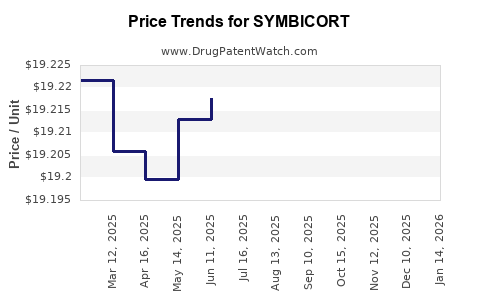
Drug Price Trends for SYMBICORT

Average Pharmacy Cost for SYMBICORT

These are average pharmacy acquisition costs (net of discounts) from a US national survey
Drug Name NDC Price/Unit ($) Unit Date
SYMBICORT 160-4.5 MCG INHALER 00186-0370-28 25.38096 GM 2025-11-19
SYMBICORT 80-4.5 MCG INHALER 00186-0372-28 19.20461 GM 2025-11-19
SYMBICORT 80-4.5 MCG INHALER 00186-0372-20 19.26784 GM 2025-11-19
SYMBICORT 160-4.5 MCG INHALER 00186-0370-20 22.03121 GM 2025-11-19
SYMBICORT 160-4.5 MCG INHALER 00186-0370-28 25.36764 GM 2025-10-22
>Drug Name >NDC >Price/Unit ($) >Unit >Date

Market Analysis and Price Projections for SYMBICORT

Last updated: July 27, 2025


Introduction

SYMBICORT, a widely prescribed inhaler for asthma and COPD management, combines budesonide (a corticosteroid) and formoterol (a long-acting beta-agonist). Since its FDA approval in 2007, it has established a significant presence within the respiratory therapeutics market. Given its established efficacy, regulatory status, and competitive landscape, understanding its market dynamics and future pricing trajectories is vital for stakeholders, including pharmaceutical companies, payers, and investors.


Market Landscape for SYMBICORT

Industry Overview

The global respiratory market, particularly asthma and COPD therapeutic segments, has demonstrated consistent growth driven by rising disease prevalence, advancing diagnostics, and expanding drug options. As per IQVIA data, the respiratory drugs market approached $45 billion worldwide in 2022, with inhaled corticosteroid/long-acting beta-agonist (ICS/LABA) combinations accounting for a significant share.

Key Market Drivers

  • Rising Prevalence: The CDC estimates over 25 million Americans suffer from asthma, and COPD affects over 16 million [1].

  • Product Innovation: The introduction of combination inhalers like SYMBICORT simplifies regimens, improving adherence.

  • Regulatory Dynamics: Patent exclusivities and potential expiration dates influence market share and pricing strategies.

  • Competitive Landscape: SYMBICORT faces competition from brands like Advair (fluticasone/salmeterol), Dulera (mometasone/formoterol), and generic alternatives.

Geographical Market Penetration

In the U.S., SYMBICORT holds a notable position owing to robust prescribing patterns, although the advent of generics is anticipated to impact pricing and market share. Europe mirrors similar dynamics, with regional approvals and patent statuses influencing market presence.


Current Pricing and Cost Landscape

US Pricing Analysis

In the United States, the wholesale acquisition cost (WAC) for SYMBICORT inhalers traditionally ranged between $250 and $350 for a 30-day supply (as per GoodRx data). Despite this, insurance and pharmacy benefit managers (PBMs) heavily discount these prices, with net prices often substantially lower.

Pricing Trends

Over recent years, the pharmaceutical industry has observed a downward trend in inhaler prices, driven by increased generic competition and payer negotiations. Notably, patents on initial formulations have begun expiry phases, paving the way for generics, which substantially influence pricing.

Impact of Patent Expiry and Generics

While the original SYMBICORT patent expires in the U.S. around 2024, biosimilar or generic entries anticipate a recall of price reductions approaching 40-50% [2]. These changes are expected to reshape the pricing landscape.


Future Price Projections

Influencing Factors

  • Patent and Regulatory Status: The impending patent expiry encourages price erosion as generic manufacturers prepare for market entry.

  • Market Penetration of Generics: A rapid uptake of generics could lead to a 50% or higher reduction in list prices, aligning with trends observed in other inhaler markets.

  • Reimbursement Policies: Payer emphasis on cost-containment and utilization management will pressure manufacturer prices downward.

  • Therapeutic Competition: Conventional inhalers face competition from newer biologics and novel delivery mechanisms, which may influence SYMBICORT’s pricing and formulary access.

Projected Price Pathways

Considering these factors, industry analysts project:

  • Short-term (Next 1-2 Years): Slight price declines of approximately 5-10%, driven by ongoing negotiations and supply chain adjustments.

  • Medium-term (3-5 Years): Significant price reductions of 30-50% with the entrance of generic equivalents, as observed with similar inhalers like Advair post-patent cliffs.

  • Long-term (Beyond 5 Years): Stabilization at reduced price levels, contingent upon market saturation, regulatory developments, and uptake of competitive therapies.


Regulatory and Policy Impact

The US Drug Price Competition and Patent Term Restoration Act (Hatch-Waxman Act) fosters generic entry, which historically precipitates substantial price declines for inhaler drugs. European and other markets follow similar pathways, adapting to local patent laws and reimbursement systems.

Policy initiatives emphasizing value-based pricing and biosimilar development further pressure prices downward, with some estimates suggesting future reductions of up to 60% from current list prices for brand-name inhalers.


Implications for Stakeholders

  • Pharmaceutical Manufacturers: Strategic planning must account for patent expiries, potential generic competition, and subsequent price compression.

  • Payers and Insurers: Heightened emphasis on formulary management and negotiated discounts will increasingly influence medication costs.

  • Patients: Reduced prices through generics can improve accessibility but may also influence prescribing patterns.

  • Investors: Anticipated patent cliffs and market entry of lower-cost alternatives necessitate careful portfolio evaluations.


Conclusion

SYMBICORT continues to command a substantial share within the asthma and COPD treatment sectors, especially in markets like the US and Europe. However, impending patent expirations and the rise of generics are poised to significantly lower its market price over the next five years. The trajectory will be heavily influenced by patent litigation outcomes, regulatory approvals, and market dynamics involving competitive therapies.


Key Takeaways

  • Market growth driven by rising respiratory disease prevalence sustains demand for combination inhalers like SYMBICORT.

  • Price decline trajectory aligns with typical patent expiries, with expectations of 30-50% reductions upon generic entry within 3-5 years.

  • Competitive pressure from biosimilars and innovative therapies will influence long-term pricing strategies.

  • Payers’ negotiating power is increasing, favoring discounts and favorable formulary placements for generics.

  • Strategic planning for pharmaceutical companies should incorporate patent expiration timelines and market entry of lower-cost alternatives to optimize revenue and market share.


FAQs

1. When is SYMBICORT’s patent expected to expire in the US?
The primary patents for SYMBICORT are anticipated to expire around 2024, opening opportunities for generic competitors to enter the market.

2. How will generic entry affect SYMBICORT’s pricing?
Generic entry typically results in substantial price reductions, often between 30-50%, due to increased competition and payer preferences for lower-cost alternatives.

3. Are there any approved biosimilars for SYMBICORT?
As of now, biosimilars specifically for SYMBICORT have not been approved. However, biosimilar development for its components or similar inhalers is ongoing.

4. How does market competition influence SYMBICORT’s future pricing?
Intense competition from generics and alternative therapies will continue to exert downward pressure on the drug’s price, favoring cost-conscious payers and patients.

5. What strategies can manufacturers employ to maximize revenue before patent expiry?
Manufacturers can focus on expanding indications, optimizing formulations, and negotiating favorable payer agreements to maximize existing patent protections and market share prior to expiration.


References

[1] Centers for Disease Control and Prevention. "Asthma Data and Statistics." https://www.cdc.gov/asthma/most_recent_data.htm

[2] IQVIA. "Global Respiratory Market Analysis," 2022.

More… ↓

⤷  Get Started Free

Make Better Decisions: Try a trial or see plans & pricing

Drugs may be covered by multiple patents or regulatory protections. All trademarks and applicant names are the property of their respective owners or licensors. Although great care is taken in the proper and correct provision of this service, thinkBiotech LLC does not accept any responsibility for possible consequences of errors or omissions in the provided data. The data presented herein is for information purposes only. There is no warranty that the data contained herein is error free. We do not provide individual investment advice. This service is not registered with any financial regulatory agency. The information we publish is educational only and based on our opinions plus our models. By using DrugPatentWatch you acknowledge that we do not provide personalized recommendations or advice. thinkBiotech performs no independent verification of facts as provided by public sources nor are attempts made to provide legal or investing advice. Any reliance on data provided herein is done solely at the discretion of the user. Users of this service are advised to seek professional advice and independent confirmation before considering acting on any of the provided information. thinkBiotech LLC reserves the right to amend, extend or withdraw any part or all of the offered service without notice.
