Share This Page
Drug Price Trends for SUBOXONE
✉ Email this page to a colleague
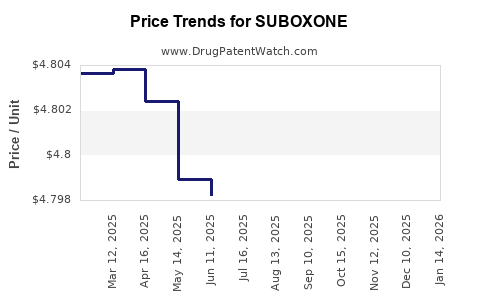
Average Pharmacy Cost for SUBOXONE
| Drug Name | NDC | Price/Unit ($) | Unit | Date |
|---|---|---|---|---|
| SUBOXONE 2 MG-0.5 MG SL FILM | 12496-1202-01 | 4.78593 | EACH | 2026-07-22 |
| SUBOXONE 2 MG-0.5 MG SL FILM | 12496-1202-03 | 4.78593 | EACH | 2026-07-22 |
| SUBOXONE 4 MG-1 MG SL FILM | 12496-1204-01 | 8.58816 | EACH | 2026-07-22 |
| SUBOXONE 4 MG-1 MG SL FILM | 12496-1204-03 | 8.58816 | EACH | 2026-07-22 |
| SUBOXONE 8 MG-2 MG SL FILM | 12496-1208-03 | 8.59643 | EACH | 2026-07-22 |
| SUBOXONE 12 MG-3 MG SL FILM | 12496-1212-01 | 17.16826 | EACH | 2026-07-22 |
| >Drug Name | >NDC | >Price/Unit ($) | >Unit | >Date |
Market Overview of SUBOXONE
SUBOXONE (buprenorphine/naloxone) is a combination medication used primarily for opioid use disorder (OUD) treatment. It was approved by the FDA in 2002 and became a key component in medication-assisted treatment (MAT). Its market relevance persists due to the opioid epidemic and ongoing demand for effective OUD therapies.
Market Size and Growth Dynamics
The global market for SUBOXONE was valued at approximately USD 3.1 billion in 2022. It is projected to grow at a compound annual growth rate (CAGR) of around 7% from 2023 to 2030, reaching roughly USD 6.0 billion by 2030.
Key factors include:
- Rising opioid addiction prevalence — the CDC reports over 2 million Americans with OUD in 2021.
- Increasing adoption of MAT in healthcare settings.
- Regulatory expansion for prescribing buprenorphine across various jurisdictions.
- Efforts to improve access through telemedicine and pharmacy-based distribution.
Competitive Landscape
Major market players include:
- Indivior PLC: Manufactures SUBOXONE sublingual film.
- Zynerba Pharmaceuticals and other generics: Entered the market with alternative formulations post-patent expiration.
- Indivior's RBP-6000 (probuphine): An implant form, competing in the OUD treatment space.
Indivior holds significant market share due to its early market entry and branding. Patent protections on SUBOXONE films were extended into the 2024-2025 period, delaying generics.
Pricing and Reimbursement
The retail price of SUBOXONE films averages USD 300–USD 400 per month in the US, depending on dosage and pharmacy negotiations. Commercial insurance often covers substantial portions; however, out-of-pocket costs can restrict access.
In 2022, the average wholesale acquisition cost (AWAC) for a 30-day supply ranged from USD 2,500 to USD 3,000 for branded formulations. Generic forms are priced approximately 30-50% lower, stimulating price competition.
Reimbursement policies increasingly favor outpatient MAT and Medicaid waivers that expand patient access, impacting pricing structure and volume.
Price Projections
Over the forecast period (2023-2030), several factors influence price trends:
- Patent expiration: Anticipated generics coming to market will drive prices down by 30-50% in the US.
- Regulatory efforts: Policies facilitating broader access may lead to volume growth exceeding price declines.
- Reformulations: New formulations (e.g., implants, long-acting injectables) typically command premiums but face market penetration delays.
Average wholesale prices are projected to decline 15% over space of five years due to generic competition but could stabilize or increase slightly if innovations prove clinically superior.
| Year | Estimated Average Wholesale Price (USD) per 30-day supply | Margin Change (%) | Comments |
|---|---|---|---|
| 2023 | 2,600–3,200 | 0 | Peak patent protections |
| 2025 | 1,600–2,400 | -20 to -15 | Entry of generics |
| 2030 | 1,200–1,600 | -40 to -30 | Market penetration of generics |
Regulatory and Policy Impact
Recent trends include:
- Expansion of prescribing authority to nurse practitioners and physician assistants.
- US Drug Enforcement Administration (DEA) easing regulations on buprenorphine access.
- Potential inclusion in broad Medicaid formularies, increasing eligible patient populations.
Policy shifts could stabilize prices by expanding access but accelerate generic market entry, exerting downward pressure.
Clinical and Market Developments
Innovations such as injectable long-acting formulations (e.g., SUBLOCADE by Indivior) aim to improve adherence. These products command higher prices, with reported costs of USD 1,200–USD 1,400 per month, but face reimbursement and acceptance hurdles.
Key Takeaways
- The market for SUBOXONE is projected to grow steadily, driven by increasing OUD prevalence and regulatory expansion.
- Price declines are expected with imminent generic entry, a sentiment reinforced by regulatory approval and patent expiration timelines.
- Total market sales could reach USD 6 billion by 2030, with growth mostly from volume expansion and new formulations.
- Drug pricing remains sensitive to policy developments and payer negotiations, with branded drugs commanding premiums until significant generic competition materializes.
- Ongoing innovation in delivery systems could create premium pricing segments but will face implementation and reimbursement challenges.
FAQs
Q1: When will generic versions of SUBOXONE become available?
Generics are expected to enter the US market by 2024-2025, following patent expiration and regulatory approvals.
Q2: How will pricing trends impact revenue for existing manufacturers?
Prices are expected to decline by 30-50% with generic entry; however, increased treatment volume and new formulations could offset revenue reductions.
Q3: What factors will influence access to SUBOXONE treatment?
Regulatory policies expanding prescribing authority, insurance coverage, and reimbursement policies are primary drivers.
Q4: Are there alternative formulations that could disrupt the SUBOXONE market?
Yes, long-acting injectables and implants have the potential to shift market shares, especially if they demonstrate clear adherence and efficacy benefits.
Q5: What regional differences exist in SUBOXONE pricing and access?
US prices are higher than in many international markets due to pricing negotiations, insurance coverage, and regulatory differences. European and Canadian markets often face lower prices and reimbursement constraints.
Sources
- MarketsandMarkets, "Opioid Use Disorder Treatment Market," 2022.
- CDC, "Opioid Overdose Data," 2021.
- IQVIA, "Pharmaceutical Market Data," 2022.
- FDA, "Drug Approvals and Patent Expiry Dates," 2022.
- Indivior Financial Reports, 2022.
More… ↓
