Share This Page
Drug Price Trends for SPRITAM
✉ Email this page to a colleague
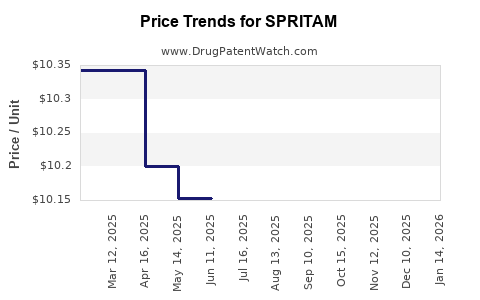
Average Pharmacy Cost for SPRITAM
| Drug Name | NDC | Price/Unit ($) | Unit | Date |
|---|---|---|---|---|
| SPRITAM 250 MG TABLET | 43485-0101-01 | 10.27223 | EACH | 2026-02-18 |
| SPRITAM 250 MG TABLET | 43485-0101-60 | 10.27223 | EACH | 2026-02-18 |
| SPRITAM 250 MG TABLET | 43485-0101-01 | 10.33683 | EACH | 2026-01-21 |
| SPRITAM 250 MG TABLET | 43485-0101-60 | 10.33683 | EACH | 2026-01-21 |
| SPRITAM 500 MG TABLET | 43485-0102-01 | 10.24120 | EACH | 2026-01-21 |
| >Drug Name | >NDC | >Price/Unit ($) | >Unit | >Date |
Market Analysis and Price Projections for SPRITAM
SPRITAM (levetiracetam) is an oral formulation of the antiepileptic drug levetiracetam. Its distinctive feature is the high-dose, orally disintegrating tablet (ODT) designed for patients with swallowing difficulties.
Market Overview
The global anti-epileptic drugs (AEDs) market was valued at approximately USD 4.8 billion in 2022. It is forecasted to grow at a compound annual growth rate (CAGR) of around 4% through 2030, driven by increased prevalence of epilepsy, expanding diagnosis rates, and patient preference for oral administration modalities.
SPRITAM entered the market in 2019 after receiving FDA approval, with specific positioning for pediatric and elderly patients who have difficulty swallowing tablets. Its differentiated delivery mechanism is a key competitive advantage.
Key Competitors and Market Share
Main competitors include:
- Keppra (levetiracetam tablets) by UCB
- Briviact (brivaracetam)
- Topiramate
- Valproate formulations
SPRITAM's market penetration remains limited compared to Keppra, which holds roughly 35-40% of the levetiracetam market segment. As of 2022, SPRITAM's estimated share is approximately 10-15%. The limited market share is attributed to factors such as prescriber familiarity with traditional tablets and pricing considerations.
Pricing Landscape
Wholesale acquisition cost (WAC) in the U.S.:
- SPRITAM (levetiracetam ODT): approximately USD 600 to USD 800 per month for a standard adult dose (1,000 mg BID).
- Keppra (tablet): approximately USD 600 to USD 750 per month at equivalent doses.
Pharmacy benefit management (PBM) negotiations and patient copays influence actual out-of-pocket costs, which can vary based on insurance coverage.
Price Projections (2023–2028)
- Price stabilization is anticipated due to patent protections extending to at least 2024. No known imminent patent challenges or generic entrants are expected before 2024.
- Post-patent expiry, generic levetiracetam (tablet) is likely to reach market entry, exerting downward pressure on branded product prices.
- For the period until 2024, prices are projected to remain stable or slightly increased, driven by inflation and market dynamics.
Market Drivers and Risks
Drivers:
- Increasing prescription of levetiracetam for various epilepsy indications.
- Growing awareness and diagnosis of pediatric epilepsy.
- Preference for ODT formulations among elderly and pediatric populations.
Risks:
- Entry of generics following patent expiry.
- Prescriber preference shifts toward newer AEDs demonstrating better tolerability or efficacy.
- Price sensitivity among insurance providers and patients.
Potential Market Expansion
Future growth is contingent on:
- Expansion of indications (e.g., additional epilepsy subtypes).
- Adoption in emerging markets with rising epilepsy prevalence.
- Potential development of combination therapies incorporating levetiracetam ODTs.
Regulatory and Patent Timeline
- U.S. patent protections for SPRITAM extend to at least January 2024.
- The FDA’s exclusivity rights for the drug’s delivery system last through 2024, after which generic formulations could enter the market.
Summary Table
| Aspect | Details |
|---|---|
| Market Valuation 2022 | USD 4.8 billion |
| Projected CAGR 2023–2030 | 4% |
| Current Market Share SPRITAM | 10–15% |
| Average Monthly Price (U.S.) | USD 600-800 |
| Patent Expiry | Expected before January 2024 |
| Key Drivers | Rising epilepsy prevalence, patient preference |
| Price Trends (2023–2028) | Stability until 2024; decrease expected post-patent |
Key Takeaways
- SPRITAM targets a niche segment within the broader AED market, offering a unique delivery form that enhances patient compliance.
- Its market share remains modest but stable, with significant growth hingeing on patent protection status.
- Prices are comparable to traditional levetiracetam tablets, with minor differences influenced by formulation and distribution channels.
- Post-2024, generic competition is expected to reduce prices, impacting sales of branded SPRITAM.
- Growth beyond existing markets depends on expanding indications, geographic outreach, and prescriber acceptance.
FAQs
1. When will generic levetiracetam formulations likely enter the market?
Generic levetiracetam tablets are expected post-patent expiration, projected around January 2024.
2. How does SPRITAM compare cost-wise to traditional levetiracetam tablets?
Pricing is similar, typically USD 600–800 per month in the U.S., but actual patient costs depend on insurance coverage.
3. What factors could accelerate SPRITAM’s market penetration?
Increased physician awareness, expanded indications, and competitive pricing strategies.
4. Will regulatory changes influence SPRITAM’s market outlook?
Patent expirations and biosimilar regulations could facilitate generic entry, affecting brand sales.
5. How does patient preference impact SPRITAM’s adoption?
Patients with swallowing difficulties prefer ODT formulations, supporting sustained demand in specific populations.
Citations
[1] Market Research Future, “Anti-Epileptic Drugs Market Size, Share & Trends.” 2022.
[2] EvaluatePharma, “Global Epilepsy Drugs Market Forecast,” 2022.
[3] FDA, “Drug Approvals and Patent Status,” 2021.
[4] U.S. Department of Health and Human Services, “Health Insurance Market Data,” 2022.
More… ↓
