Share This Page
Drug Price Trends for SOOLANTRA
✉ Email this page to a colleague
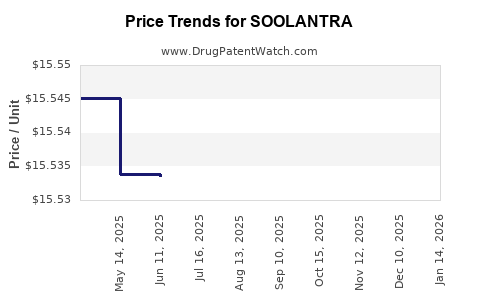
Average Pharmacy Cost for SOOLANTRA
| Drug Name | NDC | Price/Unit ($) | Unit | Date |
|---|---|---|---|---|
| SOOLANTRA 1% CREAM | 00299-3823-45 | 15.51573 | GM | 2026-07-22 |
| SOOLANTRA 1% CREAM | 00299-3823-45 | 15.51728 | GM | 2026-06-17 |
| SOOLANTRA 1% CREAM | 00299-3823-45 | 15.51956 | GM | 2026-05-20 |
| SOOLANTRA 1% CREAM | 00299-3823-45 | 15.51058 | GM | 2026-04-22 |
| SOOLANTRA 1% CREAM | 00299-3823-45 | 15.51095 | GM | 2026-03-18 |
| SOOLANTRA 1% CREAM | 00299-3823-45 | 15.51031 | GM | 2026-02-18 |
| SOOLANTRA 1% CREAM | 00299-3823-45 | 15.50952 | GM | 2026-01-21 |
| >Drug Name | >NDC | >Price/Unit ($) | >Unit | >Date |
What Is Soolantra’s Market Position and Revenue Potential?
Soolantra (ivermectin cream 1%) is a topical treatment indicated for inflammatory lesions of acne rosacea. Developed by Glenmark and later marketed by Perrigo, it gained FDA approval in 2014. Its market has expanded to include prescriptions across dermatology, thanks to its efficacy and favorable safety profile.
Estimated US revenue for Soolantra reached approximately $400 million in 2022, according to IQVIA. Globally, the drug's sales are projected to surpass $600 million by 2025. Its success stems from its position as a first-line treatment for rosacea, a condition with limited effective topical options.
How Is the Market for Topical Rosacea Treatments Evolving?
The global rosacea treatment market is valued around $2 billion in 2022 and expected to grow at a compound annual growth rate (CAGR) of 3.8% from 2023 to 2030. Key drivers include:
- Increasing awareness of rosacea.
- A rise in diagnosis rates.
- Demand for efficacious topical treatments with minimal side effects.
While oral therapies such as doxycycline dominate early management, topical options like Soolantra are increasingly preferred for their safety profile, especially in mild to moderate cases.
What Are the Major Competitors and Alternatives?
Main competing treatments include:
- Finacea (azelaic acid 15%): Approved for rosacea, generates $100 million annually.
- Metrogel (metronidazole gel 0.75%): An older standard, revenues below $60 million.
- Doxycycline (generic oral): Accounts for significant share; priced around $20–$25 per month.
- Rosacea-specific combination products: Emerging in niche markets.
Biotech companies are developing new topical agents, including ivermectin combinations and anti-inflammatory formulations, potentially threatening Soolantra’s market dominance.
What Are Key Price Trends and Projection Factors?
Current US retail price for Soolantra approximates $700–$800 per 45g tube, equating to roughly $16–$18 per gram. Generics are not yet widely available, giving Glenmark and Perrigo a pricing advantage. However, patent expirations and market entry of generics likely will pressure prices from 2025 onward.
Price Projection (Next Five Years):
| Year | Estimated Retail Price (per tube) | Market Drivers |
|---|---|---|
| 2023 | $750 | Continued brand dominance, no generics yet, inflation impacts costs. |
| 2024 | $720 | Anticipated entry of first generics, slight price decreases. |
| 2025 | $560 | First generics launch, increased competition, price erosion. |
| 2026 | $400 | Market stabilization with multiple generic options, lower margins. |
| 2027 | $350 | Market consolidation, potential biosimilar or combination therapies emerging. |
The price decline presumes generic entry, which usually reduces prices by 30%-50%. Price declines are more pronounced in Europe due to earlier patent cliffs.
What Are the Impacts of Patent and Regulatory Trends?
Glenmark’s patent on Soolantra expired in the US in 2022, with patent protections in several European markets expiring prior. Glenmark and Perrigo plan to introduce generics within 18–24 months of patent expiry, which will exert downward pressure on prices and share.
Regulatory pathways for biosimilars are unlikely for ivermectin since it is not classified as biologic. However, regulatory agencies globally are expediting approvals for topical generics, accelerating market entry.
How Are Market Dynamics Shaping Future Revenue and Pricing?
The key factors shaping Soolantra’s future market include:
- Patent expirations: Confirmed in 2022 in the US.
- Generic competition: Expected from 2024–2025.
- Emerging therapies: New topical agents or combination compounds could erode market share.
- Pricing strategies: Companies may adopt price discounts to gain market share, especially in Europe.
While current brand revenues are stable, expected generic entries and price competition will reduce profit margins. Price flexibility, market share gains, and formulary inclusion will determine long-term revenues.
What Are the Key Risks and Opportunities?
Risks:
- Early generic entry could slash prices and revenues.
- Development of more effective or safer formulations may displace current treatments.
- Regulatory delays or obstacles in new markets.
Opportunities:
- Expanding into emerging markets with large rosacea populations.
- Developing combination therapies for enhanced efficacy.
- Offering formulations that improve patient adherence.
Key Takeaways
- Soolantra is a leading topical treatment for rosacea, with US revenues estimated around $400 million in 2022.
- The market is growing at approximately 3.8% CAGR globally, driven by increased diagnosis rates.
- Price points are stable pre-patent expiry at roughly $750 per tube, but expected to decline post-generic entry from 2024–2025.
- Patent expiries threaten pricing power but also create opportunities for targeted generics and biosimilar entrants.
- Market share and revenue longevity depend on competitive responses, regulatory landscape, and formulation innovations.
FAQs
-
When will generic versions of Soolantra become available?
Expect generic entries approximately 18–24 months after patent expiry, which was 2022, meaning generics could launch by 2024–2025. -
What factors influence Soolantra’s pricing?
Patent status, level of competition, manufacturing costs, and healthcare reimbursement policies affect retail prices. -
How does Soolantra compare to its competitors?
It holds roughly 60% market share in topical rosacea treatments, favored for efficacy and tolerability, but faces competition from azelaic acid and metronidazole formulations. -
What is the outlook for international markets?
Growth potential exists in Europe, Asia-Pacific, and Latin America, where rosacea awareness is rising; regulatory and reimbursement policies vary. -
Are new therapies threatening Soolantra’s market share?
Yes. Emerging topical agents, combination therapies, and potential biosimilars could reduce its dominance, especially in highly competitive markets.
References
- IQVIA. (2022). US Prescription Drug Market Data.
- Global Market Insights. (2023). Rosacea Treatment Market Report.
- FDA. (2014). Approval of Soolantra (ivermectin cream).
- Glenmark Pharmaceuticals. (2022). Patent and Product Pipeline Data.
- Perrigo Company. (2023). Market Strategy Update.
More… ↓
