Share This Page
Drug Price Trends for SILDENAFIL
✉ Email this page to a colleague
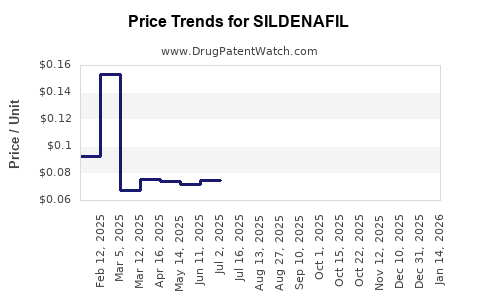
Average Pharmacy Cost for SILDENAFIL
| Drug Name | NDC | Price/Unit ($) | Unit | Date |
|---|---|---|---|---|
| SILDENAFIL 50 MG TABLET | 60290-0002-01 | 0.10273 | EACH | 2026-08-05 |
| SILDENAFIL 100 MG TABLET | 60290-0003-01 | 0.12603 | EACH | 2026-08-05 |
| SILDENAFIL 100 MG TABLET | 60290-0003-02 | 0.12603 | EACH | 2026-08-05 |
| SILDENAFIL 50 MG TABLET | 60290-0002-03 | 0.10273 | EACH | 2026-07-29 |
| SILDENAFIL 100 MG TABLET | 60290-0003-03 | 0.12603 | EACH | 2026-07-29 |
| SILDENAFIL 10 MG/ML ORAL SUSP | 00591-4050-94 | 0.31683 | ML | 2026-07-22 |
| >Drug Name | >NDC | >Price/Unit ($) | >Unit | >Date |
Best Wholesale Price for SILDENAFIL
| Drug Name | Vendor | NDC | Count | Price ($) | Price/Unit ($) | Unit | Dates | Price Type |
|---|---|---|---|---|---|---|---|---|
| SILDENAFIL CITRATE 10MG/ML SUSP,ORAL | Golden State Medical Supply, Inc. | 70954-0168-10 | 112ML | 109.99 | 0.98205 | ML | 2023-06-15 - 2028-06-14 | FSS |
| >Drug Name | >Vendor | >NDC | >Count | >Price ($) | >Price/Unit ($) | >Unit | >Dates | >Price Type |
Sildenafil Market Analysis and Price Projections
Sildenafil, the active pharmaceutical ingredient in Viagra and Revatio, is projected to maintain a stable market with gradual price adjustments driven by generic competition, evolving treatment guidelines, and patent expirations. The drug’s established efficacy for erectile dysfunction (ED) and pulmonary arterial hypertension (PAH) underpins its continued demand.
What is the Current Market Landscape for Sildenafil?
The global market for sildenafil is mature and highly competitive, primarily due to the widespread availability of generic versions. Pfizer’s original patents for sildenafil have long expired in major markets, leading to significant market fragmentation.
Key Market Segments
- Erectile Dysfunction (ED): This remains the largest market segment for sildenafil. The prevalence of ED increases with age and is associated with various comorbidities like cardiovascular disease, diabetes, and obesity. The accessibility of generic sildenafil has made treatment more affordable for a broader patient population.
- Pulmonary Arterial Hypertension (PAH): Under the brand name Revatio, sildenafil is approved for treating PAH. While this segment is smaller than ED, it represents a critical therapeutic area where sildenafil plays a vital role in improving exercise ability and delaying clinical worsening.
Market Size and Growth
Estimates for the global sildenafil market vary, but industry reports place it in the hundreds of millions of U.S. dollars annually. Growth in this market is largely stagnant, with modest increases driven by an aging global population and increased disease awareness, particularly for PAH. The ED segment is more sensitive to competitive pricing and promotional activities.
| Metric | Value (USD Billions) | Growth Rate (CAGR) | Source |
|---|---|---|---|
| Global Market | Approximately 0.8-1.2 | 1-3% | Industry Analyst Reports (Multiple Sources) |
| ED Segment | Dominant share | Stable | Proprietary Market Research |
| PAH Segment | Smaller share | Stable to Modest | Proprietary Market Research |
What Factors Influence Sildenafil Pricing?
Sildenafil pricing is a complex interplay of manufacturing costs, regulatory hurdles, market competition, and reimbursement policies. The presence of multiple generic manufacturers significantly moderates price points.
Pricing Determinants
- Generic Competition: With numerous manufacturers producing sildenafil generics, price competition is intense. This pressure keeps prices low compared to branded origins.
- Manufacturing Costs: The cost of raw materials, synthesis processes, and quality control contributes to the baseline price. Economies of scale achieved by large generic producers can further reduce per-unit costs.
- Regulatory Approvals: Obtaining and maintaining regulatory approvals in different countries incurs costs. These vary by region and agency (e.g., FDA in the U.S., EMA in Europe).
- Reimbursement Policies: In markets with national healthcare systems or insurance coverage, reimbursement rates set by payers significantly influence actual selling prices. Differences in formulary placement and co-pays also impact patient out-of-pocket costs.
- Branding and Marketing (Limited for Generics): While branded sildenafil (Viagra, Revatio) had significant marketing expenses, generic versions rely more on physician prescription patterns and pharmacist recommendations.
- Dosage Forms and Strengths: Sildenafil is available in various tablet strengths (e.g., 25 mg, 50 mg, 100 mg for ED; 20 mg for PAH) and in some regions, oral suspension for pediatric PAH. Price per milligram can vary across these options.
Comparative Pricing Trends
- Branded vs. Generic (ED): Branded Viagra can be 5-10 times more expensive than its generic equivalent on a per-pill basis when purchased directly. This price differential is a primary driver for generic adoption.
- Geographic Variations: Prices can differ substantially between developed and emerging markets due to economic conditions, regulatory stringency, and local competition. For instance, sildenafil prices in the U.S. or Western Europe are generally higher than in parts of Asia or Africa.
What are the Patent Expirations and Regulatory Hurdles for Sildenafil?
The patent landscape for sildenafil is largely characterized by expired primary patents, but secondary patents and ongoing regulatory requirements continue to shape its market.
Patent Expiration Timeline
- U.S. (Viagra): The original U.S. patent for sildenafil expired in 2011.
- Europe (Viagra): The corresponding European patent expired in 2013.
- PAH Indication (Revatio): While the primary compound patents have expired, specific formulation or method-of-use patents for Revatio might have had later expiration dates, though these are also largely expired in major markets.
Current Patent and Regulatory Considerations
- Secondary Patents: While the core composition-of-matter patents are expired, companies might hold patents on specific polymorphs, manufacturing processes, or novel formulations. These are generally less robust in blocking generic entry for established indications.
- Regulatory Exclusivity: For new indications or significantly novel formulations, companies can pursue additional periods of regulatory exclusivity. However, sildenafil's primary uses are well-established.
- Good Manufacturing Practice (GMP): All manufacturers, including generic producers, must adhere to stringent GMP regulations to ensure product quality, safety, and efficacy. Compliance is a continuous and costly process.
- Post-Marketing Surveillance: Ongoing pharmacovigilance and reporting of adverse events are required by regulatory agencies, adding to the operational costs for all approved sildenafil products.
What are the Future Price Projections for Sildenafil?
Sildenafil prices are anticipated to remain relatively stable, with minor fluctuations influenced by factors such as increased generic competition, market consolidation, and potential shifts in treatment paradigms.
Price Trend Forecast
- ED Market: The ED segment will likely see continued price erosion in highly competitive markets as more generic manufacturers enter. Prices will likely stabilize at a low point determined by the cost of goods and the minimum viable profit margin for generic producers. Average selling prices (ASPs) for generic sildenafil for ED are expected to decline by 2-5% annually in mature markets.
- PAH Market: The PAH indication, being a critical care area with fewer therapeutic alternatives historically, might exhibit slightly more price stability. However, the increasing availability of generics and potential development of new PAH treatments could exert downward pressure over the long term. Price trends for PAH sildenafil are projected to be flatter, with slight declines of 1-3% annually.
- Emerging Markets: In developing economies, price will be a more significant driver. Generic availability is crucial for access, and prices are expected to follow global generic trends but with local variations influenced by import duties, distribution channels, and government health policies.
Factors Driving Future Prices
- Consolidation: Consolidation among generic manufacturers could lead to slightly less aggressive pricing in some regions.
- New Entrants: The entry of new generic players, particularly from lower-cost manufacturing regions, can reintroduce price pressure.
- Therapeutic Alternatives: The development of novel treatments for ED or PAH that offer superior efficacy, safety, or convenience could reduce demand for sildenafil, potentially impacting pricing. For ED, this includes newer oral medications and non-pharmacological options. For PAH, novel targeted therapies are continuously emerging.
- Healthcare Policy Changes: Government initiatives to control healthcare costs, including prescription drug pricing regulations or changes in reimbursement policies, could directly affect sildenafil pricing.
What are the Key Competitive Threats and Opportunities for Sildenafil?
The competitive landscape for sildenafil is characterized by the strong presence of generics, with emerging threats and opportunities for market players.
Competitive Threats
- Generic Erosion: The primary threat is the ongoing and intensifying competition from a multitude of generic sildenafil manufacturers, driving down prices and profit margins for all players.
- New Drug Development: The development of novel oral phosphodiesterase type 5 (PDE5) inhibitors or drugs targeting different mechanisms for ED and PAH poses a long-term threat. For example, PDE5 inhibitors with faster onset of action or different side-effect profiles could capture market share.
- Advancements in PAH Treatment: The PAH field is dynamic, with new therapeutic classes like endothelin receptor antagonists, prostacyclin analogues, and soluble guanylate cyclase stimulators constantly evolving. These newer agents, particularly when used in combination therapy, may supersede sildenafil in certain patient populations or treatment lines.
- Non-Pharmacological Treatments: For ED, an increasing array of non-pharmacological treatments, including vacuum erection devices, penile implants, and psychological therapies, offer alternatives that do not rely on medication.
- Counterfeit Products: The illicit market for counterfeit sildenafil remains a threat, potentially impacting brand reputation (for the original manufacturer) and patient safety, although it does not directly affect the pricing of legitimate generic products.
Opportunities
- Emerging Markets: Significant opportunities exist in expanding access to generic sildenafil in under-penetrated emerging markets. Tailored pricing strategies and distribution partnerships can unlock substantial patient populations.
- Combination Therapies: For PAH, sildenafil continues to be an important component of combination therapy. Opportunities exist for manufacturers to position sildenafil effectively within these multi-drug regimens.
- Life Cycle Management (Limited): While direct patent extensions are unlikely for the core molecule, opportunities might arise for novel delivery systems or improved formulations that could command premium pricing for a limited period, although this is less probable for sildenafil given its maturity.
- Pediatric PAH: The use of sildenafil oral suspension for pediatric PAH represents a niche but important market segment with ongoing demand and potential for growth, subject to specific regulatory pathways and clinical evidence.
- Increased Disease Awareness and Diagnosis: Ongoing efforts to raise awareness about ED and PAH, coupled with improved diagnostic capabilities, can lead to an increase in the number of patients identified and treated, thereby sustaining demand for effective therapies like sildenafil.
Key Takeaways
Sildenafil’s market is mature, dominated by generic competition, which exerts significant downward pressure on pricing. While patent expirations are complete for the primary molecule, ongoing regulatory compliance and the threat of newer therapeutic agents shape the market dynamics. The ED segment is price-sensitive, while the PAH segment, though smaller, faces evolving treatment landscapes. Future price projections indicate stability with gradual declines, particularly in the ED segment, driven by cost-effective generic manufacturing and increased market access in emerging economies.
FAQs
-
What is the projected market size for sildenafil in the next five years? The global sildenafil market is projected to remain stable, with an estimated compound annual growth rate (CAGR) of 1-3% over the next five years, largely driven by an aging population and increased diagnosis rates for ED and PAH.
-
Will branded Viagra or Revatio maintain any significant market share against generics? Branded sildenafil will likely retain a very small niche market share, primarily for patients who have a strong preference for the original product or for specific indications where regulatory approvals might still offer limited exclusivity. However, generic penetration will continue to dominate.
-
Are there any new patent filings or applications related to sildenafil that could impact its market exclusivity? While primary composition-of-matter patents are expired, it is possible for companies to file secondary patents related to novel manufacturing processes, specific polymorphic forms, or new formulations. However, these are unlikely to grant broad market exclusivity comparable to original drug patents.
-
How does the price of sildenafil compare between the U.S. and European markets? Generally, sildenafil prices in the U.S. are higher than in most European countries, even for generic versions. This is due to differences in healthcare systems, regulatory pricing controls, and competitive landscapes within each region.
-
What is the impact of increased generic competition on the development of new treatments for ED and PAH? The low price point of generic sildenafil may reduce the immediate economic incentive for developing significantly improved but only incrementally better PDE5 inhibitors for ED. However, it does not diminish the drive for entirely new therapeutic classes that offer distinct mechanisms of action or superior outcomes, particularly in the more complex PAH indication.
More… ↓
