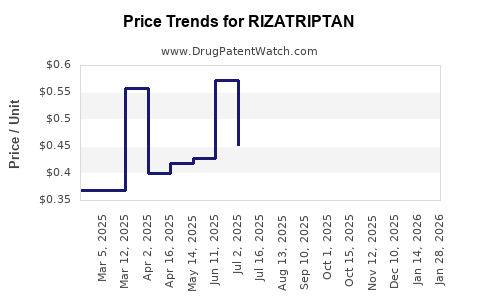
Last updated: February 20, 2026
What is the Current Market Landscape for Rizatriptan?
Rizatriptan is a selective serotonin receptor agonist used primarily for acute migraine treatment. Approved by the FDA in 1998, it is marketed under the brand name Maxalt and Maxalt MLT (dispersible tablets). The drug is available as a prescription medication in multiple formulations, including tablets and disintegrating tablets.
The global triptan market was valued at approximately USD 1.5 billion in 2022. Rizatriptan accounts for an estimated 20-25% of this market, reflecting its prevalent use. The drug's penetration is sustained by its efficacy and rapid onset of action, which positions it as a preferred option among healthcare providers and patients.
The competitive landscape includes other triptans such as sumatriptan, eletriptan, and naratriptan. Sumatriptan holds the largest market share due to its earliest availability and extensive generic options. Rizatriptan's unique position stems from its improved tolerability and tolerability profile, factors influencing prescribing patterns.
What Are the Key Drivers of Market Growth?
-
Increasing Global Migraine Prevalence: According to the World Health Organization, over 1 billion individuals experience migraines annually. The rising diagnosis rates fuel demand for effective acute treatments like rizatriptan.
-
Expanding Insurance Coverage & Prescription Access: Widespread insurance coverage for triptan therapies enhances accessibility, especially in high-income countries.
-
Development of Generic Versions: The entry of generic rizatriptan in key markets reduces cost barriers, increasing patient and clinician acceptance.
-
Product Differentiation & Line Extensions: The availability of disintegrating forms and combination therapies supports continued usage and market expansion.
How Do Recent Regulatory and Patent Trends Impact Market Dynamics?
Patent Status: The original patent for Maxalt expired in 2014 in the US, leading to manufacturer entry into the generic market. Multiple generics now account for approximately 60-70% of prescriptions, exerting downward pressure on prices.
Regulatory Approvals: Market entrants from emerging markets enhance global accessibility but introduce price competition. Regulatory agencies have approved reformulations with different excipients, but these have not significantly impacted sales.
Labeling and Safety Warnings: The FDA has issued warnings regarding cardiovascular risks associated with triptans, including rizatriptan. This influences prescribing behaviors and limits market expansion among certain patient subgroups.
What Is the Current Pricing Structure?
Brand-Name Rizatriptan (Maxalt):
- US average retail price: USD 20-25 per 10-tablet pack
- Price elasticity is high due to insurance coverage and generics
Generic Rizatriptan:
- US average retail price: USD 4-8 per 10-tablet pack
- Price reduction of approximately 60-80% compared to brand-name
Regional Variations:
- In Europe, prices range from EUR 10-15 per pack for generics
- In emerging markets, prices can fall below USD 2 per pack due to local manufacturing and pricing policies
What Are the Projected Market Trends in 2023–2028?
| Year |
Estimated Global Market Value (USD billion) |
Major Growth Factors |
Predicted Rizatriptan Share |
Key Risks |
| 2023 |
1.6 |
Continued generic penetration, new formulations |
20-25% |
Patent expirations, safety concerns |
| 2024 |
1.7 |
Increasing migraine prevalence, digital health links |
20% |
Regulatory restrictions, side effects |
| 2025 |
1.9 |
Expansion into emerging markets, line extensions |
18-22% |
Competition, reimbursement challenges |
| 2026 |
2.1 |
Adoption of telemedicine prescriptions |
17-20% |
Pricing pressures, off-label use increase |
| 2027 |
2.3 |
New formulations (e.g., nasal sprays), improved access |
15-18% |
New competitor launches, safety alerts |
| 2028 |
2.5 |
Market saturation, innovation in migraine therapies |
15-17% |
Market displacement, patent challenges |
How Will Pricing Evolve?
The trend indicates continuing price erosion, driven primarily by increased generic penetration. In mature markets like the US, prices are expected to decline by an additional 20-30% through 2028. In developing regions, prices will likely stabilize or slightly decrease as local manufacturers expand access and supply chains strengthen.
Introducing new formulations—such as nasal sprays or self-injectables—may command premium prices initially but will face future generic competition, constraining long-term price growth.
Summary of Key Market Factors
- Rizatriptan remains a significant player in the triptan market, though its share diminishes due to generic competition.
- Prices are declining globally, with premium positioning for novel formulations.
- Patent expirations, safety considerations, and regulatory approvals critically influence market dynamics.
- Emerging markets offer opportunities for volume-driven growth with lower pricing thresholds.
Key Takeaways
- The global rizatriptan market is projected to grow to USD 2.5 billion by 2028, driven by rising migraine prevalence.
- Generic versions dominate, reducing average retail prices by approximately 70% in the US.
- Regulatory sensitivities regarding cardiovascular risks impact prescribing patterns and market expansion.
- New delivery methods and combination products could stimulate short-term premium pricing.
- Price pressures will persist, especially in mature markets, limiting profitability for brand-name manufacturers.
FAQs
1. When will patent expirations significantly impact rizatriptan prices?
Patent expiry in major markets like the US occurred in 2014, leading to widespread generic entry. Future patent protections for new formulations could temporarily sustain higher prices but are typically short-lived.
2. How does rizatriptan compare to other triptans in pricing?
It is generally more affordable than newer triptans such as eletriptan, but pricier than sumatriptan generics. Its pricing depends on formulation and regional market factors.
3. Are there upcoming regulatory changes that could influence the market?
FDA safety warnings and label updates regarding cardiovascular risks may restrict use in certain patient populations, influencing overall market sales.
4. What role do non-oral formulations play in future market growth?
Nasal sprays and injectable forms offer faster relief and alternative administration for specific patients, potentially commanding higher prices initially but facing eventual generic competition.
5. What is the outlook for rizatriptan in emerging markets?
Growth will depend on regulatory environments, local manufacturing capacity, and healthcare infrastructure, with prices generally lower but sales volume higher.
References
[1] World Health Organization. (2022). "Migraine Fact Sheet." WHO.
[2] IMS Health. (2022). "Global Triptan Market Overview."
[3] FDA. (2019). "Safety Communications on Triptan Use."
[4] Statista. (2022). "Pricing and Market Share Data for Triptans."