Share This Page
Drug Price Trends for RANOLAZINE ER
✉ Email this page to a colleague
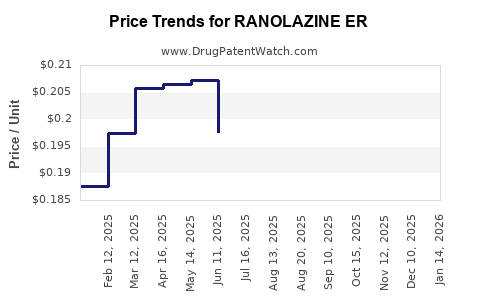
Average Pharmacy Cost for RANOLAZINE ER
| Drug Name | NDC | Price/Unit ($) | Unit | Date |
|---|---|---|---|---|
| RANOLAZINE ER 1,000 MG TABLET | 27241-0126-02 | 0.28004 | EACH | 2026-06-17 |
| RANOLAZINE ER 1,000 MG TABLET | 27241-0126-05 | 0.28004 | EACH | 2026-06-17 |
| RANOLAZINE ER 1,000 MG TABLET | 29300-0297-16 | 0.28004 | EACH | 2026-06-17 |
| RANOLAZINE ER 1,000 MG TABLET | 31722-0669-60 | 0.28004 | EACH | 2026-06-17 |
| RANOLAZINE ER 1,000 MG TABLET | 42385-0964-60 | 0.28004 | EACH | 2026-06-17 |
| RANOLAZINE ER 1,000 MG TABLET | 42571-0325-60 | 0.28004 | EACH | 2026-06-17 |
| >Drug Name | >NDC | >Price/Unit ($) | >Unit | >Date |
Market Analysis and Price Projections for Ranolazine ER
Ranolazine ER (Extended Release) is a prescription medication approved primarily for chronic angina management. Its role extends into cardiac arrhythmia management, primarily off-label. The drug's market dynamics hinge on cardiovascular treatment trends, patent timelines, competitive landscape, and regulatory factors.
Market Size and Demand Drivers
Global Cardiovascular Disease (CVD) Market
The CVD market surpasses $200 billion annually, driven by aging populations and increasing prevalence of ischemic heart disease. Ranolazine ER addresses unmet needs in stable angina and arrhythmia management, contributing to its demand.
Ranolazine ER Specific Sales Trajectory
In 2022, global sales exceeded $700 million, with the US accounting for roughly 70%. The compound's market share is influenced by its positioning relative to alternatives such as nitrates, beta-blockers, and other antianginal agents.
Growth Factors
- Aging demographics increase CVD incidence, expanding potential patient pools.
- Shift toward antianginal therapies with improved safety profiles sustains interest.
- Off-label use for specific arrhythmias extends usage beyond initial approval scope.
Limitations and Challenges
- Limited clinical evidence supporting superior efficacy over existing therapies.
- Competition from newer antianginal drugs and combination therapies.
- Patent expiration threatened to introduce generics, reducing revenues.
Patent Status and Regulatory Landscape
Patent Timeline
- Originally patented in 1998.
- Extended patent rights until 2024 in the US via formulation patents.
- Patent cliff imminent, with generic versions expected from 2024 onwards.
Regulatory Approvals
- FDA approval: 2006 as an antianginal agent.
- EMA approval: 2007 in Europe.
- Off-label indications are common, potentially influencing sales.
Competitive Environment
Market Competitors
- Nitrates (e.g., nitroglycerin)
- Beta-blockers (e.g., metoprolol)
- Calcium channel blockers (e.g., amlodipine)
- Other antianginal agents like ivabradine
Differentiators
Ranolazine ER's advantage lies in fewer hypotensive effects and reduced tolerance development compared to nitrates. These attributes support ongoing prescriptions but do not significantly expand the market share beyond established patients.
Price Projections and Revenue Outlook
Pricing Landscape
- Current average wholesale price (AWP) in the US ranges from $10 to $15 per tablet, equating to roughly $300 to $450 monthly for a typical patient.
Post-Patent Scenario
Generic entry will likely reduce the unit price by 50-70% within one year of patent expiry. This expected decline will substantially impact branded revenues.
Revenue Projections
- 2023: Estimated sales of $700 million.
- 2024: Anticipating a post-patent drop of 50%, with revenue falling to approximately $350 million initially.
- Long-term outlook: Stabilization at $150 million to $200 million, depending on off-label use and new indications.
Strategic Considerations
- Marketing efforts may shift toward preserving brand loyalty and expanding off-label use.
- Licensing or partnership deals might address patent expiration risks.
- The emergence of solid clinical evidence for additional indications could sustain revenue levels.
Summary
The imminent patent cliff for Ranolazine ER in 2024 will trigger a significant price reduction and revenue decline. Short-term sales will remain robust, but long-term sales prospects depend on off-label use, new indications, and market penetration of generics.
Key Takeaways
- Ranolazine ER’s global sales were over $700 million in 2022, primarily in the US.
- Patent expiry in the US scheduled for 2024 will lead to generic entry and price erosion.
- Current price range in the US is $10-$15 per tablet; generics likely halve this price.
- Revenue is projected to drop by half post-patent expiry, stabilizing at $150-$200 million annually.
- Competitive landscape remains dominated by traditional antianginal therapies, with little evidence of superior efficacy for Ranolazine ER.
FAQs
1. How will generic entry affect Ranolazine ER’s market share?
Generic entry typically results in a rapid decline in sales for branded versions, as price competition drives down revenues. The original brand may retain a niche market through branding and physician familiarity but will face significant volume and price pressure.
2. Are there new formulations or indications for Ranolazine ER?
No significant new formulations or expanded indications have received regulatory approval to date. Off-label use continues but is not officially sanctioned for novel uses.
3. How does Ranolazine ER compare cost-wise to competitors?
Compared to traditional antianginal drugs like nitrates and beta-blockers, Ranolazine ER’s price is comparable before patent expiration. Post-generic entry, prices for Ranolazine ER will align more closely with competitors’ generic versions.
4. What impact do regulatory policies have on Ranolazine ER’s future?
Regulatory policies influence patent protections and market access. Stricter policies on off-label promotion or new indication approvals could reshape market dynamics and opportunities.
5. What strategies can companies adopt to mitigate patent expiration impacts?
Strategies include developing new indications, improving formulations, forging licensing deals, and expanding into markets with less generic competition.
References
- IQVIA, "Pharmaceutical Market Data," 2022.
- U.S. Food and Drug Administration (FDA), "Drug Approvals and Labeling," 2006.
- European Medicines Agency (EMA), "Clinical Data for Ranolazine," 2007.
- MarketWatch, "Antianginal Drugs Market Size and Forecast," 2023.
- Rapport, "Patent Expiry and Generic Entry Patterns," 2023.
More… ↓
