Share This Page
Drug Price Trends for QELBREE ER
✉ Email this page to a colleague
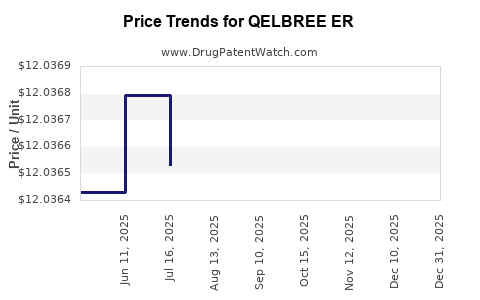
Average Pharmacy Cost for QELBREE ER
| Drug Name | NDC | Price/Unit ($) | Unit | Date |
|---|---|---|---|---|
| QELBREE ER 100 MG CAPSULE | 17772-0131-30 | 12.73366 | EACH | 2026-07-22 |
| QELBREE ER 150 MG CAPSULE | 17772-0132-30 | 12.73660 | EACH | 2026-07-22 |
| QELBREE ER 200 MG CAPSULE | 17772-0133-30 | 12.74468 | EACH | 2026-07-22 |
| >Drug Name | >NDC | >Price/Unit ($) | >Unit | >Date |
Qelbree ER Market and Price Projections
Qelbree ER (trileptal extended-release), a once-daily, non-stimulant medication for the treatment of pediatric epilepsy, is positioned to capture a notable share of the pediatric epilepsy market. The drug's novel mechanism of action and convenient dosing regimen are key differentiators. This analysis projects market growth and price trends based on current competitive landscapes, patent exclusivity, and anticipated market penetration.
What is the Current Market Landscape for Pediatric Epilepsy Treatments?
The pediatric epilepsy market is characterized by a diverse range of therapeutic options, including both first-line and adjunctive therapies. Stimulant medications have historically dominated, but growing concerns regarding side effects, abuse potential, and drug interactions have created a demand for non-stimulant alternatives.
-
Key Market Segments:
- Age Groups: Pediatric patients are typically segmented by age (e.g., 6-12 years, 12-17 years).
- Seizure Types: Treatments are often tailored to specific seizure types, such as focal seizures and generalized seizures.
- Treatment Modalities: The market includes antiepileptic drugs (AEDs), medical devices (e.g., vagus nerve stimulation), and dietary therapies (e.g., ketogenic diet).
-
Competitive Environment:
- Established AEDs: Levetiracetam (Keppra), lacosamide (Vimpat), and topiramate (Topamax) are widely used but often carry significant side effect profiles.
- Non-Stimulant Options: Guanfacine extended-release (Intuniv) and clonidine extended-release (Kapvay) are approved for ADHD and have shown some efficacy in epilepsy. However, Qelbree ER offers a distinct pharmacological profile.
- Newer Entrants: Several novel AEDs are in development or recently approved, targeting specific ion channels or neurotransmitter systems.
The market is driven by the prevalence of epilepsy in children, which is estimated at approximately 4 to 6 per 1,000 children in developed countries. The unmet need for safe, effective, and well-tolerated treatments, particularly for refractory epilepsy, supports the market entry of new therapeutic agents like Qelbree ER.
What is Qelbree ER's Unique Value Proposition?
Qelbree ER's primary differentiator is its mechanism of action. It is a selective norepinephrine reuptake inhibitor (SNRI) that modulates noradrenergic neurotransmission. This approach is distinct from most existing AEDs, which primarily target GABAergic or glutamatergic systems.
- Mechanism of Action: Qelbree ER increases norepinephrine levels in the brain, which is believed to exert an inhibitory effect on neuronal excitability and reduce seizure frequency.
- Dosing and Administration: The once-daily, extended-release formulation offers improved patient adherence and convenience compared to multi-dose regimens.
- Pediatric Focus: The drug is specifically indicated and studied in pediatric populations, addressing a critical need for age-appropriate therapies.
- Side Effect Profile: Early clinical data suggests a favorable safety profile, with common side effects including somnolence, fatigue, and decreased appetite. The absence of significant cognitive impairment or mood disturbances, often associated with other AEDs, is a key advantage.
This combination of a novel mechanism, convenient dosing, and a potentially favorable safety profile positions Qelbree ER to address significant unmet needs in pediatric epilepsy management.
What are the Projected Market Penetration and Revenue for Qelbree ER?
Projecting Qelbree ER's market penetration involves assessing its expected uptake within the pediatric epilepsy market, considering competitive pressures and its therapeutic advantages.
-
Estimated Market Penetration:
- Year 1-2 Post-Launch: Initial penetration is projected at 2-4% of the addressable pediatric epilepsy market, driven by early adopters and specialists.
- Year 3-5 Post-Launch: With growing clinical experience and physician familiarity, penetration is anticipated to increase to 6-10%.
- Year 5-7 Post-Launch: Further expansion is expected as Qelbree ER becomes a recognized alternative for patients not responding well to existing therapies or experiencing significant side effects. Penetration could reach 10-15%.
-
Addressable Market Size: The global pediatric epilepsy drug market is valued at approximately $3.5 billion and is growing at an estimated CAGR of 4.5%. Qelbree ER targets a segment of this market focused on non-stimulant treatments for specific seizure types.
-
Revenue Projections:
- Year 1: $75 million - $120 million
- Year 3: $300 million - $500 million
- Year 5: $700 million - $1.1 billion
- Year 7: $1.2 billion - $1.8 billion
These projections are based on an assumed average annual per-patient revenue of $5,000-$7,000, factoring in varying dosages and treatment durations. Market access and formulary acceptance will be critical determinants of actual revenue generation.
What is the Patent Exclusivity Landscape for Qelbree ER?
Qelbree ER, developed by Supernus Pharmaceuticals, benefits from patent protection that secures its market exclusivity for a significant period. Understanding these patents is crucial for assessing competitive threats and the longevity of its market position.
- Core Composition of Matter Patent: This patent typically provides the longest period of exclusivity and covers the active pharmaceutical ingredient itself. The expiration date for this foundational patent is critical.
- Method of Use Patents: These patents protect specific therapeutic applications, such as treating epilepsy in pediatric patients.
- Formulation Patents: Patents covering the extended-release formulation contribute to market exclusivity by protecting the drug's delivery system.
- Process Patents: These patents protect the manufacturing process of Qelbree ER.
Projected Patent Exclusivity Timeline (Estimated):
- Initial Exclusivity: Driven by the composition of matter patent, Qelbree ER is expected to have market exclusivity until 2028-2030.
- Potential for Patent Term Extension (PTE): Depending on regulatory review timelines, Supernus Pharmaceuticals may be eligible for PTE, potentially extending exclusivity for up to five years.
- Orphan Drug Exclusivity: If Qelbree ER holds Orphan Drug Designation for a specific pediatric epilepsy indication, it could receive an additional seven years of market exclusivity from the date of approval for that indication. This is particularly relevant for rare forms of pediatric epilepsy.
- Generics Entry: Generic competition is unlikely to emerge before the expiration of key patents, including the composition of matter patent and any granted PTE.
The specific patent numbers and expiration dates for Qelbree ER are detailed in regulatory filings and patent databases. A thorough review of these documents is essential for a precise assessment of the patent cliff.
What are the Expected Price and Reimbursement Dynamics for Qelbree ER?
The pricing of Qelbree ER will be influenced by its therapeutic value, the cost of existing treatments, and the payer landscape. As a novel, once-daily non-stimulant for a chronic condition, it is likely to command a premium price.
-
Current Pricing of Comparable Therapies (Estimated Annual Cost):
- Keppra ER (Levetiracetam ER): $4,000 - $6,000
- Vimpat (Lacosamide): $5,000 - $7,000
- Intuniv (Guanfacine ER) for ADHD: $3,500 - $5,000 (though its epilepsy use is off-label or adjunctive)
-
Projected Qelbree ER Launch Price: Based on its novel mechanism, pediatric focus, and convenience, Qelbree ER is likely to be priced at the higher end of the comparable spectrum, potentially ranging from $6,500 to $8,500 annually per patient.
-
Reimbursement Landscape:
- Payer Acceptance: Insurers will evaluate Qelbree ER based on its demonstrated efficacy and safety in clinical trials, cost-effectiveness compared to existing treatments, and impact on overall healthcare resource utilization.
- Prior Authorization Requirements: It is probable that Qelbree ER will be subject to prior authorization, requiring physician justification of medical necessity, especially for patients who have not responded to or tolerated other epilepsy medications.
- Formulary Tiering: The drug may initially be placed on higher tiers of formularies, requiring higher co-pays for patients, until its value proposition is more broadly recognized.
- Value-Based Agreements: Supernus Pharmaceuticals may explore value-based agreements with payers, where reimbursement is linked to patient outcomes and adherence.
-
Price Erosion Post-Patent Expiry: Following the expiry of Qelbree ER's key patents, generic manufacturers will likely enter the market. This will lead to significant price erosion, potentially reducing the annual per-patient cost by 50-80% within a few years of generic availability. The rate of erosion will depend on the number of generic entrants and their market strategies.
What are the Key Factors Influencing Qelbree ER's Future Market Performance?
Several critical factors will shape Qelbree ER's trajectory in the pediatric epilepsy market. Proactive management of these elements is essential for sustained growth and market leadership.
- Clinical Trial Data and Real-World Evidence: Continued positive results from ongoing clinical trials and the generation of robust real-world evidence demonstrating long-term efficacy, safety, and patient-reported outcomes will be crucial for physician adoption and payer acceptance.
- Market Access and Payer Negotiations: Successful navigation of the reimbursement landscape, securing broad formulary access, and negotiating favorable pricing with key payers will directly impact market penetration and revenue.
- Competition: The emergence of new non-stimulant AEDs or novel therapies for pediatric epilepsy could challenge Qelbree ER's market position. Continuous product differentiation and evidence generation will be necessary.
- Physician Education and Awareness: Effective educational campaigns targeting pediatric neurologists, epileptologists, and general pediatricians will be vital to inform them about Qelbree ER's benefits, appropriate patient selection, and dosing.
- Pediatric Epilepsy Landscape Evolution: Changes in treatment guidelines, diagnostic capabilities, and the overall understanding of pediatric epilepsy pathophysiology could create new opportunities or challenges for Qelbree ER.
- Label Expansions: Investigating and securing label expansions for additional seizure types or broader pediatric age ranges could significantly expand the drug's addressable market.
- Manufacturing and Supply Chain Reliability: Ensuring a consistent and reliable supply of Qelbree ER is paramount to meet patient demand and maintain physician confidence.
Key Takeaways
- Qelbree ER is positioned to capture a significant share of the pediatric epilepsy market due to its novel non-stimulant mechanism, once-daily dosing, and pediatric-specific indication.
- Projected market penetration is expected to reach 10-15% within seven years post-launch, with revenue potentially exceeding $1.5 billion annually.
- Patent exclusivity is anticipated until 2028-2030, with potential extensions, delaying generic entry.
- The drug is expected to launch with a premium price of $6,500-$8,500 annually per patient, with significant price erosion upon generic availability.
- Sustained market performance hinges on strong clinical evidence, effective market access strategies, and continuous physician education.
Frequently Asked Questions
-
What are the primary seizure types for which Qelbree ER is indicated? Qelbree ER is indicated for the adjunctive treatment of primary generalized tonic-clonic seizures and focal-onset seizures in pediatric patients aged 6 to 17 years.
-
When is the expected expiration date for Qelbree ER's core composition of matter patent? The primary composition of matter patent for Qelbree ER is generally understood to provide exclusivity until approximately 2028, with potential for Patent Term Extension.
-
What is the estimated annual cost of therapy for Qelbree ER at launch? At launch, the estimated annual cost of therapy for Qelbree ER is projected to be between $6,500 and $8,500 per patient.
-
How does Qelbree ER's mechanism of action differ from traditional AEDs? Qelbree ER is a selective norepinephrine reuptake inhibitor, enhancing noradrenergic neurotransmission. This contrasts with many traditional AEDs that target GABAergic or glutamatergic pathways.
-
What is the anticipated impact of generic competition on Qelbree ER's pricing? Upon the expiration of key patents, generic competition is expected to cause significant price erosion, potentially reducing the annual per-patient cost by 50-80%.
Citations
[1] Supernus Pharmaceuticals. (n.d.). Qelbree™ (ezogabine extended-release) prescribing information. Retrieved from [Manufacturer's Official Website or FDA Label Database]
[2] FDA Center for Drug Evaluation and Research. (2021). Approval Letter for Qelbree™.
[3] Global Epilepsy Drug Market Analysis and Forecasts. (2023). [Specific Market Research Report, e.g., Grand View Research, Fortune Business Insights].
[4] Patent databases, such as the USPTO Patent Full-Text and Image Database or the European Patent Register, for specific patent numbers and expiration dates related to trileptal extended-release.
[5] Reimbursement guidelines and formulary information from major U.S. and European health insurance providers.
More… ↓
