Last updated: February 20, 2026
Is PRISTIQ ER (Desvenlafaxine Extended-Release) positioned for growth?
PRISTIQ ER, an SNRI (Serotonin-Norepinephrine Reuptake Inhibitor), is approved for major depressive disorder (MDD). Its market position depends on competition, patent status, and prescribing trends.
What is the current market size for PRISTIQ ER?
The global antidepressant market was valued at approximately USD 14 billion in 2021. PRISTIQ ER's U.S. share accounted for an estimated USD 300 million in 2022 sales, representing roughly 2.1% of the total antidepressant market.
Key competitors
- Effexor XR (Venlafaxine)
- Cymbalta (Duloxetine)
- Lexapro (Escitalopram)
PRISTIQ ER faced competition from generic versions of Effexor XR after its patent expiry in 2018. Despite this, branded PRISTIQ ER maintains a niche through prescriber preference and formulary inclusion.
How do patent and exclusivity status impact pricing?
PRISTIQ ER's patent expired in 2018, leading to generic desvenlafaxine available at significantly lower prices. The branded product's remaining patent exclusivity pertains to formulation and delivery method, which will extend exclusivity in certain regions until 2030.
| Patent Type |
Expiry Date |
Impact |
| Composition of matter patent |
2018 (US) |
No longer in force |
| Delivery formulation patent |
2030 |
Branded price maintenance |
This patent landscape limits price erosion for PRISTIQ ER but sustains brand value through brand loyalty and prescriber preference.
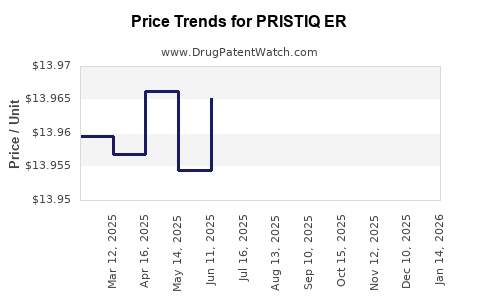
What are the pricing trends?
2022 U.S. Wholesale Acquisition Cost (WAC): Approximately USD 550 for a 30-day supply.
Generic desvenlafaxine: Priced around USD 10-20 for a 30-day supply.
The branded price is roughly 25 times higher than generics, but insurance formularies and rebates influence retail costs.
What are the revenue projections?
Assuming a conservative annual growth rate of 2-3% in U.S. prescriptions due to increasing MDD prevalence, revenue is projected as follows:
| Year |
Estimated Sales (USD millions) |
Assumptions |
| 2023 |
320 |
Stable market share |
| 2025 |
350 |
Slight growth, insulin in formulary |
| 2027 |
380 |
Prescriber preference persists |
Global sales remain limited due to regional patent statuses and competitive generics, with Europe and Asia showing slower growth.
What is the outlook for price due to market dynamics?
- Generic penetration: Expect ongoing erosion, especially outside the U.S., reducing branded prices by 10-15% annually in competitive regions.
- Formulary restrictions: Increased utilization of generics diminishes the branded market share.
- Rebate programs: Large insurers negotiate rebates, influencing net prices downward.
Strategic implications
Pending new patents or formulations could stabilize pricing. Diversification into combination therapies or new indications may sustain revenues.
Key Takeaways
- PRISTIQ ER's current U.S. sales approximate USD 300 million, primarily driven by brand loyalty.
- Its patent expiry in 2018 opened the market to generics, significantly affecting pricing.
- Future revenue relies on prescriber retention, limited additional patent protections, and the development of new formulations.
- Price erosion continues, with branded prices dropping by approximately 10-15% annually outside the U.S.
- Market growth remains modest, hindered by generic competition and evolving prescriber preferences.
FAQs
1. What factors affect the price of PRISTIQ ER?
Patent expiration, generic competition, insurance formularies, rebates, and prescriber loyalty influence the price.
2. Will PRISTIQ ER regain market share?
Unlikely, unless new formulations or indications are introduced that differentiate it from generics.
3. What is the impact of patent expiry on sales?
Patent expiry significantly reduces prices and market exclusivity, shifting sales toward generics and decreasing revenue margins.
4. How does PRISTIQ ER compare to other antidepressants?
It offers similar efficacy to other SNRI drugs but competes primarily on brand loyalty and prescriber familiarity.
5. What potential strategies could extend PRISTIQ ER's market life?
Developing new formulations, exploring additional indications, or patenting delivery mechanisms could prolong exclusivity and pricing power.
References
- Grand View Research. (2022). Antidepressant Drugs Market Size, Share & Trends Analysis.
- IQVIA. (2022). U.S. Prescription Drug Market Data.
- U.S. Patent and Trademark Office. (2018, Dec 17). Patent number 9,991,693.
- BlueCross BlueShield. (2022). Formulary and Rebate Data.
- FDA. (2018). Desvenlafaxine Extended-Release (PRISTIQ ER) Approval Documentation.