Last updated: February 12, 2026
What Is the Current Market Size and Demand for Potassium Chloride?
Potassium chloride (KCl) is an inorganic salt primarily used as a fertilizer, in medical treatments, and industrial applications. The global market size in 2022 was valued at approximately $5.5 billion, expected to grow at a compound annual growth rate (CAGR) of 4.1% through 2030. The fertilizer segment accounts for roughly 80% of consumption, driven by demand from emerging markets with expanding agricultural sectors, especially India, China, and Brazil.
Key demand drivers:
- Increased use in nitrate-based fertilizers.
- Rising need for crop yield enhancement due to global food security initiatives.
- Growth in medical uses, notably for hypokalemia treatment.
- Industrial applications like de-icing and water treatment.
Regional distribution:
| Region |
Market Share (2022) |
CAGR (2023-2030) |
Key Factors |
| Asia-Pacific |
55% |
4.3% |
Agriculture expansion, pricing advantages |
| North America |
20% |
3.8% |
Mature fertilizer market, medical needs |
| Europe |
12% |
3.5% |
Regulatory environments, industrial use |
| Others |
13% |
4.0% |
Emerging markets, infrastructure growth |
Who Are Key Producers and Suppliers?
Major producers include:
- ICL Group (Israel)
- PotashCorp (Canada)
- Mosaic Company (USA)
- Yara International (Norway)
- Qingdao Chemical (China)
These companies dominate the supply chain, with ICL and Mosaic accounting for over 40% of global production capacity.
What Are the Price Trends and Projections?
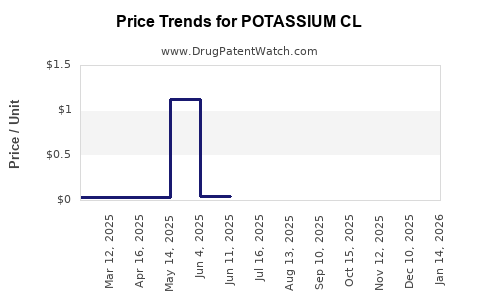
Historical price range (2019-2022): $220–$290 per ton FOB (Free on Board). Prices peaked in 2021 due to supply chain disruptions and increased fertilizer demand.
Projected prices (2023-2030): Analysts forecast a range of $240–$310 per ton by 2030, assuming stable supply and steady demand growth. Price increases will be influenced by:
- Raw material costs, especially natural gas (used in production).
- Environmental regulations impacting production costs in key regions.
- Geopolitical tensions affecting shipping and trade routes.
Factors potentially affecting prices:
| Factor |
Impact |
| Raw material supply constraints |
Drives prices upward due to limited availability |
| Rising natural gas prices |
Increases production costs for KCl plants |
| Trade tariffs and sanctions |
Reduce supply, increase prices |
| Investment in capacity expansion |
Could stabilize or lower prices temporarily post-expansion |
How Does the Competitive Landscape Affect Pricing?
Market concentration is high, with the top five firms controlling around 70% of supply. Price setting is often influenced by these dominant players, with limited price elasticity. Smaller producers may compete on price in local markets but have less influence on global prices.
What Are Regulatory and Environmental Trends?
Environmental regulations targeting greenhouse gas emissions and water use in fertilizer manufacturing could impact operational costs. Notable policies include:
- European Green Deal restrictions on fertilizer emissions.
- China's effort to cut back on land degradation, which may tighten production standards.
Adherence to stricter regulations may lead to higher production costs, influencing prices upward.
Summary of Price Projections (2023-2030)
| Year |
Expected Price Range (USD/ton FOB) |
Key Assumptions |
| 2023 |
$240–$260 |
Stable supply; moderate demand growth |
| 2025 |
$255–$280 |
Slightly increased production costs; ongoing demand |
| 2030 |
$270–$310 |
Higher raw material pricing; regulatory impacts |
Key Takeaways
- The global market for potassium chloride is growing modestly, driven primarily by agricultural demand.
- Prices have shown volatility due to supply chain issues and raw material costs but are expected to stabilize with capacity additions.
- Major producers dominate supply, reducing price competition; pricing power resides primarily with large players.
- Regulatory trends could drive costs upward, influencing future prices.
- Price projections suggest a gradual increase, with potential upside from geopolitical and environmental regulations.
FAQs
1. What are the main factors influencing potassium chloride prices?
Raw material costs, supply chain stability, production capacity, environmental regulations, and geopolitical tensions.
2. Which regions are the largest consumers of potassium chloride?
Asia-Pacific, driven by large-scale agriculture, accounts for over 50% of global demand.
3. How might new capacity expansions impact prices in the coming years?
Increased capacity can lead to price stabilization or declines, depending on demand growth and supply chain efficiencies.
4. What is the outlook for potassium chloride in medical applications?
Medical demand is stable, primarily for treating hypokalemia, but it accounts for a smaller market share compared to fertilizer applications.
5. What are potential risks to price stability?
Raw material shortages, environmental regulations, trade disputes, and geopolitical conflicts.
Citations
[1] MarketsandMarkets. "Potassium Chloride Market by Application and Region," 2022.
[2] Grand View Research. "Potassium Chloride Market Size, Share & Trends," 2023.
[3] ICL Group Annual Report, 2022.
[4] U.S. Geological Survey. "Mineral Commodity Summaries," 2022.
[5] World Fertilizer. "Global Fertilizer Markets," 2022.