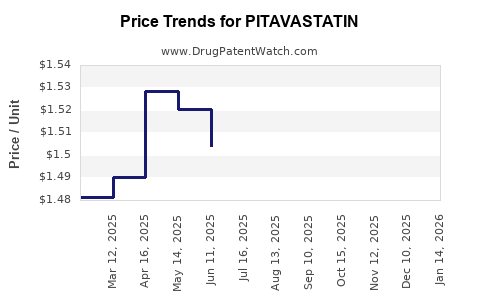
Last updated: February 13, 2026
Pitavastatin, a lipid-lowering agent in the statin class, gained market approval in Japan in 2009 and later received approvals in other countries, including the United States (FDA approval in 2017) and the European Union. It is marketed under brand names such as Livalo in the U.S. and Kastalis in Japan. The drug’s primary indication is for hyperlipidemia and cardiovascular risk reduction.
Market Size and Growth Trends
Global Market Value
The global statin market was valued at approximately USD 12.8 billion in 2021. Pitavastatin accounts for a smaller segment due to competition from established statins like atorvastatin, rosuvastatin, and simvastatin.
Market Share Dynamics
- Established statins dominate, capturing over 85% of the market.
- Pitavastatin's share remains below 3%. It appeals mainly to patients intolerant to other statins or with specific pharmacokinetic profiles.
Regional Markets
| Region |
2022 Market Share |
Key Factors |
| North America |
~1.5% |
High competition, label differentiation |
| Europe |
~1% |
Similar to North America, slower adoption |
| Asia-Pacific |
~4% |
Greater acceptance, local manufacturing |
| Rest of World |
<1% |
Less penetration |
Pricing Landscape
Current Pricing
- In the U.S., the list price for a 30-day supply of branded pitavastatin (2 mg) ranges from USD 250-300, depending on pharmacy and insurance coverage.
- Generic versions are not yet widely available, maintaining higher prices for brand-name products.
Comparison with Other Statins
| Drug |
Typical Monthly Cost (USD) |
Notes |
| Atorvastatin |
10-20 |
Widely available generics |
| Rosuvastatin |
20-30 |
Slightly higher than atorvastatin |
| Pitavastatin (brand) |
250-300 |
Premium pricing, no generics yet |
Factors Influencing Market and Prices
- Patent Status: The U.S. patent for Pitavastatin expired in 2022, potentially opening the market for generics.
- Regulatory Approvals: Approval in additional markets enhances potential sales channels.
- Clinical Data: Comparable efficacy and safety profiles to other statins influence prescriber acceptance.
- Competitive Dynamics: Existing drugs' established safety profiles and lower prices hinder rapid growth for Pitavastatin.
Price Projections (2023-2030)
| Year |
Estimated Price for Brand (USD, 30-day supply) |
Notes |
| 2023 |
250-300 |
Stable, offset by patent expiry risk |
| 2025 |
200-250 |
Potential decrease with generic entry |
| 2027 |
150-200 |
Increased competition reduces prices |
| 2030 |
120-150 |
Expected widespread availability of generics |
Prices are expected to decline by approximately 50-60% over the next seven years following patent expiration, with accelerated reduction if multiple generics enter the market.
Market Opportunities and Risks
Opportunities
- Growing demand in Asia-Pacific markets where statins are increasingly adopted.
- Potential for niche differentiation based on pharmacokinetics or reduced drug-drug interactions.
- Expansion into emerging markets with less established lipid regulation.
Risks
- Strong incumbents with patents and extensive marketing.
- Price erosion following generics' introduction.
- Preference for well-established statins with long safety records.
- Limited clinical differentiation compared to other statins.
Summary
Pitavastatin holds a minor share of the global statin market, with prices significantly higher than more established competitors. Its growth prospects depend on patent status, regulatory approval, and clinical differentiation. Prices are expected to decline markedly over the next decade, primarily due to generic competition.
Key Takeaways
- Pitavastatin's market share is below 3% globally, constrained by strong competition.
- Current prices for branded formulations in the U.S. hover around USD 250-300 per month.
- Patent expiry in the U.S. in 2022 sets the stage for generics, likely reducing prices by up to 50%.
- Asia-Pacific regions present growth opportunities due to increasing statin adoption.
- Market expansion hinges on clinical differentiation and regulatory approvals.
FAQs
1. What factors support market growth for Pitavastatin?
Growing cardiovascular disease prevalence and adoption in Asia-Pacific countries drive demand, especially if clinical benefits over other statins are established.
2. How does patent expiry influence pricing?
Patent expiration opens the market to generics, which typically lower prices by 50% or more within a few years.
3. Are there clinical advantages for Pitavastatin over other statins?
Some studies suggest fewer drug interactions and better tolerability in certain populations, but lacks widespread clinical superiority evidence.
4. What is the outlook for generic Pitavastatin?
Generic versions are expected post-2022 in the U.S., with similar timing possible elsewhere, substantially reducing prices.
5. How does pricing compare internationally?
Prices are generally higher in the U.S. and Western Europe due to less competition and patent protections; lower in Asia-Pacific where generics and local manufacturing reduce costs.
Sources:
[1] Global Data. 2022. Statin Market Analysis.
[2] IQVIA. 2022. Prescription Drug Pricing Reports.
[3] U.S. FDA. Drug Approvals and Patent Data.
[4] European Medicines Agency. Product Information.
[5] Market Research Future. 2022. Lipid-Lowering Drugs Market Forecast.