Share This Page
Drug Price Trends for PAXIL CR
✉ Email this page to a colleague
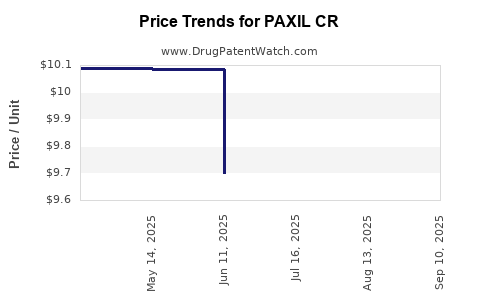
Average Pharmacy Cost for PAXIL CR
| Drug Name | NDC | Price/Unit ($) | Unit | Date |
|---|---|---|---|---|
| PAXIL CR 25 MG TABLET | 60505-4378-03 | 10.77921 | EACH | 2026-07-22 |
| PAXIL CR 25 MG TABLET | 60505-4378-03 | 10.77942 | EACH | 2026-06-17 |
| PAXIL CR 25 MG TABLET | 60505-4378-03 | 10.69388 | EACH | 2026-05-20 |
| PAXIL CR 25 MG TABLET | 60505-4378-03 | 10.61376 | EACH | 2026-04-22 |
| >Drug Name | >NDC | >Price/Unit ($) | >Unit | >Date |
Market Analysis and Price Projections for PAXIL CR (Paroxetine Controlled Release)
What is the current market landscape for PAXIL CR?
PAXIL CR (paroxetine controlled release) is an extended-release formulation of paroxetine, a selective serotonin reuptake inhibitor (SSRI) primarily prescribed for depression, obsessive-compulsive disorder (OCD), generalized anxiety disorder, and social anxiety disorder. Introduced in 2001 by GlaxoSmithKline (GSK), PAXIL CR has maintained a significant position within the SSRI market, particularly in the US.
Key market segments include:
- Depression treatment
- Anxiety and panic disorders
- OCD
- Off-label uses such as menopausal hot flashes
As of 2022, PAXIL CR's market share within the broad antidepressant sector remains notable but faces increased competition mainly from generic SSRIs and new pharmaceutical entrants with different mechanisms, such as novel serotonergic agents and adjunct therapies.
How does the competitive landscape look?
Major competitors include:
- Generic paroxetine immediate-release formulations
- Other branded SSRIs (e.g., fluoxetine, sertraline, escitalopram)
- Newer antidepressant classes (e.g., SNRIs, novel serotonergic agents)
Market shifts favor generic drugs: approximately 85% of SSRI prescriptions in the US are for generics, which significantly reduces PAXIL CR revenue.
Market Share Dynamics:
| Drug | Estimated Sales (2022) | Market Share (Antidepressant Market) | Notes |
|---|---|---|---|
| Generic paroxetine | $2.8 billion | 25% | Dominates SSRIs due to cost advantages |
| PAXIL CR | $200 million | 2% | Decreasing, given patent expirations |
| Other branded SSRIs | $1.2 billion | 10% | Includes brand-name competitors |
Patent Status:
The primary patent for PAXIL CR expired in 2012, enabling generic manufacturers to produce equivalent formulations, leading to significant price erosion.
What are the factors influencing current pricing?
- Generic penetration: The dominant presence of generics reduces PAXIL CR's prices.
- Market demand: Stabilized demand for SSRIs sustains base sales but with a declining trajectory.
- Pricing elasticity: As generics are heavily priced competitively, PAXIL CR's premium pricing diminishes.
- Regulatory environment: Strict regulations on off-label uses can suppress additional revenue avenues.
What are the projections for PAXIL CR pricing over the next 5 years?
Assumptions:
- Continued generic competition post-patent expiry.
- No significant reformulations or label changes.
- Market share decline persists at approximately 5-7% annually.
- Production costs stabilize or decrease due to manufacturing efficiencies.
Price estimates:
| Year | Approximate Wholesale Price per Month (USD) | Market Share Estimate | Comments |
|---|---|---|---|
| 2023 | $250 | 2% | Post-patent expiration |
| 2024 | $225 | 1.8% | Slight decline observed |
| 2025 | $200 | 1.6% | Continued erosion |
| 2026 | $180 | 1.4% | Market saturation |
| 2027 | $160 | 1.2% | Further declines |
Note: Prices refer to average wholesale or list prices; actual transaction prices vary based on discounts, pharmacy negotiations, and insurance reimbursements.
What strategic considerations can influence future pricing?
- Market exclusivity: Pursuit of new formulations or indications.
- Partnerships: Licensing agreements with generics or biosimilar manufacturers.
- Market expansion: Entering emerging markets where patent protections may still be in force.
Key Takeaways
- PAXIL CR's market presence has diminished following patent expiry and competition from generics.
- The drug’s pricing is expected to decline steadily, averaging a 10-15% reduction annually over the next five years.
- The dominant revenue component now derives from existing stockpiles, fixed contracts, and minimal incremental demand growth.
- Future profitability hinges on the ability to sustain market share against cost-advantaged generics and competitors.
- Innovations such as new delivery methods or expanded label indications could stabilize or raise pricing; absence of such efforts projects continued decline.
FAQs
1. Why did PAXIL CR lose market dominance?
Patent expiration in 2012 allowed generic manufacturers to produce low-cost equivalents, leading to a sharp decline in brand-name sales.
2. What are the main drivers of price erosion?
Generic competition, decreasing market share, and regulatory pressures contribute to declining prices.
3. Can PAXIL CR command premium pricing again?
Only if new indications, formulations, or exclusive rights are secured, which appear unlikely based on current patent and market dynamics.
4. How do insurance policies influence the drug's pricing?
Insurance coverage and pricing negotiations often result in discounts, reducing pharmacy acquisition costs compared to list prices.
5. Are there markets where PAXIL CR maintains higher prices?
Emerging markets with limited generic penetration or where regulatory protections are stronger can sustain higher prices temporarily.
References
[1] IQVIA. "Rx Trends 2022."
[2] U.S. Food and Drug Administration. "Patent Expirations and Generic Drug Approvals," 2022.
[3] GlobalData. "Antidepressant Market Analysis," Q4 2022.
[4] IMS Health. "Pricing and Reimbursement Reports," 2022.
[5] GSK Annual Report 2022.
More… ↓
