You're using a free limited version of DrugPatentWatch: Upgrade for Complete Access

Last Updated: December 16, 2025

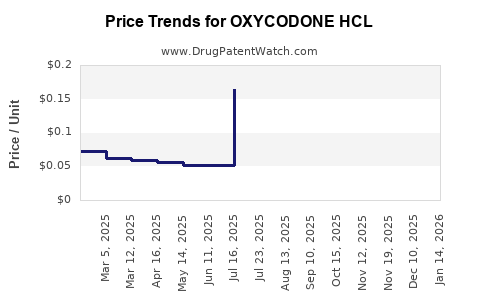
Drug Price Trends for OXYCODONE HCL


✉ Email this page to a colleague

« Back to Dashboard


Drug Price Trends for OXYCODONE HCL

Average Pharmacy Cost for OXYCODONE HCL

These are average pharmacy acquisition costs (net of discounts) from a US national survey
Drug Name NDC Price/Unit ($) Unit Date
OXYCODONE HCL (IR) 10 MG TAB 10702-0056-01 0.16392 EACH 2025-11-19
OXYCODONE HCL (IR) 10 MG TAB 10702-0056-50 0.16392 EACH 2025-11-19
OXYCODONE HCL (IR) 10 MG TAB 00406-8510-62 0.16392 EACH 2025-11-19
OXYCODONE HCL (IR) 10 MG TAB 42858-0002-01 0.16392 EACH 2025-11-19
OXYCODONE HCL (IR) 10 MG TAB 00406-8510-01 0.16392 EACH 2025-11-19
OXYCODONE HCL 5 MG/5 ML SOLN 71930-0022-43 0.04435 ML 2025-11-19
>Drug Name >NDC >Price/Unit ($) >Unit >Date

Best Wholesale Price for OXYCODONE HCL

These are wholesale prices available to the US Federal Government which, by law, must be the best prices available to any customer under comparable terms and conditions
Drug Name Vendor NDC Count Price ($) Price/Unit ($) Unit Dates Price Type
OXYCODONE HCL 5MG/5ML SOLN,ORAL Golden State Medical Supply, Inc. 00054-0390-63 500ML 16.50 0.03300 ML 2023-06-15 - 2028-06-14 FSS
OXYCODONE HCL 5MG/ACETAMINOPHEN 325MG TAB Golden State Medical Supply, Inc. 71930-0045-12 100 6.36 0.06360 EACH 2023-06-16 - 2028-06-14 FSS
OXYCODONE HCL 5MG/5ML SOLN,ORAL Golden State Medical Supply, Inc. 00121-4827-40 40X5ML 144.67 2023-06-15 - 2028-06-14 FSS
OXYCODONE HCL 5MG/ACETAMINOPHEN 325MG TAB Golden State Medical Supply, Inc. 71930-0045-52 500 44.71 0.08942 EACH 2023-06-16 - 2028-06-14 FSS
OXYCODONE HCL 5MG/5ML SOLN,ORAL Golden State Medical Supply, Inc. 00121-4827-40 40X5ML 154.48 2023-06-23 - 2028-06-14 FSS
OXYCODONE HCL 7.5MG/ACETAMINOPHEN 325MG TAB Golden State Medical Supply, Inc. 71930-0046-12 100 13.41 0.13410 EACH 2023-06-16 - 2028-06-14 FSS
>Drug Name >Vendor >NDC >Count >Price ($) >Price/Unit ($) >Unit >Dates >Price Type
Price type key: Federal Supply Schedule (FSS): generally available to all Federal Govt agencies / 'BIG4' prices: VA, DoD, Public Health & Coast Guard only / National Contracts (NC): Available to specific agencies

Market Analysis and Price Projections for Oxycodone HCl

Last updated: July 27, 2025

Introduction

Oxycodone Hydrochloride (HCl) is a potent opioid analgesic extensively used for managing moderate to severe pain. Its widespread prescription, coupled with the ongoing opioid epidemic, has positioned it as both a critical pain management drug and a focal point for regulatory scrutiny. This duality influences market dynamics and pricing strategies. This analysis provides a comprehensive overview of the current market landscape and offers forward-looking price projections based on recent trends, regulatory developments, and supply-demand factors.

Market Overview

Global Market Size and Growth Trends

The global opioid market, driven largely by oxycodone-based formulations, was valued at approximately USD 20 billion in 2021, with oxycodone constituting a significant share due to its efficacy and versatility in formulations (e.g., immediate-release, sustained-release, combination products). The compound's demand is particularly high in North America, which accounts for over 75% of global consumption, primarily attributed to the chronic pain epidemic and widespread opioid prescriptions [1].

The market is expected to grow at a compound annual growth rate (CAGR) of about 3-4% over the next five years, driven by expanding indications for pain management, advancements in controlled-release formulations, and emerging markets’ evolving healthcare infrastructure.

Regulatory Landscape

The opioid market faces strict regulatory oversight, especially in North America and Europe. The U.S., in particular, has implemented rigorous prescribing guidelines and oversight mechanisms to combat abuse and diversion. These policies directly impact the availability, prescribing patterns, and consequently, the pricing of oxycodone products.

Additionally, legal actions and settlement agreements have led to heightened scrutiny over pharmaceutical companies’ marketing practices, affecting gross margins and potentially influencing market entry barriers for generic manufacturers.

Supply Chain and Manufacturing

Oxycodone production involves complex synthetic processes derived from thebaine, an opiate alkaloid. Regulatory restrictions on precursor chemicals and manufacturing quotas influence supply dynamics. Recent years have seen increased investments in synthetic pathways that could stabilize or expand supply, potentially impacting price stability.

Market Segmentation

  1. Brand-Name vs. Generic
    The market is highly commoditized, with generic forms comprising approximately 85% of sales in key markets like the U.S., exerting downward pressure on prices. Major players such as Purdue Pharma (OxyContin), and numerous generics manufacturers compete aggressively, influencing price dynamics.

  2. Formulations

    • Immediate-release (IR): Used for acute pain. Typically priced higher per dose but with lower abuse potential.
    • Extended-release (ER): Used for chronic pain. Often commands premium pricing due to convenience and formulation complexity.
    • Combination products: Oxycodone with acetaminophen or aspirin are common, affecting pricing slightly compared to single-entity formulations.
  3. Geography
    North America dominates, but increasing adoption in emerging markets like Asia and Latin America offers growth avenues, albeit with pricing constraints due to regulatory and economic factors.

Pricing Dynamics

Current Pricing Landscape

The price for oxycodone HCl varies significantly by formulation, dosage, and market status:

  • Brand-Name Products: OxyContin (Purdue Pharma), historically premium-priced, with a per-pill cost ranging from USD 15 to USD 30 in retail settings.
  • Generic Formulations: Typically priced between USD 0.50 and USD 2 per tablet, reflecting market saturation and price competition.
  • Bulk Acquisition: Hospitals and pharmacies purchase oxycodone powders or tablets at negotiated prices, often substantially lower, with cost per unit decreasing with scale [2].

Factors Influencing Prices

  • Regulatory Policies: Stricter prescribing guidelines and crackdowns on misuse reduce demand and influence pricing strategies, especially for brand-name formulations.
  • Supply Chain Constraints: Disruptions in precursor chemical supply or manufacturing can tighten availability, pushing prices upward temporarily.
  • Market Competition: Increased presence of generics exerts downward pressure, while patents or formulations with abuse-deterrent features can command premium prices.
  • Legal and Litigation Risk: Ongoing litigation against manufacturers can lead to legal costs and settlements, indirectly impacting pricing strategies to recover expenses.

Price Projections (2023–2028)

Baseline Scenario

Given current market trends, regulatory pressures, and supply chain considerations, the following projections are presented:

  • Generic Oxycodone Tablets: Prices are expected to decrease modestly over the next five years, with an annual decline of approximately 2-3%. By 2028, the average price could be around USD 0.40–USD 0.80 per tablet, depending on dosage and market competition.

  • Brand-Name Oxycodone Products: Given patent expirations and market saturation, prices are projected to decline at a slightly faster rate, around 4-6% annually, reaching approximately USD 10–USD 18 per pill in 2028.

Upside Factors

  • Abuse-Deterrent Formulations: Innovations with abuse-deterrent properties command premium prices, potentially offsetting some downward pressure.
  • Emerging Markets: Entry into countries with less stringent regulations could temporarily boost volumes and prices, especially if local supply chains are underdeveloped.
  • Supply Constraints: New regulations or geopolitical issues impacting precursor chemical supply could lead to temporary price spikes.

Downside Risks

  • Regulatory Crackdowns: More stringent prescribing guidelines or tighter controls on opioid distribution could significantly restrict demand.
  • Legal Settlements: Large-scale litigation costs could lead manufacturers to raise prices to recoup legal expenses, affecting affordability.
  • Market Saturation: High availability of generics and price-sensitive markets may further depress prices.

Strategic Implications for Stakeholders

  • Manufacturers: Should innovate in abuse-deterrent formulations and leverage emerging markets for growth, while managing regulatory risks.
  • Healthcare Providers: Must balance effective pain management with regulatory compliance, influencing demand.
  • Investors: Should monitor regulatory developments, patent expirations, and supply chain stability to inform valuation models.

Key Takeaways

  • The oxycodone HCl market is mature, with significant dependence on regulatory landscapes, especially in North America.
  • Prices are under downward pressure due to generic competition, though innovation in formulation can temporarily sustain premium pricing.
  • Supply chain constraints and legal risks could cause short-term fluctuations, but long-term projections indicate modest price declines.
  • Emerging markets represent growth opportunities, albeit with price and regulatory caveats.
  • Stakeholders should focus on formulation innovation, regulatory compliance, and supply chain resilience to maintain profitability and market positioning.

FAQs

Q1: How will the opioid epidemic influence oxycodone pricing in the future?
A: Increased regulatory scrutiny and prescribing guidelines aim to reduce misuse, likely leading to decreased demand and downward pressure on prices, especially for brand-name products. However, demand for legitimate medical use remains stable, supporting sustained, though moderated, prices.

Q2: Are generic oxycodone prices expected to decrease further?
A: Yes. Intense competition among generic manufacturers continues to drive prices downward, with some estimates suggesting a 2-3% annual decline. Market saturation and regulatory pressures reinforce this trend.

Q3: What impact will new formulation innovations have on market prices?
A: Abuse-deterrent and extended-release formulations, which often command higher prices, can temporarily offset downward pricing trends. Such innovations may create niche premium markets but face regulatory and reimbursement hurdles.

Q4: How might regulatory changes in emerging markets affect oxycodone prices?
A: Softer regulations or increased approval in emerging markets can boost demand and prices temporarily. Conversely, stricter controls can suppress prices and limit market growth.

Q5: What strategic moves should pharmaceutical companies consider regarding oxycodone?
A: Focus on developing abuse-deterrent formulations, diversify into emerging markets with tailored regulatory strategies, and improve supply chain agility to mitigate risks and capitalize on growth opportunities.


Sources:

[1] MarketWatch, "The Global Opioid Market 2022," 2022.
[2] IQVIA, "Pharmaceutical Pricing Trends," 2021.

More… ↓

⤷  Get Started Free

Make Better Decisions: Try a trial or see plans & pricing

Drugs may be covered by multiple patents or regulatory protections. All trademarks and applicant names are the property of their respective owners or licensors. Although great care is taken in the proper and correct provision of this service, thinkBiotech LLC does not accept any responsibility for possible consequences of errors or omissions in the provided data. The data presented herein is for information purposes only. There is no warranty that the data contained herein is error free. We do not provide individual investment advice. This service is not registered with any financial regulatory agency. The information we publish is educational only and based on our opinions plus our models. By using DrugPatentWatch you acknowledge that we do not provide personalized recommendations or advice. thinkBiotech performs no independent verification of facts as provided by public sources nor are attempts made to provide legal or investing advice. Any reliance on data provided herein is done solely at the discretion of the user. Users of this service are advised to seek professional advice and independent confirmation before considering acting on any of the provided information. thinkBiotech LLC reserves the right to amend, extend or withdraw any part or all of the offered service without notice.