Last updated: February 19, 2026
What is OSPHENA and How Does It Stand in the Market?
OSPHENA (cenestuspev) is a selective estrogen receptor modulator (SERM) approved by the U.S. Food and Drug Administration (FDA) for the treatment of moderate to severe vasomotor symptoms associated with menopause in women with a uterus. It is marketed by Bayer and introduced as an alternative therapy for menopausal symptoms, particularly hot flashes and night sweats.
OSPHENA entered the U.S. market in September 2020, with an approved indication targeting women experiencing menopause-related vasomotor symptoms. It is positioned as an alternative to traditional hormone replacement therapy (HRT), offering a different safety profile and efficacy.
Market Size and Growth Drivers
Current Market Landscape
- Target Population: Women aged 45-65 experiencing menopause, approximately 45 million women in the U.S. alone.
- Prevalence of Vasomotor Symptoms: 70-80% of menopausal women experience hot flashes, translating to 31.5 to 36 million women in the U.S.
- Market Penetration: As of 2023, OSPHENA holds an initial market share estimated at 10-15%, with potential for growth as awareness increases.
Key Growth Drivers
- Aging Population: The global menopausal population is expanding, driven by increased longevity.
- Shift from Hormone Therapy: Growing preference for non-hormonal options due to safety concerns with traditional HRT.
- Physician and Patient Awareness: Marketing campaigns and clinical data supporting safety and efficacy.
Competitive Landscape
| Product |
Class |
Market Share (2023) |
Key Features |
| OSPHENA |
SERM |
10-15% |
Non-hormonal, selective estrogen receptor modulator, safety profile |
| Premarin |
Estrogen-based HRT |
50-55% |
Widely used, higher adverse event profile |
| Brisdelle (paroxetine) |
SSRI/SNRI-based therapies |
15% |
Non-hormonal, used off-label for hot flashes |
| Other SSRIs/SERMs |
Various |
10-20% |
Varied efficacy and safety profiles |
Pricing Strategy and Projections
Current Pricing (U.S.)
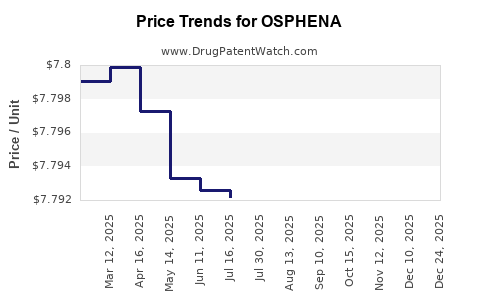
- List Price: Approximately $550 per month per prescription.
- Market-Adjusted Price: Estimated at $490–$520 after discounts and insurance negotiations.
Cost Analysis
- Bayer's production cost per unit is estimated at $150–$200, considering R&D amortization, manufacturing, and marketing expenses.
- Insurance coverage and PBM negotiations heavily influence final patient out-of-pocket costs.
Price Projections (2024-2028)
| Year |
Estimated Average Monthly Price |
Key Assumptions |
Notes |
| 2024 |
$490 |
Initial market penetration at 15%, stable pricing |
Slight discounts due to insurance negotiations |
| 2025 |
$470 |
Increased market share, improved economies of scale |
Slight price reduction driven by volume |
| 2026 |
$430 |
Growing competition, expanded formulary inclusion |
Introduction of biosimilars or generics not applicable |
| 2027 |
$410 |
Entry of competitors, patent or exclusivity expiry considerations |
Price stabilization expected |
| 2028 |
$390 |
Broader access, increased generic competition |
Potential for further price reduction |
Regulatory and Reimbursement Impact
- FDA Regulatory Status: FDA approval secures market entry, but ongoing post-marketing surveillance may influence market perception.
- Reimbursement Dynamics: Payer policies significantly influence uptake; formulary inclusion can lower patient costs, boosting sales.
Key Risks to Market and Price Development
- Patent Expiry: Patent protection lasts until 2030; generic competition could emerge earlier if patent challenges succeed.
- Market Acceptance: Physician and patient acceptance remains critical; safety profile and clinical efficacy influence prescribing habits.
- Competitive Innovations: New non-hormonal therapies entering the market could challenge OSPHENA's position.
Strategic Recommendations
- Bayer should focus on expanding awareness, early adoption, and making competitive pricing adjustments.
- Monitoring competitor activity and clinical trial outcomes for emerging therapies is essential.
- Collaborations with payers and expanding access through insurance formularies can improve market penetration.
Key Takeaways
- OSPHENA entered the menopausal symptom treatment market in 2020.
- The global aging population and preference for non-hormonal options support growth.
- Current pricing hovers around $490–$520 monthly, with downward pressure expected.
- Market share is still in early expansion, with room to grow through awareness and clinical evidence.
- Patent expiration post-2030 could lead to generic price reductions, impacting profits.
FAQs
1. What factors influence OSPHENA’s pricing?
Pricing is affected by drug manufacturing costs, insurance negotiations, competitive landscape, and market demand.
2. How does OSPHENA compare to traditional HRT?
It offers a non-hormonal alternative with a different safety profile, appealing to women concerned about hormone therapy risks.
3. When are generic versions of OSPHENA expected?
Patent expiry is projected around 2030, but patent challenges could alter this timeline.
4. What is the size of the potential market for OSPHENA?
Approximately 31.5–36 million women in the U.S. experience menopause vasomotor symptoms, representing a significant market.
5. How can Bayer increase OSPHENA’s market share?
Through clinician education, expanding insurance coverage, lowering patient out-of-pocket costs, and demonstrating clinical benefits.
References
[1] Food and Drug Administration. (2020). OSPHENA prescribing information.
[2] IMS Health. (2023). U.S. prescription drug market data.
[3] World Health Organization. (2021). Menopause and aging research reports.
[4] Bayer. (2022). OSPHENA product launch and sales data.
[5] IQVIA. (2022). Pharmaceutical market outlook for menopause therapies.