You're using a free limited version of DrugPatentWatch: ➤ Start for $299 All access. No Commitment.

Last Updated: December 16, 2025

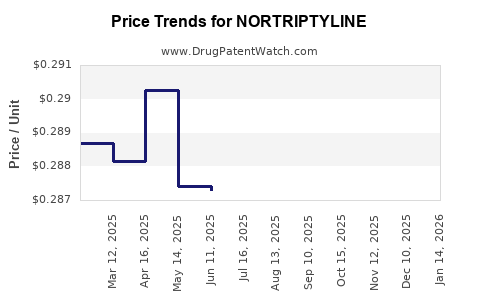
Drug Price Trends for NORTRIPTYLINE


✉ Email this page to a colleague

« Back to Dashboard


Drug Price Trends for NORTRIPTYLINE

Average Pharmacy Cost for NORTRIPTYLINE

These are average pharmacy acquisition costs (net of discounts) from a US national survey
Drug Name NDC Price/Unit ($) Unit Date
NORTRIPTYLINE HCL 10 MG CAP 00093-0810-05 0.11697 EACH 2025-11-19
NORTRIPTYLINE HCL 10 MG CAP 51672-4001-01 0.11697 EACH 2025-11-19
NORTRIPTYLINE HCL 10 MG CAP 00093-0810-01 0.11697 EACH 2025-11-19
NORTRIPTYLINE HCL 10 MG CAP 51672-4001-02 0.11697 EACH 2025-11-19
NORTRIPTYLINE 10 MG/5 ML SOLN 00121-0678-16 0.27299 ML 2025-11-19
NORTRIPTYLINE HCL 75 MG CAP 75907-0072-01 0.31364 EACH 2025-11-19
>Drug Name >NDC >Price/Unit ($) >Unit >Date

Best Wholesale Price for NORTRIPTYLINE

These are wholesale prices available to the US Federal Government which, by law, must be the best prices available to any customer under comparable terms and conditions
Drug Name Vendor NDC Count Price ($) Price/Unit ($) Unit Dates Price Type
NORTRIPTYLINE HCL 50MG CAP Golden State Medical Supply, Inc. 51672-4003-01 100 25.12 0.25120 EACH 2023-06-23 - 2028-06-14 FSS
NORTRIPTYLINE HCL 25MG CAP Golden State Medical Supply, Inc. 51672-4002-01 100 18.98 0.18980 EACH 2023-06-15 - 2028-06-14 FSS
NORTRIPTYLINE HCL 50MG CAP Golden State Medical Supply, Inc. 51672-4003-02 500 83.53 0.16706 EACH 2023-06-15 - 2028-06-14 FSS
NORTRIPTYLINE HCL 25MG CAP Golden State Medical Supply, Inc. 51672-4002-01 100 20.50 0.20500 EACH 2023-06-23 - 2028-06-14 FSS
NORTRIPTYLINE HCL 10MG/5ML SOLN,ORAL Golden State Medical Supply, Inc. 00121-0678-16 473ML 151.90 0.32114 ML 2023-06-15 - 2028-06-14 FSS
NORTRIPTYLINE HCL 10MG CAP Golden State Medical Supply, Inc. 51672-4001-01 100 14.25 0.14250 EACH 2023-06-15 - 2028-06-14 FSS
>Drug Name >Vendor >NDC >Count >Price ($) >Price/Unit ($) >Unit >Dates >Price Type
Price type key: Federal Supply Schedule (FSS): generally available to all Federal Govt agencies / 'BIG4' prices: VA, DoD, Public Health & Coast Guard only / National Contracts (NC): Available to specific agencies

Market Analysis and Price Projections for Nortriptyline

Last updated: July 28, 2025

Introduction

Nortriptyline, a tricyclic antidepressant (TCA), has been widely utilized since its FDA approval as an antidepressant therapy in the 1960s. It primarily treats major depressive disorder (MDD), but its off-label applications extend to neuropathic pain, anxiety, and insomnia. The evolving landscape of neuropsychiatric treatment, combined with regulatory and competitive pressures, influences the market dynamics and pricing strategies for Nortriptyline. This analysis provides a comprehensive overview of its current market, key drivers, regulatory environment, competitive landscape, and future price projections.


Market Overview

Historical Context

Initially launched by Sepracor (now part of Sunovion Pharmaceuticals) and subsequently by other generics manufacturers, Nortriptyline has transitioned from brand dominance to a predominantly generic market. Its low-cost profile and long-standing generic status position it as an accessible therapy, especially in regions prioritizing affordability.

Current Market Size

Globally, the antidepressant market was valued at approximately USD 16.5 billion in 2022, with TCAs accounting for roughly 10% of this segment [1]. Within this, Nortriptyline's share remains significant in the generic antidepressant space, particularly in the US, Europe, and emerging markets. Its use in neuropathic pain management, especially fibromyalgia and diabetic neuropathy, further expands its market reach.

Key Market Drivers

  • Rising Prevalence of Depression and Neuropathic Conditions: The WHO estimates over 300 million people globally suffer from depression, raising demand for diverse antidepressant options [2]. Neuropathic pain cases are also increasing, supporting Nortriptyline's off-label indications.
  • Cost-Effectiveness: As a generic medication, Nortriptyline appeals to healthcare systems and patients seeking affordable treatment options.
  • Established Safety Profile: Long-term clinical data support its efficacy and safety, bolstering its continuing prescribing.

Market Challenges

  • Competition from SSRIs and SNRIs: Contemporary antidepressants like escitalopram and venlafaxine, with improved side effect profiles, have diminished TCA market share.
  • Side Effect Profile: Its anticholinergic effects and cardiac toxicity risks limit broader use, especially among vulnerable populations.
  • Regulatory and Formulation Barriers: Variability in formulations and patents may influence availability and pricing.

Regulatory Environment and Patent Landscape

Regulatory Status

Nortriptyline remains off-patent globally, making it accessible via multiple generic manufacturers. Regulatory agencies such as the FDA and EMA advocate for affordable medications, which supports the continued availability of Nortriptyline as a low-cost generic.

Patent Expiry and Exclusivity

As a drug introduced in the 1960s, Nortriptyline’s original patents have expired, leading to a saturated market of generic equivalents. However, formulation patents or manufacturing processes may still afford some exclusivity in specific jurisdictions, although such protections are limited.


Competitive Landscape

Generic Manufacturers

Numerous global pharmaceutical companies produce Nortriptyline generics, including Teva, Mylan, Sandoz, and Sunovion. Price competition is intense, driven by high manufacturing capacity and minimal differentiation.

Emerging Biosimilar and Alternative Therapies

While biosimilars are not applicable to Nortriptyline due to its small-molecule composition, newer antidepressant formulations and pain therapies exert pressure on its market share.

Pricing Strategies

Manufacturers often engage in price competition, discounts, and bulk purchasing incentives to gain market share, resulting in key price considerations for healthcare providers and pharmacies.


Price Projections

Current Price Trends

In the United States, the average wholesale acquisition cost (WAC) for Nortriptyline 25 mg ranges between USD 0.04 and USD 0.12 per capsule, depending on the manufacturer [3]. The pricing remains relatively stable due to high generic competition.

Forecasting Future Prices

  1. Market Saturation and Competition: Given the high level of generic competition, significant price reductions are unlikely unless production costs decrease or new market entrants emerge.

  2. Regulatory Incentives and Policy Changes: Increased emphasis on affordable medications through government procurement policies in regions like Europe and North America may further pressure prices downward.

  3. Potential for Price Stagnation or Slight Decline (2023-2028): Based on current trends, prices are projected to decline modestly, averaging around USD 0.03–0.07 per capsule in developed markets by 2028.

  4. Emerging Markets: In low- and middle-income nations, prices may be lower initially, but import tariffs, distribution costs, and local manufacturing can influence local retail prices, possibly stabilizing them.

Influencing Factors

  • Manufacturing costs: Advances in cost-efficient synthesis could lower prices.
  • Regulatory environment: Streamlined approvals of generics globally may increase competition.
  • Market demand shifts: Preference for newer antidepressants with better side effect profiles could diminish demand, especially in developed markets.

Implications for Stakeholders

  • Manufacturers: To maintain margins, focus may shift toward cost-efficient production and expanding markets in developing regions.
  • Healthcare Providers: Price stability ensures Nortriptyline remains a cost-effective option for depression and neuropathic pain management.
  • Payers and Policy Makers: Continuous downward price pressure highlights the importance of formulary management to optimize care costs.

Key Takeaways

  • The global Nortriptyline market has matured, with high generic penetration leading to stable, low pricing.
  • Demand continues driven by its affordability and utility in depression and neuropathic pain, especially in cost-sensitive settings.
  • Competition from newer antidepressants and side effect concerns constrain market expansion in developed countries.
  • Future price projections suggest slight declines, hovering around USD 0.03–0.07 per capsule by 2028, barring unforeseen regulatory or market disruptions.
  • Manufacturers and stakeholders must capitalize on cost efficiencies and expanding markets in emerging economies to sustain profitability.

FAQs

1. How does Nortriptyline compare in price to newer antidepressants?
Nortriptyline remains significantly cheaper than SSRIs and SNRIs, with prices often less than $0.10 per dose, whereas newer agents typically range from $0.50 to several dollars per dose, depending on formulation and region.

2. Will Nortriptyline's market share increase with the rise of off-label pain management?
Potentially, as off-label use for neuropathic pain persists and depending on clinical guidelines, but competition from other pain therapies may limit growth.

3. What regulatory factors could impact its pricing?
Strengthening generic drug regulations, increased approval of biosimilars, and policy initiatives promoting affordability could further suppress prices.

4. Are there regional differences in Nortriptyline pricing?
Yes; prices are generally lower in emerging markets due to manufacturing costs and regulatory policies, while high-income countries maintain slightly higher prices due to distribution and regulatory costs.

5. How might pharmaceutical companies extend Nortriptyline’s market viability?
By developing new formulations, combining with other agents, or expanding into underserved markets, manufacturers can sustain or grow demand despite price pressures.


References

[1] MarketWatch. "Antidepressant Drugs Market Size & Share Analysis."
[2] WHO. "Depression Fact Sheet."
[3] Red Book. "Pharmaceutical Price Reports."

More… ↓

⤷  Get Started Free

Make Better Decisions: Try a trial or see plans & pricing

Drugs may be covered by multiple patents or regulatory protections. All trademarks and applicant names are the property of their respective owners or licensors. Although great care is taken in the proper and correct provision of this service, thinkBiotech LLC does not accept any responsibility for possible consequences of errors or omissions in the provided data. The data presented herein is for information purposes only. There is no warranty that the data contained herein is error free. We do not provide individual investment advice. This service is not registered with any financial regulatory agency. The information we publish is educational only and based on our opinions plus our models. By using DrugPatentWatch you acknowledge that we do not provide personalized recommendations or advice. thinkBiotech performs no independent verification of facts as provided by public sources nor are attempts made to provide legal or investing advice. Any reliance on data provided herein is done solely at the discretion of the user. Users of this service are advised to seek professional advice and independent confirmation before considering acting on any of the provided information. thinkBiotech LLC reserves the right to amend, extend or withdraw any part or all of the offered service without notice.