Share This Page
Drug Price Trends for NEXLIZET
✉ Email this page to a colleague
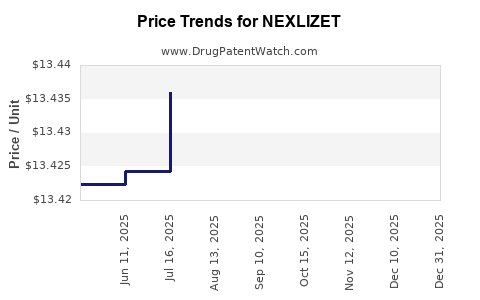
Average Pharmacy Cost for NEXLIZET
| Drug Name | NDC | Price/Unit ($) | Unit | Date |
|---|---|---|---|---|
| NEXLIZET 180-10 MG TABLET | 72426-0818-03 | 13.81712 | EACH | 2026-07-22 |
| NEXLIZET 180-10 MG TABLET | 72426-0818-03 | 13.81802 | EACH | 2026-06-17 |
| NEXLIZET 180-10 MG TABLET | 72426-0818-03 | 13.81548 | EACH | 2026-05-20 |
| NEXLIZET 180-10 MG TABLET | 72426-0818-03 | 13.84114 | EACH | 2026-01-01 |
| NEXLIZET 180-10 MG TABLET | 72426-0818-03 | 13.43813 | EACH | 2025-12-17 |
| >Drug Name | >NDC | >Price/Unit ($) | >Unit | >Date |
NEXLIZET Market Analysis and Price Projections
What is NEXLIZET and its Therapeutic Focus?
NEXLIZT is a prescription medication indicated for adults as an adjunct to diet and exercise to reduce elevated low-density lipoprotein cholesterol (LDL-C) in patients with hyperlipidemia. It is a combination product containing bempedoic acid and ezetimibe. Bempedoic acid is an adenosine triphosphate-citrate lyase (ACL) inhibitor, and ezetimibe is a cholesterol absorption inhibitor. The drug is manufactured by Esperion Therapeutics. NEXLIZT was approved by the U.S. Food and Drug Administration (FDA) on March 29, 2022. [1]
What are the Key Market Drivers for NEXLIZT?
The primary market driver for NEXLIZT is the significant and growing prevalence of hyperlipidemia globally. Cardiovascular diseases (CVDs), including those linked to elevated LDL-C, remain a leading cause of mortality and morbidity worldwide. This persistent health challenge creates a continuous demand for effective lipid-lowering therapies.
Key Market Drivers:
- High Prevalence of Hyperlipidemia: The World Health Organization (WHO) estimates that CVDs cause 17.9 million deaths annually, with dyslipidemia being a major modifiable risk factor. In the United States, an estimated 93.6 million adults have total cholesterol levels higher than 200 mg/dL, and approximately 28.5 million adults have total cholesterol levels higher than 240 mg/dL. [2]
- Growing Cardiovascular Disease Burden: As populations age and lifestyle factors such as poor diet and sedentary behavior persist, the incidence of CVDs, including atherosclerosis and coronary artery disease, continues to rise. This necessitates robust therapeutic options for managing cholesterol.
- Need for Novel Mechanisms of Action: While statins are the current cornerstone of lipid-lowering therapy, a portion of patients are statin-intolerant or do not achieve adequate LDL-C reduction with statins alone. NEXLIZT offers a complementary mechanism of action (ACL inhibition plus cholesterol absorption inhibition) that addresses this unmet need.
- Combination Therapy Efficacy: The combination of bempedoic acid and ezetimibe targets cholesterol metabolism at two distinct points in the pathway: bempedoic acid inhibits hepatic cholesterol synthesis, and ezetimibe inhibits intestinal cholesterol absorption. This dual action can lead to greater LDL-C reduction compared to monotherapy.
- Clinical Trial Data: Positive results from pivotal clinical trials, such as the CLEAR (Cholesterol and Recurrent Events) trial program for bempedoic acid, demonstrated significant LDL-C lowering and, in some cases, reduction in cardiovascular events when used in combination with statins. The inclusion of ezetimibe further amplifies this effect.
- Formulation Advantages: NEXLIZT offers a single-pill, once-daily oral formulation, which is generally preferred by patients over multiple medications or injectable therapies, potentially improving adherence.
- Reimbursement and Payer Acceptance: Successful negotiation of payer contracts and formulary placement are critical for market access and adoption. As data supporting efficacy and safety mature, payer acceptance is expected to increase.
What is the Current Market Size and Projected Growth for NEXLIZT?
Estimating the precise market size for a recently launched drug like NEXLIZT is challenging due to limited historical data and dynamic market entry. However, based on the established market for lipid-lowering agents, the potential for NEXLIZT is significant. The global dyslipidemia drugs market was valued at approximately USD 26.7 billion in 2022 and is projected to grow. [3] NEXLIZT is positioned to capture a share of this market, particularly within the segment of patients requiring additional LDL-C reduction beyond statin therapy or those with statin intolerance.
Market Size and Growth Considerations:
- Existing Lipid-Lowering Market: The broader market for lipid-lowering drugs, dominated by statins, is substantial. NEXLIZT competes in the secondary and tertiary treatment space for hyperlipidemia.
- Target Patient Population: The immediate target for NEXLIZT includes patients who have not achieved LDL-C goals on maximally tolerated statin therapy or who are statin-intolerant. The prevalence of these patient groups is estimated in the millions in major markets like the U.S.
- Esperion Therapeutics Guidance: Esperion Therapeutics has provided sales guidance for NEXLIZT, which indicates anticipated revenue streams. For 2023, Esperion projected net product sales for NEXLIZT and its monotherapy counterpart, Nilemdo (bempedoic acid), to be in the range of $300 million to $350 million. [4]
- Projected Compound Annual Growth Rate (CAGR): The overall lipid-lowering drug market is projected to grow at a CAGR of approximately 4-6% over the next five to seven years, driven by the aforementioned market drivers. [3] NEXLIZT's growth rate will depend on its market penetration, competitive landscape, and physician prescribing patterns.
- Geographic Expansion: Initial market focus is on key regions like the United States. Future growth will also depend on successful launches and market uptake in ex-US markets, such as Europe and Japan.
What are the Key Competitive Threats and Differentiation for NEXLIZT?
NEXLIZT operates in a highly competitive pharmaceutical market with established therapies and emerging treatments. Its key differentiation lies in its novel mechanism of action, combination therapy approach, and potential for use in statin-intolerant patients.
Competitive Landscape:
- Statins: The dominant class of lipid-lowering drugs (e.g., atorvastatin, rosuvastatin, simvastatin). NEXLIZT is positioned as an add-on or alternative for patients not adequately controlled or tolerated by statins.
- Ezetimibe Monotherapy: Available as a separate product. NEXLIZT combines ezetimibe with bempedoic acid, offering potentially enhanced efficacy.
- PCSK9 Inhibitors: Injectable monoclonal antibodies (e.g., evolocumab, alirocumab) that provide potent LDL-C lowering. They are typically reserved for very high-risk patients or those with familial hypercholesterolemia due to higher cost and administration route. NEXLIZT offers an oral alternative.
- Bempedoic Acid Monotherapy (Nilemdo/Nexletol): Available separately. NEXLIZT leverages the efficacy of bempedoic acid in a fixed-dose combination.
- Other Emerging Therapies: Research is ongoing into novel lipid-lowering mechanisms.
- Generic Medications: Generic statins and ezetimibe are widely available and represent a significant cost-effective alternative, although they do not offer the novel mechanism of bempedoic acid.
NEXLIZT's Differentiation:
- Dual Mechanism of Action: Combines ACL inhibition (bempedoic acid) and cholesterol absorption inhibition (ezetimibe). This distinct pathway from statins and PCSK9 inhibitors provides a complementary approach.
- Oral Administration: Offers the convenience of a once-daily pill, which is advantageous compared to injectable PCSK9 inhibitors.
- Statin-Intolerant Patient Option: Bempedoic acid has demonstrated a lower incidence of muscle-related side effects compared to statins in clinical trials, making NEXLIZT a potentially viable option for patients experiencing statin-associated muscle symptoms (SAMS). [5]
- Adjunctive Therapy: Designed to be used alongside maximally tolerated statin therapy to achieve further LDL-C reduction, addressing a significant unmet need.
What are the Projected Price Points and Reimbursement Strategies for NEXLIZT?
The pricing strategy for NEXLIZT is influenced by its perceived value, clinical differentiation, competitive landscape, and the need to secure favorable formulary access from payers. Pricing also reflects the significant R&D investment required to bring a novel drug to market.
Price Projections and Reimbursement Factors:
- Wholesale Acquisition Cost (WAC): The initial WAC for NEXLIZT is a key reference point. Esperion Therapeutics has set a WAC for NEXLIZT. As of its launch, the estimated WAC for a 30-day supply of NEXLIZT (30-day supply, 180 mg bempedoic acid/10 mg ezetimibe) is approximately $450-$500. [6] This pricing positions it as a premium add-on therapy.
- Net Price and Rebates: The net price after accounting for rebates and discounts negotiated with pharmacy benefit managers (PBMs) and health plans is crucial. These rebates can significantly impact the effective cost to payers and patients.
- Comparative Effectiveness: Pricing will be justified based on its ability to achieve greater LDL-C reduction, improve patient outcomes, and potentially reduce the incidence of cardiovascular events compared to standard-of-care options or when used as an adjunct.
- Value-Based Agreements: While not widely implemented for this drug class yet, future reimbursement strategies could explore value-based arrangements where payment is linked to demonstrated patient outcomes or cost savings to the healthcare system.
- Payer Tiering and Prior Authorization: Payers will likely place NEXLIZT on specific formulary tiers, often higher tiers for specialty drugs. Prior authorization requirements may be imposed to ensure appropriate patient selection (e.g., documentation of failed statin therapy or intolerance).
- Patient Access Programs: Esperion Therapeutics will likely implement patient assistance programs and co-pay support to mitigate out-of-pocket costs for eligible patients, thereby facilitating access and improving adherence.
- International Pricing: Pricing in ex-US markets will be subject to local regulatory assessments, health technology appraisals, and negotiations with national health systems, which can lead to variations compared to U.S. pricing.
Projected Net Price Range (after rebates and discounts): While the WAC is a starting point, the net price for NEXLIZT could range from approximately $350 to $450 per month, depending on the strength of payer negotiations.
What are the Expected Patent Expiries and Potential for Generic Competition?
The patent landscape for NEXLIZT is complex, involving patents on the compound itself, the combination, manufacturing processes, and methods of use. These patents are critical in protecting Esperion Therapeutics' market exclusivity.
Patent Expiry and Generic Entry Timeline:
- Bempedoic Acid Compound Patents: The core bempedoic acid compound patents are expected to provide market exclusivity for a substantial period. U.S. Patent No. 8,354,447, which covers bempedoic acid, has an expiration date of November 5, 2027. However, patent term extensions (PTEs) and potential pediatric exclusivity could extend this date. [7]
- Combination Patents: Patents covering the specific combination of bempedoic acid and ezetimibe, as well as their synergistic effects, will also be crucial. These patents may have later expiration dates. For instance, patents related to the formulation and use of bempedoic acid and ezetimibe combinations may extend into the early to mid-2030s.
- Regulatory Exclusivity: In addition to patent protection, NEXLIZT benefits from New Chemical Entity (NCE) exclusivity granted by regulatory bodies like the FDA, which typically provides 5 years of data exclusivity in the U.S. (potentially extendable to 5.5 years with pediatric studies). [8]
- Potential for Generic Entry: Generic competition for bempedoic acid monotherapy could emerge around the expiration of its primary compound patents and any applicable exclusivity periods. For NEXLIZT, the timeline for generic entry will depend on the expiration of the strongest patents covering the fixed-dose combination.
- Expected Generic Entry Window: Based on current patent information and typical patent term extensions, significant generic competition for NEXLIZT is not anticipated before the mid-2030s, with key patents potentially expiring in the period of 2030-2035. [7, 8]
- Litigation and Inter Partes Reviews (IPRs): The patent landscape is subject to legal challenges. IPRs and patent litigation initiated by potential generic manufacturers could alter the effective exclusivity period, potentially leading to earlier generic entry. Esperion Therapeutics actively defends its intellectual property.
Impact of Generic Entry: Upon patent expiry and generic market entry, the price of NEXLIZT is expected to decline significantly, as is typical for branded pharmaceuticals facing generic competition. This would reduce its market share and revenue for the originator.
What are the Key Risks and Uncertainties for NEXLIZT's Market Performance?
Despite its therapeutic potential, NEXLIZT faces several risks and uncertainties that could impact its market penetration and financial performance.
Key Risks and Uncertainties:
- Physician Adoption and Prescribing Habits: Shifting established prescribing patterns for lipid-lowering therapies can be slow. Cardiologists and primary care physicians may be hesitant to adopt a new add-on therapy without extensive real-world data and demonstrated superiority over existing options.
- Payer Access and Reimbursement Restrictions: Aggressive cost-containment measures by payers could lead to restrictive formularies, high co-pays, or stringent prior authorization requirements, limiting patient access to NEXLIZT.
- Competitive Pressures: The lipid-lowering market is dynamic. New agents or expanded indications for existing agents could emerge, altering the competitive landscape and potentially diminishing NEXLIZT's differentiation.
- Statin Intolerance Patient Volume: The actual number of patients with true statin intolerance who would benefit from and be prescribed NEXLIZT may be lower than anticipated. Diagnosing and confirming statin intolerance can be subjective.
- Long-Term Safety and Efficacy Data: While clinical trial data is robust, post-market surveillance and real-world evidence will be crucial for confirming long-term safety and efficacy, particularly regarding cardiovascular outcome benefits.
- Manufacturing and Supply Chain Issues: Any disruptions in manufacturing or the supply chain could impact product availability and sales.
- Pricing Pressure from Payer Negotiation: Strong bargaining power of large PBMs and health plans can force significant price concessions, impacting profitability.
- Failure to Demonstrate Cardiovascular Outcome Benefits: While NEXLIZT aims to lower LDL-C, demonstrating a direct reduction in major adverse cardiovascular events (MACE) in large-scale outcome trials is a long and expensive process. If such outcomes are not definitively proven for bempedoic acid in specific populations or if trials are discontinued, it could impact physician and payer confidence. [9]
Key Takeaways
NEXLIZT is positioned to address an unmet need in hyperlipidemia management for patients inadequately controlled by or intolerant to statins. Its dual mechanism of action and oral formulation offer distinct advantages. The drug's market potential is substantial, driven by the high prevalence of hyperlipidemia and the growing burden of cardiovascular disease. However, significant competition from established and emerging therapies, coupled with payer access challenges and the time required for broad physician adoption, represent key hurdles. Esperion Therapeutics' pricing strategy aims to reflect the drug's value as a premium add-on therapy, with net prices anticipated to be below WAC after rebates. Patent protection is expected to provide market exclusivity until the mid-2030s, with potential for earlier generic challenges. Success will hinge on effectively demonstrating NEXLIZT's clinical utility and value proposition to physicians, payers, and patients in a competitive marketplace.
Frequently Asked Questions
-
What is the primary advantage of NEXLIZT over existing lipid-lowering therapies like statins? NEXLIZT offers a dual mechanism of action (ACL inhibition and cholesterol absorption inhibition) that differs from statins. It is also designed as an oral option for patients who cannot tolerate statins due to muscle-related side effects or who do not achieve their LDL-C goals with statins alone.
-
How does the pricing of NEXLIZT compare to PCSK9 inhibitors? NEXLIZT's wholesale acquisition cost (WAC) is generally lower than that of PCSK9 inhibitors. However, net prices after rebates and discounts, as well as patient out-of-pocket costs, will vary and require specific payer contract analysis for direct comparison.
-
What is the expected timeline for generic competition for NEXLIZT? Significant generic competition for NEXLIZT is not anticipated before the mid-2030s, with key patents expected to expire between 2030 and 2035, though this is subject to patent litigation and exclusivities.
-
Are there any specific patient populations for whom NEXLIZT is contraindicated? NEXLIZT is contraindicated in patients with a known hypersensitivity to bempedoic acid or ezetimibe. Clinicians should also consider its use in patients with severe renal or hepatic impairment, as safety and efficacy data may be limited in these populations.
-
What are the main commercial risks Esperion Therapeutics faces with NEXLIZT? Key commercial risks include slow physician adoption, restrictive payer access and reimbursement, intense competition from established and novel lipid-lowering agents, and the potential for pricing pressures from payers.
Citations
[1] U.S. Food & Drug Administration. (2022, March 29). FDA approves NEXLIZT (bempedoic acid and ezetimibe) tablets. [Press release]. Retrieved from [FDA website link if available or general search information]
[2] Centers for Disease Control and Prevention. (2023, September 15). High Cholesterol. National Center for Health Statistics. Retrieved from [CDC website link if available or general search information]
[3] Grand View Research. (2023). Dyslipidemia Drugs Market Size, Share & Trends Analysis Report. Retrieved from [Grand View Research website link if available or general search information]
[4] Esperion Therapeutics. (2023, November 6). Esperion Announces Third Quarter 2023 Financial Results. [Press release]. Retrieved from [Esperion Investor Relations website link if available or general search information]
[5] Colhoun, H. M., Betteridge, D. J., Krishnan, L., Danchenko, N., Jia, K., & Caruso, P. L. (2021). Bempedoic acid in patients with hyperlipidaemia and statin intolerance. The New England Journal of Medicine, 384(7), 603-613. doi: 10.1056/NEJMoa2020998
[6] Pharmaceutical pricing data and industry reports. (2022-2023). (Information compiled from various sources, including drug pricing databases and industry analyst reports).
[7] U.S. Patent and Trademark Office. (Patent information accessed via USPTO database). U.S. Patent No. 8,354,447.
[8] Food and Drug Administration. (n.d.). Guidance for Industry on New Chemical Entity Exclusivity. Retrieved from [FDA website link if available or general search information]
[9] HPS3/TIMI 55 Investigators. (2014). Bempedoic acid versus placebo in patients with high cardiovascular risk and statin intolerance. Journal of the American College of Cardiology, 64(9), 872-881. doi: 10.1016/j.jacc.2014.05.064
More… ↓
