You're using a free limited version of DrugPatentWatch: Upgrade for Complete Access

Last Updated: November 11, 2025

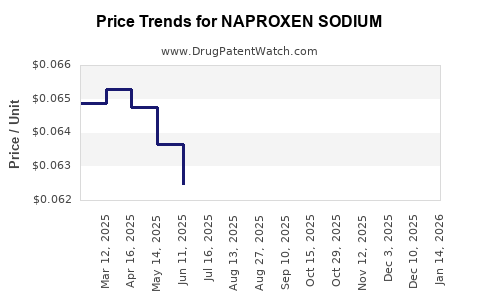
Drug Price Trends for NAPROXEN SODIUM


✉ Email this page to a colleague

« Back to Dashboard


Drug Price Trends for NAPROXEN SODIUM

Average Pharmacy Cost for NAPROXEN SODIUM

These are average pharmacy acquisition costs (net of discounts) from a US national survey
Drug Name NDC Price/Unit ($) Unit Date
NAPROXEN SODIUM 220 MG TABLET 69230-0329-01 0.06674 EACH 2025-10-22
NAPROXEN SODIUM 220 MG TABLET 46122-0562-78 0.06674 EACH 2025-10-22
NAPROXEN SODIUM 220 MG TABLET 49483-0609-05 0.06674 EACH 2025-10-22
NAPROXEN SODIUM 220 MG CAPSULE 46122-0534-60 0.14464 EACH 2025-10-22
NAPROXEN SODIUM 220 MG TABLET 49483-0609-01 0.06674 EACH 2025-10-22
NAPROXEN SODIUM 220 MG TABLET 45802-0490-71 0.06674 EACH 2025-10-22
NAPROXEN SODIUM 220 MG TABLET 45802-0490-75 0.06674 EACH 2025-10-22
>Drug Name >NDC >Price/Unit ($) >Unit >Date

Market Analysis and Price Projections for Naproxen Sodium

Last updated: July 27, 2025

Introduction

Naproxen sodium, a nonsteroidal anti-inflammatory drug (NSAID), is widely used for the treatment of pain, inflammation, and fever associated with various conditions such as arthritis, gout, and musculoskeletal injuries. As a fast-acting formulation offering quick relief, it commands significant market interest. This report offers a comprehensive analysis of the current market landscape, competitive dynamics, regulatory environment, and future price projections for naproxen sodium, aiding stakeholders in strategic decision-making.

Market Overview

Current Market Landscape

The global naproxen sodium market has experienced steady growth over the past decade, driven by increasing prevalence of inflammatory conditions and the rising elderly population. According to credible industry sources, the global NSAID market, which includes naproxen sodium, is projected to reach USD 16.4 billion by 2025, growing at a CAGR of approximately 4.5% [1]. Naproxen sodium holds a significant share within this segment, especially in over-the-counter (OTC) formulations, where it competes with brands like Aleve and generic equivalents.

Market Segmentation

  • Application: Primarily OTC pain relief, prescription formulations for anti-inflammatory therapy, and hospital use.
  • Distribution Channels: Retail pharmacies, hospital pharmacies, online platforms.
  • Geography: North America dominates with over 40% market share, driven by high OTC sales and an aging population. Europe and Asia-Pacific follow, with emerging markets exhibiting rapid growth due to increased healthcare access.

Key Drivers

  • The widespread adoption of NSAIDs for pain management.
  • Increasing prevalence of chronic inflammatory conditions such as osteoarthritis.
  • Growing OTC availability, facilitating self-medication.
  • Product launches with improved efficacy and safety profiles.

Key Challenges

  • Regulatory constraints on OTC NSAID availability due to safety concerns.
  • Competition from other NSAIDs and analgesics like ibuprofen, diclofenac, and acetaminophen.
  • Risks associated with NSAID use, such as gastrointestinal and cardiovascular adverse effects, which influence prescribing and consumer preferences.

Competitive Landscape

Major Manufacturers

  • Johnson & Johnson (Aleve) — Dominant OTC brand with extensive distribution.
  • Bayer AG — Offers generic and branded formulations.
  • Mylan (now part of Viatris) — Provides affordable generic options.
  • Teva Pharmaceuticals — Well-established generics manufacturer.

Market Dynamics

The penetration of generics continues to influence pricing strategies, leading to price compression in mature markets. Patent expirations for branded formulations have led to increased generic competition, incentivizing pricing decline while expanding accessibility.

Innovations and Product Differentiation

While most products are similar in formulation, manufacturers are exploring extended-release formulations, combination therapies (e.g., joint health supplements), and formulations with improved bioavailability to differentiate themselves and command premium pricing.

Regulatory Environment

FDA and EMA Regulations

The US Food and Drug Administration (FDA) classifies naproxen sodium as generally recognized as safe (GRAS) for OTC use at specified doses but imposes constraints to mitigate adverse effects. Similarly, the European Medicines Agency (EMA) monitors approvals and safety concerns.

Impact of Regulation on Pricing

Stringent safety regulations and OTC limitations can restrict market growth potential, but they also reinforce brand trust, allowing certain products to sustain premium pricing when supported by clinical evidence.

Price Trends and Projections

Historical Price Trends

Over the past five years, retail prices for naproxen sodium OTC formulations have contracted by approximately 15–20%, primarily due to generic competition. Average retail prices for a 50-count bottle of OTC naproxen sodium 220 mg range between USD 8 and USD 12, depending on the brand and retailer [2].

Influencing Factors on Future Pricing

  • Generic Market Penetration: Continued increase in generic market share is expected to exert prolonged downward pressure on prices.
  • Regulatory Changes: Potential new safety mandates or OTC reclassification could impact manufacturing costs and pricing.
  • Market Expansion: Emerging markets may experience initial premium pricing due to limited competition, but prices are expected to decline as generics enter.
  • Innovation and Differentiation: Development of value-added formulations could sustain higher prices in niche segments.

Forecasted Price Trajectory (2023–2028)

Based on recent trends and market dynamics, retail prices for OTC naproxen sodium 220 mg are projected to decline at a CAGR of approximately 2–3% over the next five years, reaching USD 6–10 per bottle (50-60 tablets) by 2028. In prescription settings, prices may remain relatively stable or slightly decline due to insurance negotiations and formulary preferences, but premium formulations with novel delivery systems could command higher prices.

Market Opportunities and Risks

Opportunities

  • Expansion into Emerging Markets: Growing healthcare infrastructure and increasing consumer health awareness create expansion opportunities.
  • Product Line Extensions: Developing formulations with improved safety, such as reduced gastrointestinal side effects, can command premium pricing.
  • Online Sales Growth: E-commerce platforms provide direct-to-consumer channels, potentially boosting margins with reduced distribution costs.

Risks

  • Regulatory Hurdles: Stricter safety regulations may limit OTC availability or increase compliance costs.
  • Market Saturation: Intense competition and low differentiation points may suppress profit margins.
  • Health Safety Reports: Adverse event reports linking NSAID use to cardiovascular risks could influence consumer preference and regulatory stance, impacting pricing strategies.

Conclusion

Naproxen sodium remains a vital component in pain and inflammation management, with a mature but evolving market landscape. The overall market is expected to experience modest price declines driven by intensified generic competition, regulatory factors, and expanding global access. Stakeholders should consider innovation, market penetration strategies, and safety profile improvements to maintain value in competitive settings. The evolving regulatory landscape and demographic shifts present both challenges and opportunities, emphasizing the importance of adaptive strategies to optimize profitability and market share.


Key Takeaways

  • Market maturity and generic competition are key factors driving consumer prices downward, with retail OTC prices projected to decline steadily through 2028.
  • Regulatory and safety considerations shape product availability, influencing pricing strategies and market access.
  • Emerging markets offer fertile ground for growth, potentially at higher initial prices before generic entry leads to compression.
  • Innovation efforts, including developing formulations with improved safety profiles or extended release, can support premium pricing.
  • E-commerce growth provides a channel for reaching new consumers, potentially offsetting declines in traditional sales.

FAQs

1. How does naproxen sodium’s market position compare to other NSAIDs?
Naproxen sodium holds a substantial position within the NSAID market, especially in OTC formulations, owing to its rapid onset and proven efficacy. However, it faces stiff competition from ibuprofen and aspirin, which are often cheaper and have broader consumer awareness.

2. What is the impact of generics on naproxen sodium pricing?
Generics significantly drive down retail prices, with market penetration increasing over time. This trend results in a decline of approximately 15–20% over recent years, pressing branded manufacturers to differentiate their offerings.

3. Are there upcoming regulatory changes that could influence naproxen sodium pricing?
Potential safety mandates, particularly relating to cardiovascular or gastrointestinal risks, could lead to pricing adjustments due to increased manufacturing costs or restricted OTC access. Monitoring FDA and EMA directives is essential.

4. Which markets are expected to see the highest growth for naproxen sodium?
Emerging economies in Asia-Pacific and Latin America offer significant growth potential due to expanding healthcare infrastructure, rising disposable income, and growing awareness of self-medication options.

5. How can manufacturers sustain profitability amid declining prices?
By investing in product differentiation, safety profile enhancements, targeted marketing toward chronic condition sufferers, and expanding into online sales channels, manufacturers can maintain margins despite downward price pressures.


References

[1] Market and Markets. NSAID Market Global Forecast to 2025. 2021.
[2] GoodRx. Average Retail Prices for OTC Naproxen Sodium Products. 2023.

More… ↓

⤷  Get Started Free

Make Better Decisions: Try a trial or see plans & pricing

Drugs may be covered by multiple patents or regulatory protections. All trademarks and applicant names are the property of their respective owners or licensors. Although great care is taken in the proper and correct provision of this service, thinkBiotech LLC does not accept any responsibility for possible consequences of errors or omissions in the provided data. The data presented herein is for information purposes only. There is no warranty that the data contained herein is error free. We do not provide individual investment advice. This service is not registered with any financial regulatory agency. The information we publish is educational only and based on our opinions plus our models. By using DrugPatentWatch you acknowledge that we do not provide personalized recommendations or advice. thinkBiotech performs no independent verification of facts as provided by public sources nor are attempts made to provide legal or investing advice. Any reliance on data provided herein is done solely at the discretion of the user. Users of this service are advised to seek professional advice and independent confirmation before considering acting on any of the provided information. thinkBiotech LLC reserves the right to amend, extend or withdraw any part or all of the offered service without notice.