Last updated: February 13, 2026
What Is the Current Market for Lithium Carbonate?
Lithium carbonate is a chemical compound primarily used in the manufacturing of lithium-ion batteries, which power electric vehicles (EVs), portable electronics, and energy storage systems. Its demand correlates strongly with the growth of the EV market and renewable energy storage.
Production and Supply
Global lithium production was approximately 120,000 metric tons of lithium carbonate equivalent (LCE) in 2022. The major producers include Australia, Chile, China, and Argentina, accounting for over 80% of supply. Australia leads with around 45% of global output, primarily from the Greenbushes lithium mine.
Demand Drivers
- Electric Vehicle Adoption: The EV sector is projected to grow at a CAGR of 20.2% from 2022 to 2030, increasing demand for lithium-ion batteries.
- Energy Storage: The expansion of grid-scale storage solutions adds further demand.
- Technological Innovation: Advances in battery chemistry and increasing battery pack sizes for EVs boost lithium needs.
Price Trends
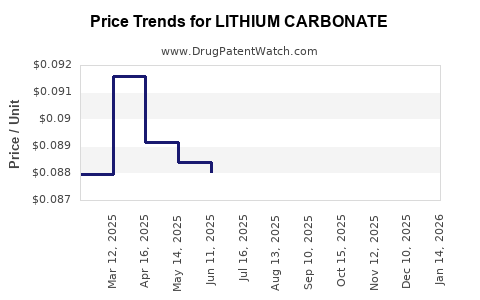
Prices for lithium carbonate have fluctuated significantly in recent years. After peaking at over $80,000 per metric ton in late 2021, prices declined to approximately $30,000 by early 2023, due to oversupply concerns and price correction mechanisms. Current prices as of Q4 2023 hover around $36,000 to $40,000 per metric ton, with futures momentum indicating potential stabilization or slight increase as demand continues rising.
How Do Supply and Demand Dynamics Shape Price Projections?
Short-term Outlook (1-2 years)
Demand growth remains robust amid rising EV sales. The supply chain faces challenges from geopolitical factors, environmental regulations, and resource constraints. Lithium producers are expanding capacity, but new projects often require 2-5 years to become operational. Prices are expected to stabilize at approximately $40,000 per metric ton, with potential upward pressure if supply constraints persist or if EV demand accelerates beyond projections.
Medium-term Outlook (3-5 years)
Production ramp-up from new mines and expansion projects should ease shortages, especially with lithium spodumene capacity increasing. Nonetheless, demand is projected to outpace supply growth, supporting prices in the $50,000 to $60,000 range. Market analysts forecast a compound annual growth rate (CAGR) of 12-15% in lithium carbonate prices from 2024 to 2028.
Long-term Outlook (5+ years)
Battery technology shifts, such as solid-state batteries, may reduce lithium demand marginally or shift supply needs. However, given the current forecasts, prices could reach between $60,000 and $70,000 per metric ton unless significant global capacity increases occur. Supply-demand balance will hinge on mining breakthroughs, recycling advancements, and potential substitutions.
What Factors Could Influence Future Price Trends?
- Technological Changes: Improvements in battery chemistry reducing lithium consumption.
- Regulatory Policies: Environmental restrictions impacting mining operations or export policies.
- Recycling & Alternatives: Advances in lithium recycling could dampen demand for virgin material.
- Geopolitical Risks: Concentration of supply in politically sensitive regions could affect stability.
- Market Speculation: Investment flows into lithium commodities can create price volatility.
How Do Competitive Dynamics Affect the Market?
The lithium market features a handful of dominant producers with significant control over pricing. New entrants face regulatory and environmental hurdles. Vertical integration, with some automakers investing directly in mining, can influence the supply chain and pricing stability.
Price Projections Summary Table
| Year |
Price Range (USD/MT) |
Commentary |
| 2023 |
$36,000 - $40,000 |
Stabilization after price correction |
| 2024 |
$45,000 - $50,000 |
Demand growth sustains prices |
| 2025 |
$50,000 - $60,000 |
Capacity expansion begins to influence prices |
| 2028 |
$60,000 - $70,000 |
Potential peak if supply constraints persist |
Key Takeaways
- Lithium carbonate's market is driven by battery sector growth.
- Prices saw significant volatility post-2021, with recent stabilization.
- Supply expansion is critical for price moderation but lagging demand still supports upward price trends.
- Prices are projected to remain in the $45,000-$70,000 range over the next five years, depending on supply-demand balance.
- External factors like policies, technological developments, and recycling influence future trends.
FAQs
1. How sensitive is lithium carbonate pricing to EV market growth?
Pricing is highly sensitive; a 10% increase in EV adoption can lead to a proportional increase in lithium demand, exerting upward pressure on prices.
2. What are the main sources of lithium carbonate?
Major sources include spodumene mineral deposits, lithium-rich brine pools, and recycled lithium from batteries.
3. Are there notable substitutes for lithium in battery technology?
Currently, lithium-ion batteries dominate; alternatives like sodium-ion are emerging but lack commercial scale.
4. How does environmental regulation impact lithium supply?
Strict environmental standards can delay mining projects, reduce available capacity, and increase operational costs, impacting prices.
5. What positional advantages do large producers hold?
Major producers like Albemarle (US), SQM (Chile), and Ganfeng Lithium (China) control significant market share and influence pricing through capacity decisions.
References
- Benchmark Mineral Intelligence. "Lithium Price Index," 2023.
- US Geological Survey. "Mineral Commodity Summaries 2023."
- Bloomberg New Energy Finance. "EV Market Outlook," 2023.
- Goldman Sachs. "Lithium Market Outlook," 2023.
- International Lithium Association. "Global Lithium Mining and Supply," 2023.