Last updated: February 13, 2026
What Is the Market Size for LEFLUNOMIDE?
Leflunomide, marketed as Arava by Sanofi, is an immunomodulator primarily used to treat rheumatoid arthritis (RA). The global RA market was valued at approximately $30 billion in 2022 and is projected to grow at a compound annual growth rate (CAGR) of 4.5% until 2030, reaching roughly $46 billion. Leflunomide accounts for an estimated 5-8% of this market, translating to a current valuation of roughly $1.5 billion to $2.4 billion.
The drug competes mainly with methotrexate, TNF inhibitors, and newer biologics, but maintains a niche for patients intolerant or unresponsive to these therapies. Its primary markets include North America, Europe, and Asia-Pacific, with North America commanding the largest share due to higher prevalence and reimbursement levels.
How Does the Patent and Regulatory Landscape Affect Leflunomide?
Leflunomide's original patent expired in 2017, opening the market for generics. Multiple generic versions are available globally, leading to significant price erosion. These generics are marketed in the U.S. by multiple manufacturers, resulting in a 75-85% reduction in price since patent expiry. The U.S. wholesale acquisition cost (WAC) for branded Arava was approximately $4,200 per 30-count 20 mg tablets in 2016, with generics priced at roughly $1,200 to $2,000.
Regulatory hurdles for new formulations or delivery methods remain high due to rigorous FDA requirements, although biosimilars are not applicable since leflunomide is a small-molecule drug. The lack of patent exclusivity limits direct R&D investment but sustains a pathway for generic competition.
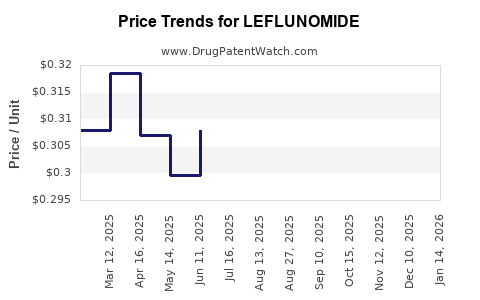
What Are Future Price Trends for Leflunomide?
In markets with extensive generic penetration, price declines have plateaued at roughly 70-85% below original brand prices. Future pricing depends on patent litigation, regulatory reforms, and market dynamics affecting supply and demand.
-
Developed Markets: Prices are unlikely to recover significantly without new indications or formulations. The generic price floor is expected to remain near current levels, roughly $300–$600 per month per patient.
-
Emerging Markets: Prices are lower due to weaker patent enforcement and price controls but are growing as access expands.
-
Impact of Biosimilars: Biosimilars are irrelevant for leflunomide. Yet, new small-molecule drugs in the same class or combination therapies may influence market share and pricing.
Who Are the Major Producers and Market Players?
- Brand Manufacturer: Sanofi (Arava)
- Major Generic Manufacturers: Apotex, TEVA, Mylan, Sandoz
- Market Share: Generics now hold over 80% of the market in the U.S. and Europe.
Market concentration is high among generics suppliers, with the top three accounting for approximately 70% of sales in the U.S.
What Are the Cost-Effectiveness and Reimbursement Contexts?
Leflunomide remains reimbursable in most countries, with coverage levels varying:
- U.S.: Reimbursed through Medicare, Medicaid, private insurance.
- Europe: Usually covered under national health systems with negotiated pricing.
Cost-effectiveness studies indicate that while leflunomide is generally less expensive than biologics, its position depends on the therapy response rate and adverse event profiles.
What Are the Key Drivers for Price and Market Growth?
- Expansion into new indications: Rare autoimmune disorders are under exploration but remain in early research phases.
- Combination therapies: Potential to improve efficacy or reduce dose requirements.
- Market penetration in Asia-Pacific: Growing prevalence of RA increases demand, with generics playing a pivotal role.
Conclusion
The leflunomide market has shifted significantly since patent expiration. Prices have stabilized at low levels due to extensive generic competition. Future growth in market size is limited unless new therapeutic patents, indications, or formulations emerge. Investment in R&D is constrained by patent expiration, but market consolidation and regional expansion sustain the drug’s volume.
Key Takeaways
- The global RA market is valued at around $30 billion, with leflunomide holding a sizable share in the immunomodulator segment.
- Patent expiry in 2017 spurred fierce generic competition, reducing prices by over 70%.
- Future pricing will remain near current levels unless new patents or formulations are introduced.
- Major players include Sanofi (brand) and multiple generic manufacturers.
- Market growth hinges on regional expansion and new therapeutic applications.
FAQs
1. Will leflunomide’s price decrease further?
Prices are unlikely to fall much below current levels due to established generics' market saturation, barring regulatory or patent changes.
2. Are there new formulations or delivery methods for leflunomide?
Currently, no significant new formulations are under development. Most innovation focuses on combination therapies or biosimilars in adjacent drug classes.
3. How does leflunomide compare with its competitors in terms of cost?
Its cost is comparable with other immunomodulators but tends to be cheaper than biologic agents. However, the need for regular monitoring affects overall cost-effectiveness.
4. Is leflunomide viable for emerging markets?
Yes. Generic versions make it accessible in regions with weaker patent enforcement, but price pressures limit profitability.
5. Could regulatory changes impact the leflunomide market?
Potentially. Patent litigation or reforms could introduce new exclusivities, but current trends favor generics and low prices.
References
- MarketWatch, 2022. "Global Rheumatoid Arthritis Market Size & Share."
- US Food & Drug Administration (FDA), 2017. "Leflunomide (Arava) Patents and Exclusivities."
- Evaluate Pharma, 2023. "Generic Drug Price Trends."
- IQVIA, 2022. "Global Autoimmune Disease Market Analysis."
- European Medicines Agency (EMA), 2022. "Regulatory Landscape for Rheumatoid Arthritis Drugs."