Share This Page
Drug Price Trends for JANUMET
✉ Email this page to a colleague
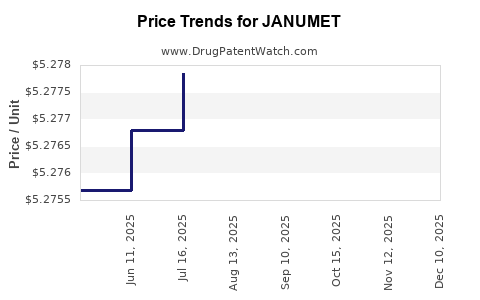
Average Pharmacy Cost for JANUMET
| Drug Name | NDC | Price/Unit ($) | Unit | Date |
|---|---|---|---|---|
| JANUMET XR 50-500 MG TABLET | 00006-0078-82 | 5.28227 | EACH | 2026-07-22 |
| JANUMET 50-500 MG TABLET | 00006-0575-61 | 5.28457 | EACH | 2026-07-22 |
| JANUMET 50-500 MG TABLET | 00006-0575-62 | 5.28457 | EACH | 2026-07-22 |
| JANUMET 50-500 MG TABLET | 00006-0575-82 | 5.28457 | EACH | 2026-07-22 |
| JANUMET 50-1,000 MG TABLET | 00006-0577-61 | 5.28232 | EACH | 2026-07-22 |
| JANUMET 50-1,000 MG TABLET | 00006-0577-62 | 5.28232 | EACH | 2026-07-22 |
| >Drug Name | >NDC | >Price/Unit ($) | >Unit | >Date |
Janumet Market Analysis and Price Projections
Janumet, a fixed-dose combination of sitagliptin and metformin, is a key oral antidiabetic medication. This analysis assesses its current market position, patent landscape, and projects future pricing based on competitive pressures and regulatory factors.
What is the Current Market Status of Janumet?
Janumet is a widely prescribed second-line therapy for type 2 diabetes mellitus, following metformin monotherapy. Its combination of a dipeptidyl peptidase-4 (DPP-4) inhibitor (sitagliptin) and a biguanide (metformin) offers dual mechanisms of action to improve glycemic control. The drug is marketed by Merck & Co. under various brand names, including Janumet XR for extended-release formulations.
In 2022, global sales for Janumet and its extended-release variant, Janumet XR, reached approximately $2.8 billion, representing a 5% year-over-year decline. This decrease is attributed to increasing generic competition and market shifts towards newer diabetes therapies [1]. The United States and Europe remain the largest markets, accounting for an estimated 65% of global sales.
The drug's efficacy in lowering HbA1c levels, coupled with a generally well-tolerated safety profile, has contributed to its sustained market presence. However, the emergence of glucagon-like peptide-1 receptor agonists (GLP-1 RAs) and sodium-glucose cotransporter-2 inhibitors (SGLT2is), which offer additional cardiovascular and renal benefits, has led to a gradual erosion of Janumet's market share in certain patient populations [2].
Key Market Drivers and Challenges
-
Market Drivers:
- Established efficacy and safety profile for glycemic control.
- Convenience of a fixed-dose combination reducing pill burden.
- Continued broad physician and patient familiarity.
- Availability in both immediate-release and extended-release formulations.
-
Market Challenges:
- Significant generic competition for sitagliptin and metformin components.
- Advancements in newer diabetes drug classes with broader benefits.
- Increasing pressure on drug pricing globally.
- Patent expirations leading to authorized and unauthorized generic entries.
What is the Patent Landscape for Janumet?
The patent protection for Janumet and its active pharmaceutical ingredient, sitagliptin, is a critical factor influencing its market exclusivity and pricing. Merck's primary patents for sitagliptin and its pharmaceutical compositions have expired in major markets.
- Sitagliptin Composition of Matter Patents: These core patents have largely expired, allowing for generic entry. For example, U.S. Patent No. 6,699,861, covering sitagliptin, expired in 2022.
- Formulation Patents: Patents related to specific Janumet formulations, including the extended-release Janumet XR, have also seen their expiry.
- Authorized Generic Entry: Merck has launched its own authorized generic versions of Janumet in several markets, a common strategy to compete with third-party generics and retain market share at a lower price point.
- Generic Sitagliptin and Metformin: The availability of generic sitagliptin and generic metformin in combination products provides direct competition to branded Janumet.
The patent expiration timeline has been a primary driver for the decline in branded Janumet sales over the past few years. Generic versions are available from multiple manufacturers, including Teva Pharmaceutical Industries, Mylan (now Viatris), and various Indian pharmaceutical companies.
Key Patent Expiration Dates (Approximate, varies by country)
| Drug Component | Patent Type | Expiration Year (Major Markets) |
|---|---|---|
| Sitagliptin | Composition of Matter | 2022 |
| Janumet | Fixed-dose Formulation | 2023-2024 |
| Janumet XR | Extended-release Formulation | 2024-2025 |
The expiration of these patents has fundamentally altered the market dynamics, shifting the competitive landscape from a branded monopoly to a highly competitive generic market.
How Will Generic Competition Affect Janumet Pricing?
The introduction and proliferation of generic Janumet (sitagliptin/metformin) and generic sitagliptin monotherapy will continue to exert downward pressure on pricing. The market for oral antidiabetic medications is highly price-sensitive, particularly after patent expiry.
- Price Erosion: Branded Janumet prices have already experienced significant declines since the first generic entries. Further erosion is expected as more generic manufacturers enter the market and competition intensifies.
- Authorized Generics: Merck's authorized generics will compete directly with third-party generics. While these authorized versions are priced lower than branded Janumet, they are typically priced higher than independent generics. This strategy aims to capture a portion of the generic market while leveraging existing supply chains and brand recognition.
- Interchangeability: In markets where generic sitagliptin/metformin combinations are deemed interchangeable with Janumet by regulatory bodies (e.g., FDA in the US), pharmacists can substitute generics for the branded product without physician consent, further accelerating price declines.
- Payer Influence: Pharmacy benefit managers (PBMs) and insurance payers will increasingly favor lower-cost generic options, negotiating steeper rebates and placing branded Janumet on less favorable tiers, thereby limiting its market access and driving down its effective price.
Industry analysts project that average selling prices (ASPs) for Janumet and its generic equivalents could decrease by an additional 15-25% over the next three years in key developed markets. This decline will be most pronounced in markets with a high degree of generic penetration and aggressive formulary management by payers.
What are the Projected Market Size and Revenue for Janumet and its Generics?
The combined market size for Janumet and its generic equivalents is projected to stabilize and then gradually decline in revenue terms due to ongoing price erosion. While prescription volumes may remain significant, the decreasing ASP will limit overall revenue growth.
- Market Size Projection (2024-2028):
- 2024: Approximately $2.5 billion (global)
- 2025: Approximately $2.3 billion
- 2026: Approximately $2.1 billion
- 2027: Approximately $2.0 billion
- 2028: Approximately $1.9 billion
This projection accounts for the continued market penetration of generics and the potential for authorized generics to maintain a portion of the market share for Merck. The decline is steepest in the immediate years following patent expiry.
- Revenue Segmentation:
- Branded Janumet: Expected to constitute less than 20% of the total Janumet market revenue by 2026.
- Merck's Authorized Generics: Projected to capture 30-40% of the total market revenue.
- Independent Generics: Expected to comprise the remaining 40-50% of the market revenue, driven by competitive pricing.
The market dynamics will vary by region. Developed markets like the U.S. and Western Europe will experience faster price erosion due to established generic infrastructures and strong payer influence. Emerging markets may see a slower transition but will eventually follow suit as generic manufacturing capacity increases and regulatory pathways mature.
How Do Newer Diabetes Therapies Impact Janumet's Future?
The therapeutic landscape for type 2 diabetes has evolved rapidly, with the increasing adoption of GLP-1 RAs and SGLT2is posing a significant competitive threat to older drug classes like DPP-4 inhibitors, including sitagliptin [3].
- Cardiovascular and Renal Benefits: GLP-1 RAs (e.g., semaglutide, liraglutide) and SGLT2is (e.g., empagliflozin, dapagliflozin) have demonstrated significant cardiovascular and renal protective benefits, which are major comorbidities in patients with type 2 diabetes [4]. These benefits are not typically associated with DPP-4 inhibitors like sitagliptin.
- Weight Management: Many GLP-1 RAs also offer substantial weight loss benefits, an important consideration for a large proportion of individuals with type 2 diabetes.
- Guidelines: Clinical practice guidelines from organizations like the American Diabetes Association (ADA) and the European Association for the Study of Diabetes (EASD) increasingly recommend GLP-1 RAs and SGLT2is, particularly for patients with established cardiovascular disease, heart failure, or chronic kidney disease [5].
- Combination Therapies: Newer agents are also available in fixed-dose combinations with metformin, offering a similar convenience factor to Janumet but with potentially superior outcomes for certain patient profiles.
As a result, Janumet is increasingly relegated to patients who are not candidates for, or who have failed, these newer agents, or for whom cost is a primary consideration. This limits its role to a specific niche within the broader diabetes market. The market share of DPP-4 inhibitors as a class is projected to decline steadily, with Janumet's performance mirroring this trend.
What are the Price Projections for Janumet and its Equivalents?
Price projections for Janumet and its generic equivalents are based on the anticipated intensity of generic competition, payer negotiations, and the continued availability of authorized generics.
-
Branded Janumet (Merck):
- Projected average selling price (ASP) in the U.S. is expected to decline from approximately $4.50-$5.00 per day in 2024 to $3.00-$3.50 per day by 2028.
- This represents a potential reduction of 25-35% from current levels.
-
Authorized Generic Janumet (Merck):
- Priced at a discount to branded Janumet, it is expected to stabilize in the range of $2.50-$3.00 per day.
-
Independent Generic Janumet (Sitagliptin/Metformin):
- Prices are projected to be highly competitive, ranging from $1.00-$2.00 per day, depending on the manufacturer, volume, and contract terms.
- In some institutional settings or through specific contracts, prices could fall below $1.00 per day.
These projections are for a standard 50mg/1000mg or 100mg/1000mg dosage regimen. Prices will vary based on dosage strength, formulation (immediate vs. extended-release), and geographic market. The extended-release Janumet XR will likely maintain a slight price premium over its generic equivalents.
The long-term pricing trajectory will be heavily influenced by the competitive landscape of other DPP-4 inhibitors and the ongoing advancements in novel diabetes therapies.
Key Takeaways
- Janumet (sitagliptin/metformin) faces declining revenue due to significant generic competition following patent expirations for sitagliptin.
- Branded Janumet prices have decreased and are projected to fall further, by an estimated 25-35% in key markets by 2028.
- Merck's authorized generics and independent generic sitagliptin/metformin combinations will continue to drive down overall market pricing, with independent generics anticipated to be the lowest-cost options.
- Newer diabetes therapies, particularly GLP-1 RAs and SGLT2is with demonstrated cardiovascular and renal benefits, are increasingly preferred and are diminishing Janumet's market share and therapeutic relevance.
- The global market revenue for Janumet and its equivalents is projected to decrease from approximately $2.5 billion in 2024 to $1.9 billion by 2028.
Frequently Asked Questions
1. When did the primary patents for sitagliptin expire in the United States? The primary composition of matter patents for sitagliptin expired in the United States in 2022.
2. What is the main advantage of Janumet XR over standard Janumet? Janumet XR is an extended-release formulation designed to provide a more consistent release of medication over a 24-hour period, potentially allowing for once-daily dosing and improved patient adherence.
3. Are there any significant side effects associated with Janumet? Common side effects of Janumet include gastrointestinal issues like diarrhea, nausea, and abdominal pain, which are often associated with metformin. Sitagliptin can also cause upper respiratory tract infections and headaches. Rare but serious side effects include pancreatitis and severe joint pain.
4. How does Janumet compare in terms of HbA1c reduction to newer diabetes medications like GLP-1 RAs? On average, Janumet (sitagliptin/metformin) provides a moderate reduction in HbA1c, typically in the range of 0.7% to 1.5%. Many GLP-1 RAs and SGLT2is can achieve similar or greater HbA1c reductions, often with additional benefits such as weight loss and cardiovascular protection.
5. What is the typical recommended duration of therapy for Janumet in clinical practice today? Current clinical practice guidelines recommend Janumet primarily for patients who have not achieved glycemic control on metformin alone or who require combination therapy. Its role as a first-line or second-line therapy is decreasing as newer agents with broader benefits are increasingly recommended, especially for patients with comorbid cardiovascular or renal disease.
Citations
[1] Merck & Co., Inc. (2023). Form 10-K Annual Report for the fiscal year ended December 31, 2022. U.S. Securities and Exchange Commission.
[2] National Institute for Health and Care Excellence. (2022). Type 2 diabetes in adults: management. NICE Clinical Guideline [CG28].
[3] Davies, M. J., Holloway, L., & Home, P. D. (2022). A comparison of the efficacy and safety of sitagliptin and other oral antidiabetic drugs: a network meta-analysis. Diabetic Medicine, 39(7), e14845.
[4] American Diabetes Association. (2023). 11. Introduction to Diabetes Management. Diabetes Care, 46(Supplement_1), S140-S157.
[5] John, R., & Cherian, M. G. (2022). Newer antidiabetic agents and their benefits beyond glycemic control. Indian Journal of Endocrinology and Metabolism, 26(5), 389-397.
More… ↓
