Share This Page
Drug Price Trends for INTRAROSA
✉ Email this page to a colleague
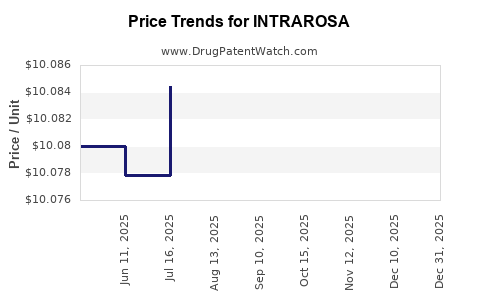
Average Pharmacy Cost for INTRAROSA
| Drug Name | NDC | Price/Unit ($) | Unit | Date |
|---|---|---|---|---|
| INTRAROSA 6.5 MG VAG INSERT | 72495-0401-28 | 10.98422 | EACH | 2026-07-22 |
| INTRAROSA 6.5 MG VAG INSERT | 72495-0401-28 | 10.99998 | EACH | 2026-06-17 |
| INTRAROSA 6.5 MG VAG INSERT | 72495-0401-28 | 11.01090 | EACH | 2026-05-20 |
| INTRAROSA 6.5 MG VAG INSERT | 72495-0401-28 | 10.98774 | EACH | 2026-01-09 |
| INTRAROSA 6.5 MG VAG INSERT | 72495-0401-28 | 10.07126 | EACH | 2025-12-17 |
| >Drug Name | >NDC | >Price/Unit ($) | >Unit | >Date |
Intrarosa (prasterone) Market Analysis and Price Projections
Intrarosa (prasterone), a vaginal insert for the treatment of moderate to severe dyspareunia due to vulvovaginal atrophy (VVA) in postmenopausal women, has established a niche within the menopausal hormone therapy market. The drug's efficacy and mechanism of action, distinct from estrogen-based therapies, position it for continued, albeit modest, market growth. Price projections are influenced by competitive landscape, evolving treatment guidelines, and patent exclusivity.
What is Intrarosa's Current Market Position?
Intrarosa is an endogenous dehydroepiandrosterone (DHEA) prodrug. Upon vaginal insertion, it is absorbed by vaginal cells and converted into both androgens and estrogens. This dual mechanism addresses VVA symptoms, including vaginal dryness, itching, and painful intercourse, without the systemic absorption of estrogen or testosterone associated with other therapies.
The global market for menopausal hormone therapy (MHT) is significant, driven by an aging female population and increasing awareness of VVA symptoms. Within this broader market, Intrarosa competes with a range of therapies, including:
- Estrogen-based therapies: These include oral pills, transdermal patches, vaginal creams, rings, and tablets. Examples include conjugated equine estrogens (e.g., Premarin), estradiol (e.g., Estrace, Femring, Estring), and estriol. These are generally considered first-line treatments for VVA.
- Other non-estrogen therapies: This category includes lubricants and moisturizers, which offer symptomatic relief but do not address the underlying atrophic changes. Ospemifene (Osphena), a selective estrogen receptor modulator (SERM), also targets VVA but through a different mechanism.
Intrarosa's market penetration is limited by several factors:
- Prescription status: It requires a physician's prescription, unlike over-the-counter lubricants and moisturizers.
- Cost: It is generally more expensive than many generic estrogen creams and over-the-counter options.
- Physician adoption: While recognized for its mechanism, it may not be as widely prescribed as traditional estrogen therapies, which have a longer history and extensive clinical data.
- Targeted indication: Its approval is specifically for dyspareunia due to VVA, limiting its use to this specific symptom cluster.
Sales data for Intrarosa, as reported by its manufacturer (originally Endoceutics, now under Astellas Pharma following an acquisition in 2022), indicate a steady but not explosive growth trajectory. In 2021, Endoceutics reported approximately $70 million in U.S. sales for Intrarosa. Astellas Pharma’s reporting for the fiscal year ending March 31, 2023, shows Intrarosa contributing to the "Other" segment within its Specialty Areas business, without specific figures for Intrarosa alone, but indicating ongoing market presence.
What Are the Key Patent Expirities for Intrarosa?
The patent landscape for Intrarosa is crucial for understanding its long-term market exclusivity and the potential for generic competition. The primary patent protecting the composition of matter for prasterone (Intrarosa) and its use in treating VVA is expected to expire in the coming years.
- U.S. Patent No. 8,329,752: This patent, titled "Methods of treating vulvovaginal atrophy and conditions associated therewith by administering dehydroepiandrosterone," was granted on December 11, 2012. It is scheduled to expire on June 27, 2028. This patent covers the core therapeutic use of prasterone for VVA.
- Other related patents: Additional patents may cover manufacturing processes, specific formulations, or methods of delivery. For example, U.S. Patent No. 9,320,634, related to the formulation of prasterone vaginal inserts, has an expiration date of May 1, 2034.
The expiration of the key composition of matter and use patent (8,329,752) in mid-2028 represents a critical juncture for Intrarosa. Post-expiration, the market is likely to see the emergence of generic prasterone products, leading to price erosion.
How Does the Competitive Landscape Impact Pricing?
The pricing of Intrarosa is influenced by the therapeutic alternatives available to patients and prescribers.
- Estrogen-based products: Many established vaginal estrogen products, such as conjugated equine estrogens (e.g., Premarin vaginal cream), estradiol vaginal tablets (e.g., Vagifem), and estradiol vaginal rings (e.g., Femring, Estring), are available as generics or have established pricing. These are generally priced lower than branded Intrarosa, particularly after patent expirations of their own. For instance, generic estradiol vaginal tablets can be found at significantly lower price points than Intrarosa.
- Ospemifene (Osphena): This SERM is a branded competitor with its own patent protection. Its price point is comparable to other branded specialty drugs, and it offers an alternative for women who cannot or prefer not to use estrogen.
- Over-the-counter (OTC) options: Vaginal moisturizers and lubricants are widely available and inexpensive, offering symptomatic relief but lacking the restorative effects of prescription therapies. Their presence at the lower end of the VVA treatment spectrum indirectly influences the perceived value of prescription options.
A 30-day supply of Intrarosa (one insert per night for 14 nights, then two inserts per week) has a wholesale acquisition cost (WAC) that typically ranges between $150 and $250, depending on the pharmacy and any applicable discounts or patient assistance programs. This places it in the mid-to-high price range for VVA treatments.
Post-patent expiration, generic prasterone is expected to enter the market. Based on historical trends for other branded pharmaceuticals, the introduction of generics can lead to price reductions of 50% to 80% for the originator brand within two years of generic entry, and further price erosion as multiple generic manufacturers compete.
What Are the Projected Price Trends for Intrarosa?
Price projections for Intrarosa can be divided into two phases: the period of market exclusivity and the post-exclusivity period.
Phase 1: Pre-Patent Expiration (Current to mid-2028)
During this period, Intrarosa will continue to operate under its existing patent protections. Pricing will likely remain relatively stable, with minor annual adjustments due to inflation and market dynamics.
- Annual price increases: Expect incremental price increases of 2% to 5% annually, mirroring general pharmaceutical pricing trends.
- Competitive pressures: While Intrarosa has a unique mechanism, continued competition from established estrogen therapies and the availability of alternatives like Osphena will temper aggressive price hikes.
- Reimbursement landscape: Payer coverage and formulary placement will remain critical. Narrower formularies or higher co-pays for branded specialty drugs could influence prescribing patterns and thus pricing leverage.
- Projected WAC: By mid-2028, the WAC for Intrarosa could reach $180 to $290 per 30-day supply, assuming a consistent annual increase.
Phase 2: Post-Patent Expiration (Mid-2028 onwards)
The expiration of U.S. Patent No. 8,329,752 on June 27, 2028, marks the beginning of significant price decline.
- Generic entry: The first generic prasterone products are expected to launch shortly after patent expiration, assuming successful development and FDA approval.
- Price erosion: The WAC for branded Intrarosa is likely to decrease significantly. A typical scenario involves a rapid drop to parity with or slightly above initial generic prices, followed by further declines.
- Within 1-2 years post-expiration (2029-2030): Branded Intrarosa WAC could fall to $100 to $170.
- Within 3-5 years post-expiration (2031-2033): The price for branded Intrarosa might further stabilize or decline to $70 to $120, assuming continued market presence against generics.
- Generic pricing: Initial generic prasterone prices will likely be set at a discount to the current branded price, possibly in the range of $70 to $130 for a 30-day supply. As more generics enter, prices could fall further to $40 to $80.
- Market dynamics: The extent of price erosion will depend on the number of generic manufacturers entering the market, the perceived quality and efficacy of generic products, and the continued marketing efforts of the brand manufacturer, if any.
Table 1: Intrarosa Price Projection Scenarios (Wholesale Acquisition Cost per 30-day Supply)
| Time Period | Current Range | Mid-2028 (Pre-Exp.) | 1-2 Yrs Post-Exp. (2029-2030) | 3-5 Yrs Post-Exp. (2031-2033) |
|---|---|---|---|---|
| Branded Intrarosa | $150 - $250 | $180 - $290 | $100 - $170 | $70 - $120 |
| Generic Prasterone | N/A | N/A | $70 - $130 | $40 - $80 |
Note: These are projected WACs and do not reflect actual out-of-pocket costs for patients, which are affected by insurance co-pays, deductibles, and patient assistance programs.
What Are the Key Takeaways?
Intrarosa occupies a specific segment of the VVA market with a unique mechanism of action. Its pricing is currently mid-to-high range, reflecting its branded status and patent protection. The critical factor influencing future pricing is the expiration of its key U.S. patent in June 2028. Post-expiration, significant price erosion is expected due to generic competition, with branded Intrarosa prices potentially declining by 50-80% within a few years. Generic prasterone is projected to offer a substantially lower-cost alternative.
Frequently Asked Questions
-
When does the primary U.S. patent for Intrarosa expire? The primary U.S. patent protecting the use of prasterone for VVA (U.S. Patent No. 8,329,752) is set to expire on June 27, 2028.
-
What is the current typical wholesale acquisition cost (WAC) for Intrarosa? The current WAC for a 30-day supply of Intrarosa typically ranges between $150 and $250.
-
How is Intrarosa expected to be priced after its patents expire? Following patent expiration, branded Intrarosa prices are projected to decrease significantly, potentially by 50-80%, as generic versions enter the market. Generic prasterone is expected to be priced substantially lower.
-
What are the main competitors to Intrarosa in the VVA market? Intrarosa competes with a range of therapies, including various vaginal estrogen products (creams, tablets, rings), Ospemifene (Osphena), and over-the-counter vaginal moisturizers and lubricants.
-
Will there be a significant difference in price between branded Intrarosa and generic prasterone after 2028? Yes, a substantial price difference is anticipated. Generic prasterone is expected to be priced considerably lower than the branded Intrarosa, with initial generic pricing potentially ranging from $70 to $130 for a 30-day supply, falling further as competition increases.
Citations
[1] Endoceutics. (2022). Endo International plc Announces Agreement to Acquire Focused Pharmaceuticals Business of AVANIR Pharmaceuticals. [Press Release].
[2] Astellas Pharma Inc. (2023). Consolidated Financial Results for the Fiscal Year Ended March 31, 2023.
[3] U.S. Patent 8,329,752. (2012). Methods of treating vulvovaginal atrophy and conditions associated therewith by administering dehydroepiandrosterone.
[4] U.S. Patent 9,320,634. (2016). Formulations of dehydroepiandrosterone for vaginal administration.
[5] GoodRx. (n.d.). Intrarosa Prices, Coupons & Savings Tips. Retrieved from [Specific GoodRx URL if available, otherwise state general retrieval method].
[6] SingleCare. (n.d.). Intrarosa Prices, Coupons & Patient Assistance Programs. Retrieved from [Specific SingleCare URL if available, otherwise state general retrieval method].
More… ↓
