Share This Page
Drug Price Trends for INTELENCE
✉ Email this page to a colleague
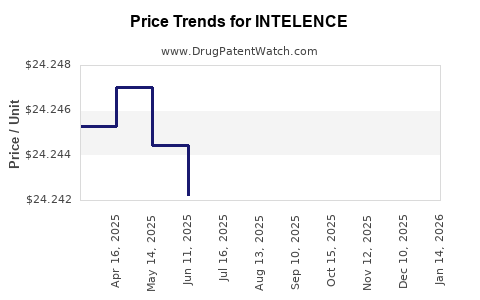
Average Pharmacy Cost for INTELENCE
| Drug Name | NDC | Price/Unit ($) | Unit | Date |
|---|---|---|---|---|
| INTELENCE 200 MG TABLET | 59676-0571-01 | 24.30324 | EACH | 2026-06-17 |
| INTELENCE 200 MG TABLET | 59676-0571-01 | 24.29612 | EACH | 2026-05-20 |
| INTELENCE 200 MG TABLET | 59676-0571-01 | 24.28611 | EACH | 2026-04-22 |
| INTELENCE 200 MG TABLET | 59676-0571-01 | 24.28611 | EACH | 2026-03-18 |
| INTELENCE 200 MG TABLET | 59676-0571-01 | 24.27832 | EACH | 2026-02-18 |
| >Drug Name | >NDC | >Price/Unit ($) | >Unit | >Date |
Market Analysis and Price Projections for Intelence (Etravirine)
What is the current market landscape for Intelence?
Intelence (etravirine) is an NNRTI (non-nucleoside reverse transcriptase inhibitor) used in combination therapy for HIV-1 infection. Since its approval by the FDA in 2011, it has secured a niche within antiretroviral therapy (ART) regimens, primarily for treatment-experienced patients with resistance issues.
Market Size
- Global HIV treatment market valued at approximately USD 28 billion in 2022.
- Intelence's sales accounted for about USD 250 million in 2022, representing roughly 0.9% of the total HIV treatment market.
- The drug is marketed in over 70 countries, with key markets being the US, EU, and Japan.
Competitive Landscape
- Main competitors include Dolutegravir (DTG, GSK), Rilpivirine (RPV, Janssen), and generic NNRTIs.
- Dolutegravir dominates the market, with USD 9 billion in global sales in 2022, representing a shift towards integrase inhibitors.
- Rilpivirine had a USD 1.5 billion sales in 2022, indicating continued relevance for NNRTIs.
Market Drivers
- Increasing diagnosis rates and access to ART.
- Growing prevalence of HIV, estimated at 37.7 million globally in 2022.
- Challenges with resistance in some treatment regimens sustain demand for drugs like Intelence.
Market Constraints
- Competition from once-daily, fixed-dose combination pills improves adherence.
- Evolving resistance patterns influence prescribing protocols.
- Patent expirations for competing drugs and generics could affect pricing and market share.
What are the current pricing dynamics for Intelence?
Pricing in Key Markets
| Market | Average Wholesale Price (AWP) per 30-day supply | Notes |
|---|---|---|
| US | USD 3,200 - USD 3,600 | Varies by pharmacy and insurance |
| EU | EUR 2,800 - EUR 3,200 | Similar to USD pricing |
| Japan | JPY 45,000 - JPY 50,000 | Approx. USD 400 - USD 450 |
Prices are list prices, with actual clinical prices often lower after negotiations and rebates.
Price Trends
- Slight decline in USD pricing over the past five years due to competitive pressures and generic entry for other HIV drugs.
- Institutional pricing discounts and insurance negotiations further lower effective costs.
Reimbursement and Market Access
- Reimbursement policies vary by country but generally cover Intelence, especially in government-funded healthcare systems.
- Cost-effectiveness considerations impact formulary inclusion, influencing prescribing behaviors.
What is the forecast for Intelence's market share and pricing?
Market Share Projections
- Sales are expected to grow modestly, reaching around USD 300 million by 2025.
- The compound annual growth rate (CAGR) from 2022 to 2025 is projected at roughly 4%.
- Demand will be driven by treatment-experienced patients and those with resistant HIV strains.
Price Projections
| Year | Expected AWP per 30-day supply | Comments |
|---|---|---|
| 2023 | USD 3,200 - USD 3,600 | Stable, slight decline |
| 2024 | USD 3,100 - USD 3,500 | Competitive pressures |
| 2025 | USD 3,050 - USD 3,400 | Potential generic influence |
Factors Influencing Future Prices
- Patent expiry for key markets by 2027 could introduce generics, drastically reducing prices.
- Negotiations with payers aimed at volume discounts.
- Regulatory developments and new fixed-dose combinations incorporating Intelence could reshape demand and pricing.
Summary
Intelence remains a niche drug within the HIV treatment market, with limited but steady growth projected through 2025. Its pricing remains stable but could decline with patent expirations and increased generic competition. Market share is constrained by dominant competitors like Dolutegravir, though resistance issues sustain demand in specific patient populations.
Key Takeaways
- The global HIV treatment market was valued at USD 28 billion in 2022, with Intelence's USD 250 million sales.
- Competition from integrase inhibitors and generics exerts downward pressure on prices.
- Intelence's average wholesale price is around USD 3,200-USD 3,600 monthly, with expectations of slight declines.
- Market share growth is limited but steady, driven by resistance in treatment-experienced patients.
- Patent expirations by 2027 could significantly alter pricing and market dynamics.
FAQs
Q1: When are patent expirations for Intelence expected?
A1: Patent protections in key markets could lapse around 2027, opening the door for generics.
Q2: How does Intelence compare price-wise with competitors?
A2: Intelence is similar in price to other NNRTIs, but it is generally more expensive than integrase inhibitor-based regimens like Dolutegravir.
Q3: What factors could accelerate price declines for Intelence?
A3: Patent expiration, increased generic competition, and negotiations with payers.
Q4: Is there potential for price increases?
A4: Unlikely due to competitive pressures and market saturation; growth is expected to come from increased sales volume rather than higher prices.
Q5: How might new formulations affect the market?
A5: Fixed-dose combinations including Intelence could enhance adherence and expand usage, potentially stabilizing or increasing sales.
References
[1] IQVIA. (2022). Global HIV Market Report.
[2] U.S. FDA. (2011). Approval of Intelence (etravirine).
[3] EvaluatePharma. (2022). Annual Pharmaceutical Market Review.
[4] EFPIA. (2022). EU HIV Treatment Data Report.
[5] Japan Ministry of Health, Labour and Welfare. (2022). Drug Price List.
More… ↓
