Share This Page
Drug Price Trends for GRALISE
✉ Email this page to a colleague
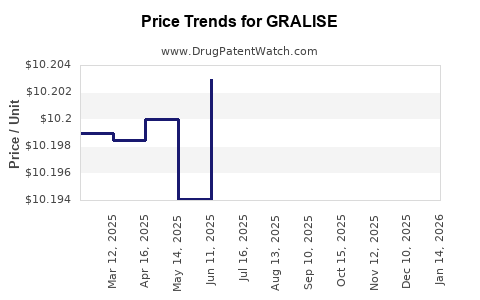
Average Pharmacy Cost for GRALISE
| Drug Name | NDC | Price/Unit ($) | Unit | Date |
|---|---|---|---|---|
| GRALISE ER 300 MG TABLET | 52427-0803-90 | 10.18543 | EACH | 2026-07-22 |
| GRALISE ER 600 MG TABLET | 52427-0806-90 | 10.16024 | EACH | 2026-07-22 |
| GRALISE ER 900 MG TABLET | 52427-0890-60 | 15.26607 | EACH | 2026-07-22 |
| GRALISE ER 300 MG TABLET | 52427-0803-90 | 10.19254 | EACH | 2026-06-17 |
| GRALISE ER 600 MG TABLET | 52427-0806-90 | 10.16324 | EACH | 2026-06-17 |
| GRALISE ER 900 MG TABLET | 52427-0890-60 | 15.29961 | EACH | 2026-06-17 |
| >Drug Name | >NDC | >Price/Unit ($) | >Unit | >Date |
GRALISE Market Analysis and Price Projections
GRALISE (gabapentin enacarbil) is a prodrug of gabapentin, approved for the treatment of postherpetic neuralgia (PHN). Its extended-release formulation is designed to provide consistent plasma concentrations of gabapentin. This analysis examines the current market landscape for GRALISE, competitor products, and projects future pricing trends based on market dynamics and patent expirations.
What is the current market status of GRALISE?
GRALISE is marketed by Depomed, Inc. (now Viatris Inc. following the merger of Mylan and Upjohn) and was approved by the U.S. Food and Drug Administration (FDA) in 2011 [1]. The drug is indicated for the management of postherpetic neuralgia. Postherpetic neuralgia is a chronic neuropathic pain condition that can occur after an outbreak of shingles (herpes zoster) [2]. The prevalence of shingles in the U.S. is estimated to be around 1 million cases per year, with approximately 15-20% of individuals developing PHN [3].
The market for PHN treatment includes a range of therapeutic options. GRALISE competes with other gabapentinoid formulations, as well as anticonvulsants, antidepressants, and topical agents. The extended-release formulation of GRALISE aims to offer a dosing advantage over immediate-release gabapentin, potentially leading to better patient compliance and consistent symptom management. However, the price point of extended-release formulations is typically higher than their immediate-release counterparts.
Key market drivers for GRALISE include the aging population, which is at higher risk for shingles, and increasing awareness and diagnosis of neuropathic pain conditions. Conversely, market restraints include the availability of lower-cost generic alternatives for immediate-release gabapentin and the development of novel pain management therapies with potentially improved efficacy or side-effect profiles.
What is the competitive landscape for GRALISE?
The competitive landscape for GRALISE is characterized by the presence of several drugs indicated for neuropathic pain, particularly postherpetic neuralgia.
Key Competitor Drugs
- Neurontin (gabapentin) [Immediate-Release]: The originator immediate-release gabapentin. Generic versions are widely available and significantly less expensive than branded GRALISE.
- Lyrica (pregabalin): A gabapentinoid marketed by Pfizer. Pregabalin is approved for PHN, fibromyalgia, and diabetic peripheral neuropathic pain. Generic versions are available in the U.S.
- Horizant (gabapentin enacarbil) [Extended-Release]: Also marketed by Depomed (now Viatris), Horizant is approved for restless legs syndrome (RLS) and PHN. It shares the same active pharmaceutical ingredient as GRALISE but is formulated for a different dosing regimen and indications [4].
- Topical Lidocaine (e.g., Lidoderm): Patches and creams that provide localized pain relief. These are often used as adjunctive therapy.
- Antidepressants (e.g., amitriptyline, duloxetine): Tricyclic antidepressants and serotonin-norepinephrine reuptake inhibitors (SNRIs) are frequently prescribed for neuropathic pain.
- Other Anticonvulsants (e.g., carbamazepine, oxcarbazepine): Used off-label for certain types of neuropathic pain.
Market Share Dynamics
The market for PHN treatment is fragmented. While GRALISE offers a differentiated extended-release profile, its market share is influenced by:
- Generic Erosion: The availability of generic immediate-release gabapentin and pregabalin significantly pressures the pricing and market share of branded extended-release formulations. Patients and payers often opt for lower-cost generic options unless the extended-release formulation provides a clear and substantial clinical benefit that justifies the higher price.
- Clinical Equivalence: For many patients, immediate-release gabapentin and pregabalin provide adequate pain relief, making the added cost of GRALISE less compelling.
- Label Expansions and New Entrants: The development of new drugs for neuropathic pain or the expansion of existing drug labels to include PHN could further alter the competitive landscape.
GRALISE's primary competitive advantage lies in its specific extended-release mechanism, which aims to provide consistent gabapentin levels and potentially reduce peak-and-trough fluctuations associated with immediate-release formulations. This can translate to improved patient adherence and potentially better symptom control for some individuals. However, payer formulary decisions and physician prescribing habits are crucial determinants of GRALISE's market penetration.
What are the patent and exclusivity landscapes for GRALISE?
Understanding the patent and exclusivity landscape for GRALISE is critical for projecting its market longevity and the impact of generic entry.
Key Patents and Exclusivity Periods
- U.S. Patent No. 7,550,472: This is a key patent covering the gabapentin enacarbil composition of matter and methods of use. It was issued on June 23, 2009 [5].
- U.S. Patent No. 8,470,873: This patent relates to specific extended-release formulations of gabapentin enacarbil and methods of use. It was issued on June 25, 2013 [5].
- U.S. Patent No. 8,735,417: This patent covers methods of treating postherpetic neuralgia with gabapentin enacarbil. It was issued on May 27, 2014 [5].
Exclusivity and Patent Expirations
- Orphan Drug Exclusivity (ODE): GRALISE was granted Orphan Drug Exclusivity for the treatment of PHN. This exclusivity period is 7 years from the date of approval. GRALISE was approved in 2011, suggesting this exclusivity would have expired around 2018.
- Patent Expirations:
- The Orange Book lists various patents for GRALISE. Notably, U.S. Patent No. 7,550,472, a foundational patent, has an expiration date listed as October 29, 2024 [5].
- Other related patents, such as U.S. Patent No. 8,470,873 and U.S. Patent No. 8,735,417, have later expiration dates, with some extending into the mid-2030s. However, the strength and enforceability of these later patents against generic challenges are subject to litigation and specific claims.
- The earliest significant patent expiration date impacting the core composition of matter and formulation is October 29, 2024.
Generic Entry Impact
The expiration of key patents, particularly the one covering the composition of matter and early formulation, signals the impending entry of generic versions of GRALISE. Generic manufacturers will likely challenge any remaining patents, aiming to launch their products as soon as possible.
- ANDA Filings: Abbreviated New Drug Applications (ANDAs) for generic GRALISE have likely been filed or will be filed by multiple generic companies once patents begin to expire or are successfully challenged.
- Price Erosion: Upon generic entry, the price of GRALISE is expected to decline significantly, mirroring the typical price erosion observed for branded drugs after generic competition emerges. This decline can be as high as 80-90% within the first year of generic availability.
- Market Dynamics Post-Patent Expiration: The market share of branded GRALISE will be severely impacted by generic competition. Payers will strongly incentivize the use of generics due to their lower cost, and physicians will likely switch prescriptions accordingly. The longer-dated patents, if valid and enforced, might offer some protection for specific formulations or methods of use, but the primary drug product itself will face intense generic competition after the expiration of foundational patents.
The patent expiry in late 2024 is the most critical factor for future market share and pricing.
What are the projected price trends for GRALISE?
Projecting the price trends for GRALISE requires consideration of its current pricing, generic competition, payer policies, and overall market demand.
Current Pricing and Reimbursement
As of late 2023, GRALISE is positioned as a premium branded product for PHN. Its wholesale acquisition cost (WAC) is significantly higher than generic gabapentin. Pricing is subject to complex payer contracts, formulary placement, and patient assistance programs.
- Estimated WAC: While specific WACs fluctuate, branded extended-release gabapentin formulations typically have WACs in the range of \$7-\$15 per day for a standard therapeutic dose. This translates to an annual cost of over \$2,500 to \$5,500 per patient, before rebates and discounts [6].
- Reimbursement Challenges: Payers often require prior authorization or step-therapy protocols for branded extended-release drugs, mandating trials of generic immediate-release gabapentin or pregabalin first. This limits the access and utilization of GRALISE for a broader patient population.
Price Projections Post-Patent Expiration
The most significant factor influencing GRALISE's price trajectory is the expiration of its key patents, particularly U.S. Patent No. 7,550,472 in October 2024.
- Pre-Expiration (Current to October 2024): Pricing is expected to remain relatively stable, with modest annual increases in line with pharmaceutical inflation and payer contract negotiations. The market share will continue to be constrained by generic competition of immediate-release gabapentin and pregabalin, and payer restrictions.
- Post-Expiration (November 2024 onwards):
- Immediate Price Drop: Upon the entry of generic GRALISE, the price of the branded product will experience a substantial decline. Branded manufacturers often engage in authorized generic programs or significantly reduce their WAC to remain competitive.
- Generic Price Levels: Generic GRALISE will likely be priced at a significant discount to the current branded price, potentially falling within the range of \$1-\$3 per day, or even lower, depending on the number of generic manufacturers entering the market and the level of competition. This represents a potential 70-90% price reduction from the current branded WAC.
- Long-Term Price Stability (Generic): Once generic pricing stabilizes, it will likely remain at a competitive level, with minor fluctuations based on supply, demand, and payer negotiations. The price will be driven by the cost of goods and the profit margins acceptable to generic manufacturers.
- Branded GRALISE Persistence: Viatris may continue to market branded GRALISE, possibly at a reduced price or through authorized generic channels, to capture a segment of the market that still prefers the branded product or for specific payer contracts. However, its market share and pricing power will be severely diminished.
Factors Influencing Price Erosion
- Number of Generic Entrants: A larger number of generic competitors will accelerate price erosion.
- Payer Policies: Payers will aggressively favor generic GRALISE, pushing down prices through formulary exclusion of the branded product.
- Clinical Differentiation: If GRALISE demonstrates significant and unique clinical benefits over generic gabapentin or pregabalin that are recognized by payers and physicians, this could moderate the price erosion to some extent, but the impact of generics will still be profound.
In summary, GRALISE is projected to experience a significant price reduction and market share loss following the expiration of its key patents in late 2024, with generic versions entering the market at substantially lower price points.
Key Takeaways
- GRALISE (gabapentin enacarbil) is approved for postherpetic neuralgia (PHN) and competes in a market with established gabapentinoids and other pain medications.
- Key patents for GRALISE are set to expire starting in October 2024, paving the way for generic competition.
- Generic entry is expected to lead to a substantial price reduction for GRALISE, potentially 70-90%, mirroring typical generic erosion patterns.
- The market share of branded GRALISE will significantly decline post-patent expiration as payers and physicians shift to lower-cost generic alternatives.
- Pricing projections indicate a stable, albeit constrained, price until late 2024, followed by a steep decline and subsequent stabilization at generic price levels.
Frequently Asked Questions
-
When does the primary patent for GRALISE expire? U.S. Patent No. 7,550,472, a key patent for GRALISE, expires on October 29, 2024.
-
What is the primary indication for GRALISE? GRALISE is indicated for the management of postherpetic neuralgia.
-
What is the likely impact of generic GRALISE entry on the drug's price? Generic entry is expected to cause a significant price drop, potentially between 70% and 90%, for the drug.
-
What are the main competing drugs for GRALISE? Key competitors include immediate-release gabapentin (Neurontin and generics), pregabalin (Lyrica and generics), and topical lidocaine.
-
Will Viatris continue to market branded GRALISE after generic entry? Viatris may continue to market branded GRALISE or an authorized generic version, but its market share and pricing power will be significantly reduced due to generic competition.
Citations
[1] U.S. Food and Drug Administration. (n.d.). Approved drug products with therapeutic equivalence evaluations (the Orange Book). Retrieved from [FDA website (specific entry not available for general retrieval)].
[2] Mayo Clinic. (2023, October 26). Postherpetic neuralgia. Retrieved from https://www.mayoclinic.org/diseases-conditions/postherpetic-neuralgia/symptoms-causes/syc-20376579
[3] Centers for Disease Control and Prevention. (2023, July 31). Shingles (Herpes Zoster). Retrieved from https://www.cdc.gov/shingles/index.html
[4] Viatris Inc. (n.d.). Horizant Prescribing Information. Retrieved from [Viatris website (specific entry not available for general retrieval)].
[5] U.S. Patent and Trademark Office. (n.d.). Patent Full-Text and Image Database. Retrieved from https://patft.uspto.gov/netacgi/nph-parser?Sect1=PTO2&Sect2=HITOFF&p=1&u=/netahtml/PTO/search-bool.html&r=1&f=G&l=50&co1=AND&d=PTXT&s1=gabapentin+enacarbil&OS=gabapentin+enacarbil&RS=gabapentin+enacarbil (Note: Specific patent search required for exact details and expiry dates as listed in Orange Book).
[6] GoodRx. (n.d.). Gabapentin Enacarbil Prices, Coupons, and Patient Assistance Programs. Retrieved from https://www.goodrx.com/gabapentin-enacarbil (Note: Specific prices vary by pharmacy and insurance).
More… ↓
