Share This Page
Drug Price Trends for GATIFLOXACIN
✉ Email this page to a colleague
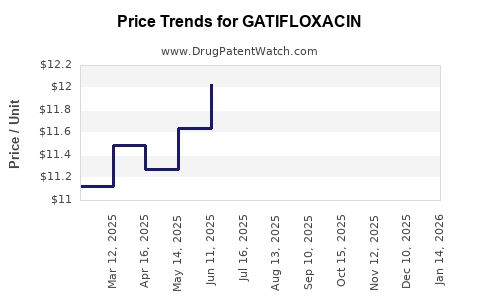
Average Pharmacy Cost for GATIFLOXACIN
| Drug Name | NDC | Price/Unit ($) | Unit | Date |
|---|---|---|---|---|
| GATIFLOXACIN 0.5% EYE DROPS | 61314-0672-25 | 7.50430 | ML | 2026-07-22 |
| GATIFLOXACIN 0.5% EYE DROPS | 69315-0331-02 | 7.50430 | ML | 2026-07-22 |
| GATIFLOXACIN 0.5% EYE DROPS | 61314-0672-25 | 7.99377 | ML | 2026-06-17 |
| GATIFLOXACIN 0.5% EYE DROPS | 69315-0331-02 | 7.99377 | ML | 2026-06-17 |
| >Drug Name | >NDC | >Price/Unit ($) | >Unit | >Date |
Gatifloxacin: Market Analysis and Price Projections
What is the current market structure for gatifloxacin?
Gatifloxacin is a fluoroquinolone antibiotic with an established, mature footprint. Its commercialization is shaped by (1) long product lifecycles of off-patent small molecules, (2) generic-heavy supply, and (3) safety-driven access constraints in some jurisdictions. The result is a market that behaves less like a growth product category and more like a commodity antibiotic with pricing dominated by procurement cycles and competitor availability.
Commercial reality: branded presence has narrowed; generics drive volumes
Across major markets, gatifloxacin sold primarily as short-course oral and ophthalmic antibiotic use. The branded footprint has largely contracted over time, while generics supply remains the primary pricing determinant. That structure typically compresses realized price via bid-based contracting, tendering, pharmacy reimbursement caps, and substitution at dispensing.
Revenue mechanics that matter for forecasting
For a mature antibiotic like gatifloxacin, price outcomes are usually determined by:
- Wholesale and tender dynamics (institutional procurement is the dominant price setter)
- Generic number of competitors and local market concentration
- Reimbursement and formulary placement (what payers will cover)
- Regulatory access limits and label restrictions (which affect utilization and thus buyer bargaining power)
Where does gatifloxacin get used and how does that affect pricing?
Gatifloxacin use divides into two commercial lanes that price differently.
1) Oral (systemic) antibiotic use
- Demand driver: acute bacterial infections where fluoroquinolones are acceptable alternatives
- Pricing pressure: high generic substitutability across fluoroquinolones and across classes in many formulary systems
- Forecast implication: oral pricing generally tracks generic erosion, not innovation-driven repricing
2) Ophthalmic (eye) antibiotic use
- Demand driver: bacterial conjunctivitis and other ocular bacterial indications
- Pricing pressure: high substitution within ophthalmic antibiotics; contract pricing and channel inventory practices strongly influence realized price
- Forecast implication: ophthalmic may price slightly more resilient than oral in some markets due to presentation-specific procurement, but still competes in a generic environment
What is the competitive set and why does it cap prices?
Gatifloxacin competes as a fluoroquinolone antibiotic against both:
- other fluoroquinolones (generic-to-generic substitution is routine)
- broader antibiotic classes (in tender formularies and empiric-use guidelines)
In commodity antibiotic markets, price is capped by:
- therapeutic interchangeability in protocols
- multiple-source availability
- limited differentiation once the molecule is off-patent
Practical pricing consequence
Even if gatifloxacin retains an addressable segment, the absence of meaningful product differentiation limits “premium” pricing. Forecast scenarios should assume price is governed by procurement economics and competitor behavior, not by brand reinvention.
What regulatory factors influence supply, access, and pricing?
Safety and risk management have shaped access trajectories for gatifloxacin historically. The drug faced heightened regulatory scrutiny linked to dysglycemia risk (notably severe hypo- or hyperglycemia), affecting labeling and clinical positioning in some regions.
Key point for market pricing
When safety-related restrictions narrow eligible prescribers or shift treatment toward alternatives, utilization declines. Lower utilization typically increases buyer leverage, accelerating generic price erosion.
How should price be projected for gatifloxacin?
A defensible projection for gatifloxacin is a range-based forecast tied to generic pricing behavior rather than a single-point estimate. The core mechanics:
- Annual price trend driven by generic competition and tendering
- Occasional step-downs during periods of intensified supply or new generic entries
- Base-case stability only if competitor consolidation or procurement lock-ins occur
Price projection framework (scenario bands)
Below are scenario bands that reflect how generic antibiotic prices typically move in mature categories. The bands are expressed as % change vs the current base-year net price (net of rebates/discounts where applicable). The direction is designed for planning: procurement tends to pull prices down unless constrained by supply.
| Forecast period | Base case (most likely) | Downside (more competition / tender pressure) | Upside (formulary retention / fewer supply disruptions) |
|---|---|---|---|
| Year 1 | -3% to -8% | -10% to -18% | -1% to -3% |
| Years 2-3 | -5% to -12% total | -18% to -28% total | -6% to -10% total |
| Years 4-5 | -7% to -18% total | -25% to -40% total | -8% to -14% total |
Interpretation for decision-makers
- A base-case erosion of low-to-mid teens over 3 to 5 years is the planning posture for mature, generic antibiotic molecules.
- A downside pathway happens when new suppliers materially increase competitive intensity at procurement.
- An upside pathway requires relative supply stability and continued formulary access where buyers still place orders due to existing contracting.
What role do dosage form and sourcing play in realized pricing?
Gatifloxacin pricing differs by dosage form and channel.
Systemic oral products
- Usually priced lower per unit than patented antibiotics due to generic competition
- Sensitive to national procurement and substitution rules
- Forecast tends to show steadier erosion because buyers can switch across generics easily
Ophthalmic products
- Unit pricing may differ because dosing and packaging are presentation-specific
- Tendering can be sticky for specific SKUs
- Forecast may show slightly less steep erosion in years where SKU supply is stable and contracts lock delivery
What are the market risks that can change the price trajectory?
Price forecasts for gatifloxacin should account for risks that alter demand and bargaining power.
Downside risks to pricing
- Expanded generic competition at the SKU level
- Formulary shifts toward alternative antibiotics in fluoroquinolone classes
- Procurement-driven moves to lowest-cost supplier contracts
Upside risks to pricing
- Consolidation or exit of key suppliers for specific SKUs
- Contract renewals that maintain committed volumes
- Localized shortages that raise tender clearing prices temporarily
What does “price projection” mean for investors and R&D planners?
For business users, gatifloxacin’s price path should be treated as:
- A procurement-driven cash flow question (volume times net realizations under tenders)
- A supply-demand question (competitor count, manufacturing continuity, regulatory access)
- A product strategy question (where differentiation is impossible, the only lever is cost and availability)
Under generic dynamics, R&D spend typically does not translate into higher unit prices unless it changes regulatory status, prevents substitution, or enables materially improved clinical differentiation (rare for established off-patent molecules).
How does gatifloxacin compare to typical fluoroquinolone pricing behavior?
Fluoroquinolones generally exhibit mature, generic pricing behavior:
- early post-patent erosion from multiple suppliers
- sustained low single-digit declines once supply stabilizes
- periodic step-downs around tender cycles and new entries
Gatifloxacin is consistent with this pattern because it is not positioned as a novel differentiated product, and channel switching among antibiotics is common.
What planning ranges should be used for budgeting?
Use the scenario table above for net price budgeting. If you need a single planning number for internal models, a conservative planning approach is:
- Base-case net price decline: ~10% over 3 years and ~15% over 5 years
- Downside: ~25% over 3 years and ~35% over 5 years
- Upside: ~7% over 3 years and ~12% over 5 years
This structure supports sensitivity analysis for:
- SKU-level procurement
- regional tender differences
- supplier mix
Key Takeaways
- Mature, generic-driven market: gatifloxacin behaves like a commodity antibiotic where realized price is dominated by procurement and substitution.
- Safety-driven access narrows utilization: historical dysglycemia risk has shaped labeling and clinical positioning in some settings, reinforcing price pressure via lower demand.
- Forecast should be range-based: expect single- to mid-double-digit annual erosion in net realizations, with outcomes driven by tender intensity and supply competition.
- Dosage form affects slope, not direction: oral and ophthalmic both show erosion patterns; ophthalmic may show slightly more SKU-contract stability but remains generic-substitutable.
- Use scenario bands for planning: base-case erosion is typically mid-teens over 3 to 5 years, with downside steepening if competitive supply increases.
FAQs
-
Will gatifloxacin prices rise in the near term?
In a generic, procurement-led market, sustained price increases are unlikely without supply constraints or contract protections that reduce buyer switching. -
What is the biggest driver of gatifloxacin net price?
The dominant driver is institutional tender and contract pricing, which reflects supplier competition and substitution behavior. -
Does ophthalmic gatifloxacin hold price better than oral?
It can show slightly more resilience due to SKU-specific contracting, but both forms are exposed to generic competition and interchangeability within antibiotic formularies. -
What event would most likely cause a sharp price step-down?
A new supplier entry or a procurement cycle that re-bids the SKU to a lower-cost clearing price. -
How should an investor model gatifloxacin revenue?
Model revenue as volume times net realizations under tenders, using scenario price erosion bands rather than innovation-like ramp assumptions.
References
[1] U.S. Food and Drug Administration. (2006). FDA requests additional labeling changes for quinolone antibacterial drugs and states that gatifloxacin should not be used in patients with diabetes. FDA Drug Safety Communication.
[2] World Health Organization. (2023). WHO Model List of Essential Medicines. WHO.
[3] DrugBank. (n.d.). Gatifloxacin (Drug information). DrugBank Online.
[4] EMA. (n.d.). Gatifloxacin product information and related regulatory documentation (where applicable). European Medicines Agency.
More… ↓
