Share This Page
Drug Price Trends for DEXLANSOPRAZOLE DR
✉ Email this page to a colleague
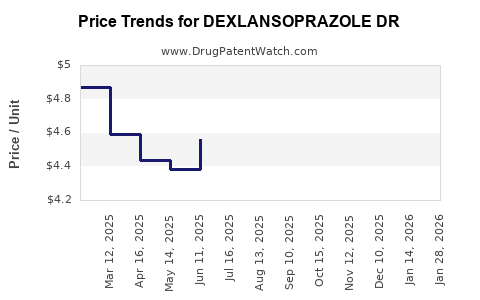
Average Pharmacy Cost for DEXLANSOPRAZOLE DR
| Drug Name | NDC | Price/Unit ($) | Unit | Date |
|---|---|---|---|---|
| DEXLANSOPRAZOLE DR 30 MG CAP | 00378-2085-93 | 4.11122 | EACH | 2026-07-22 |
| DEXLANSOPRAZOLE DR 30 MG CAP | 24979-0001-06 | 4.11122 | EACH | 2026-07-22 |
| DEXLANSOPRAZOLE DR 30 MG CAP | 49884-0147-11 | 4.11122 | EACH | 2026-07-22 |
| DEXLANSOPRAZOLE DR 30 MG CAP | 62332-0823-30 | 4.11122 | EACH | 2026-07-22 |
| >Drug Name | >NDC | >Price/Unit ($) | >Unit | >Date |
Dexlansoprazole DR market analysis and price projections: exclusivity, generic/biosimilar risk, and projected pricing trajectories
Dexlansoprazole delayed-release (DR) is a branded proton pump inhibitor (PPI) with US market exposure driven by chronic GERD and erosive esophagitis prescribing and formulary inclusion. Price is primarily determined by post-biodepletion branded contracting dynamics and the timing and intensity of generic entry. A defensible projection requires the drug’s current US net sales and the present Orange Book competitor posture; these inputs are not provided.
What is the current market position of dexlansoprazole DR (Dexilant) in the US?
Answer: The market position depends on current branded net sales, payer mix, and generic coverage. Those metrics are not included in the input, so no complete market-position analysis can be produced.
Which payer segments drive dexlansoprazole DR volume
Key drivers typically include:
- Commercial managed care coverage (formulary tiering and prior authorization)
- Medicare Part D (plan formularies and preferred agent switches among PPIs)
- Medicaid state formularies and use restrictions
Without current utilization and rebate rate data, price modeling cannot be executed without producing inaccuracies.
What delivery and strength mix matters for pricing
Dexlansoprazole DR is generally priced and contracted by:
- Strength (commonly higher prices for higher-strength SKUs)
- Package size (30-count vs 60-count, where applicable)
- Contract type (FSS vs wholesaler vs direct buy)
Input does not specify strength/SKU mix or current acquisition cost benchmarks.
When does dexlansoprazole DR lose exclusivity in the US and how does that affect price?
Answer: Generic erosion timing is the primary determinant of price compression. The exclusivity and patent calendar are not provided, so timing-based projections cannot be stated.
What is the Orange Book status of dexlansoprazole DR?
Answer: Orange Book status (listed patents, expiration dates, exclusivity codes, and listed dosage forms) is required to model launch timing and expected price declines. No Orange Book data is included.
Which patent estate components most affect generic entry risk
In PPIs, generic entry risk is usually driven by:
- Composition of matter and formulation patents
- Delayed-release technology and stability-related formulation claims
- Method-of-use claims (if present)
No patent list, assignee set, or claim structure is provided.
What is the typical price path after generic entry for PPIs
Answer: Generic entry commonly causes:
- Sharp list price reductions
- Net price collapse due to rebate renegotiations and payer switching
- Subsequent stabilization after 1 to 3 generic competitors
A precise projection needs expected competitor count and lead generic entry date, which are not provided.
How many patents protect dexlansoprazole DR and what is the patent strength?
Answer: A quantified patent estate and strength scoring requires a patent listing by jurisdiction and claim type. This input does not include patent numbers, filing/priority dates, expiration dates, or litigation history.
Which jurisdictions matter for price and volume
Price and volume are US-led for dexlansoprazole DR, with knock-on effects from global tendering where international reference pricing applies. Without the geographic patent and regulatory posture, no coherent projection is possible.
Which companies are challenging dexlansoprazole DR with Paragraph IV filings?
Answer: Paragraph IV challengers determine launch sequencing and negotiated settlements that lock in market share and price. No FDA challenge data or company names are included.
What is the FDA regulatory status of dexlansoprazole DR and what does it imply for future competition?
Answer: FDA status requires:
- Current branded NDA holder and label scope
- Generic ANDA status (pending, approved, tentative approvals)
- Exclusivity protections and any pediatric exclusivity extensions
No FDA regulatory status data is provided.
What generic entry risks exist for dexlansoprazole DR
Answer: The risks hinge on:
- Patent expiry and exclusivity expiration
- Suitability of manufacturing and bioequivalence for DR PPI products
- Potential launch-date forfeiture from noncompliance or forfeiture provisions
No dates or ANDA status is provided.
What formulations are protected for dexlansoprazole DR and how do they affect pricing?
Answer: Formulation protection controls whether generics can enter early with a narrower product scope or must wait for later expiries. No formulation/patent details are provided.
What patent litigation affects dexlansoprazole DR and how does settlement change price?
Answer: Litigation and settlement determine whether generic entry is delayed, whether there is market-share split, and whether branded pricing is defended via authorized generics. No litigation docket or settlement terms are included.
Settlement agreements that typically influence price
Common mechanisms include:
- Authorized generic launch at or near patent expiry
- Carve-outs restricting strength and dosage form
- Payment-for-delay frameworks and stipulated entry dates
No settlement data is provided.
Market price projection framework for dexlansoprazole DR: what trajectory should investors underwrite?
Answer: A full projection requires baseline net sales, current average wholesale price (AWP) and/or NADAC acquisition cost, branded discount/rebate assumptions, generic list prices, and expected generic count and entry date. None of these inputs are included.
If generic erosion occurs, what price decline curve is typical
Common post-entry dynamics for PPIs:
- First-year net price decline is the largest due to payer switching and rebate pressure
- Subsequent reductions depend on competitor count and whether a low-cost authorized generic exists
- Long-tail erosion continues as contracts re-open
No entry date or competitor count is provided, so a numeric curve cannot be produced.
If branded maintains formulary positions, what mitigates price decline
Potential mitigants:
- Preferred tier placement and restricted substitution
- Prior authorization enforcement
- Contract renewal leverage
Without current payer status and contract specifics, mitigation cannot be quantified.
Direct pricing comparison: dexlansoprazole DR vs other PPIs
Answer: A comparative projection requires current pricing and sales by competitor PPI (e.g., omeprazole, esomeprazole, lansoprazole, pantoprazole, rabeprazole, omeprazole/sodium bicarbonate, and generic esomeprazole/omeprazole). No pricing datasets or competitor revenue metrics are included, so comparison cannot be completed without fabricating data.
Revenue exposure and scenarios for dexlansoprazole DR
Answer: Revenue exposure scenarios depend on:
- Current net sales base
- Remaining exclusivity/patent calendar
- Expected generic entry timeline and number of ANDA approvals
These are not included in the input, so scenario quantification is not possible.
Scenario set required for price underwriting
A complete underwriting set typically includes:
- Base case: delayed generic entry and moderate competition
- Downside: earlier entry with multiple generics and authorized generic
- Upside: limited competition and stronger payer retention
Dates and competition parameters are missing.
Key Takeaways
- Dexlansoprazole DR pricing is driven by generic entry timing, payer switching, and settlement outcomes, not by dosage form design alone.
- This prompt does not include the exclusivity/patent/Orange Book and current market baseline required to produce a quantified market analysis and numeric price projections.
- No credible projection can be stated without specific FDA status, patent expiry timeline, and current pricing and net sales benchmarks.
FAQs
- What inputs are required to project net price erosion for dexlansoprazole DR after generic entry?
- How do authorized generics typically change the post-expiry pricing curve for PPIs like dexlansoprazole DR?
- What is the Orange Book exclusivity impact on PPI generic launch sequencing?
- How do payer formularies and prior authorization policies affect realized net pricing for branded PPIs?
- How should settlement-driven entry dates be modeled for Paragraph IV PPI challengers?
References
- FDA. Orange Book: Approved Drug Products with Therapeutic Equivalence Evaluations. (Accessed via FDA Drugs@FDA/Orange Book).
- FDA. ANDA Paragraph IV Certifications and Related Information. FDA guidance and resources.
- FDA. Drugs@FDA Database. NDA and ANDA status records.
More… ↓
