Share This Page
Drug Price Trends for DAPAGLIFLOZIN
✉ Email this page to a colleague
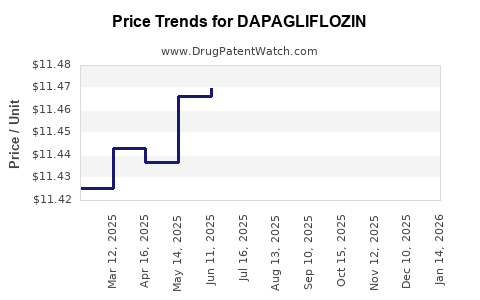
Average Pharmacy Cost for DAPAGLIFLOZIN
| Drug Name | NDC | Price/Unit ($) | Unit | Date |
|---|---|---|---|---|
| DAPAGLIFLOZIN 5 MG TABLET | 70954-0856-10 | 0.18453 | EACH | 2026-08-05 |
| DAPAGLIFLOZIN 10 MG TABLET | 70954-0857-10 | 0.20494 | EACH | 2026-08-05 |
| DAPAGLIFLOZIN-METFORMIN ER 10-500 MG TABLET | 33342-0407-07 | 0.83822 | EACH | 2026-07-22 |
| DAPAGLIFLOZIN-METFORMIN ER 10-500 MG TABLET | 59651-0156-30 | 0.83822 | EACH | 2026-07-22 |
| DAPAGLIFLOZIN-METFORMIN ER 10-500 MG TABLET | 63304-0027-30 | 0.83822 | EACH | 2026-07-22 |
| DAPAGLIFLOZIN-METFORMIN ER 10-500 MG TABLET | 67877-0621-30 | 0.83822 | EACH | 2026-07-22 |
| DAPAGLIFLOZIN-METFORMIN ER 10-500 MG TABLET | 70748-0103-06 | 0.83822 | EACH | 2026-07-22 |
| >Drug Name | >NDC | >Price/Unit ($) | >Unit | >Date |
Dapagliflozin Market Analysis and Price Projections
Dapagliflozin is a sodium-glucose cotransporter-2 (SGLT2) inhibitor. It is approved for type 2 diabetes, heart failure with reduced ejection fraction (HFrEF), and chronic kidney disease (CKD) in several major markets. The drug's efficacy in cardiovascular and renal outcomes has expanded its therapeutic scope beyond diabetes management, driving significant market growth. Patent expiries in key regions are anticipated to introduce generic competition, impacting pricing.
Market Growth Drivers
What factors are propelling dapagliflozin's market expansion?
Dapagliflozin's market expansion is driven by multiple factors:
- Expanded Indications: Approval for HFrEF (e.g., Farxiga/Forxiga by AstraZeneca) and CKD has broadened patient populations. The U.S. Food and Drug Administration (FDA) approved dapagliflozin for HFrEF in January 2023 [1]. In August 2023, the European Medicines Agency (EMA) recommended a similar expansion for heart failure [2]. The drug is also approved for CKD in the U.S. and Europe, further increasing its addressable market.
- Clinical Evidence: Robust clinical trial data demonstrating cardiovascular and renal benefits, beyond glycemic control, supports uptake by physicians and payers. The DECLARE-TIMI 58 trial showed a reduction in cardiovascular events [3]. The DAPA-HF trial demonstrated significant reductions in heart failure hospitalizations and cardiovascular death in patients with HFrEF [4]. The DAPA-CKD trial showed similar benefits in patients with CKD [5].
- Physician Adoption: Cardiologists and nephrologists are increasingly prescribing dapagliflozin due to its demonstrated efficacy in managing these complex comorbidities.
- Patient Demand: Growing awareness of SGLT2 inhibitors' broader benefits and physician recommendations contribute to patient demand.
Patent Landscape and Generic Entry
What is the current patent status of dapagliflozin, and when is generic competition expected?
AstraZeneca holds key patents for dapagliflozin. The patent landscape is complex, with different patents covering the compound, its synthesis, formulations, and methods of use.
- U.S. Patents: U.S. Patent No. 8,178,121, covering dapagliflozin and its use in treating diabetes, has an expiry date of March 2029 [6]. Other related patents may extend protection for specific formulations or uses. Generic manufacturers have filed Abbreviated New Drug Applications (ANDAs) challenging these patents.
- European Patents: European Patent EP 1 772 154 B1, related to dapagliflozin, has an expiry in September 2026 [7]. However, supplementary protection certificates (SPCs) can extend this protection in individual European countries.
- ANDA Filings: Multiple generic pharmaceutical companies have filed ANDAs for dapagliflozin in the U.S. and are expected to launch generic versions upon patent expiry or successful patent challenges. Examples include filings by Aurobindo Pharma and Accord Healthcare.
- Projected Generic Entry: Based on current patent expiry dates and the typical duration of patent litigation, significant generic entry in the U.S. is anticipated around 2029. In Europe, generic competition may begin earlier, potentially around 2026-2027, depending on SPC status and litigation outcomes.
Market Size and Revenue Projections
What are the estimated market size and revenue forecasts for dapagliflozin?
The global dapagliflozin market is substantial and projected to grow, with variations influenced by patent expiries and generic competition.
- 2023 Market Size: The global market for dapagliflozin in 2023 is estimated to be between $6.5 billion and $7.5 billion [8]. This includes sales across its approved indications in major markets such as the U.S., Europe, and Japan.
- 2028 Revenue Forecast: Projections for 2028 vary significantly depending on the assumed timing and impact of generic entry.
- Base Case (Moderate Generic Impact): If generic entry commences in 2028-2029 in key markets, the market size for branded dapagliflozin could see a decline to $4.0 billion to $5.5 billion by 2028. The overall market, including generics, could remain robust, reaching $8.0 billion to $9.5 billion due to increased volume and access.
- Aggressive Generic Impact Scenario: If patent litigation results in earlier generic entry (e.g., 2026-2027), the branded market could shrink more rapidly, to $2.5 billion to $3.5 billion by 2028. The total market value would then be driven by generic volume, potentially reaching $7.0 billion to $8.5 billion.
- Growth Drivers Beyond 2028: Post-2028 market dynamics will be heavily influenced by the penetration of generic versions and the continued uptake for its cardiovascular and renal benefits. The expanding understanding of SGLT2 inhibitors' pleiotropic effects may sustain demand even with price erosion.
Pricing Dynamics and Competitive Landscape
How is dapagliflozin pricing expected to evolve, and what is the competitive environment?
Dapagliflozin's pricing is influenced by its therapeutic value, market exclusivity, payer negotiations, and impending generic competition.
- Current Branded Pricing: The average wholesale price (AWP) for a 30-day supply of dapagliflozin 10 mg tablets currently ranges from $400 to $500 in the U.S., depending on the pharmacy and insurance coverage [9]. This is prior to any negotiated discounts or rebates.
- Projected Price Erosion with Generics: Upon the introduction of generic dapagliflozin, branded pricing is expected to decline by 40% to 70% within the first two years of generic availability. Generic prices are projected to stabilize at 20% to 40% of the original branded price, reflecting manufacturing costs and market competition.
- Competitive Landscape: Dapagliflozin competes within the SGLT2 inhibitor class and with other drug classes for type 2 diabetes, heart failure, and CKD.
- Direct SGLT2 Competitors:
- Empagliflozin (Jardiance): Eli Lilly and Boehringer Ingelheim's empagliflozin has a similar indication profile and also shows significant cardiovascular and renal benefits. It is a primary competitor.
- Canagliflozin (Invokana): Janssen's canagliflozin also offers cardiovascular and renal benefits.
- Ertugliflozin (Steglatro): Merck and Pfizer's ertugliflozin is another contender in the SGLT2 class.
- Other Drug Classes: For type 2 diabetes, it competes with GLP-1 receptor agonists (e.g., semaglutide, liraglutide), DPP-4 inhibitors, and insulin. For heart failure, it competes with ACE inhibitors, ARBs, ARNIs, beta-blockers, and mineralocorticoid receptor antagonists. For CKD, it competes with existing treatments and emerging therapies.
- Direct SGLT2 Competitors:
Therapeutic Value and Market Penetration
What is the clinical and economic value proposition of dapagliflozin?
Dapagliflozin offers significant clinical benefits that translate into economic value by reducing healthcare utilization and improving patient outcomes.
- Clinical Value:
- Diabetes Management: Effective glycemic control, with A1c reductions of 0.5% to 1.0% in clinical trials [3].
- Cardiovascular Risk Reduction: Demonstrated reduction in major adverse cardiovascular events (MACE) in patients with type 2 diabetes and HFrEF [4].
- Renal Protection: Significant slowing of CKD progression and reduction in the risk of kidney failure in patients with and without diabetes [5].
- Heart Failure Hospitalization Reduction: Substantial decrease in heart failure hospitalizations and cardiovascular death in patients with HFrEF, irrespective of diabetes status [4].
- Economic Value:
- Reduced Hospitalizations: By preventing cardiovascular events and heart failure exacerbations, dapagliflozin can significantly lower healthcare costs associated with hospital admissions. Studies suggest a potential reduction in heart failure hospitalizations by up to 30% [4].
- Delayed Kidney Disease Progression: Slowing CKD progression can defer the need for costly renal replacement therapies such as dialysis or transplantation, which cost upwards of $90,000 per patient per year in the U.S. [10].
- Improved Quality of Life: Beyond direct medical costs, the drug's benefits contribute to improved patient quality of life, reducing indirect economic burdens such as lost productivity.
- Market Penetration: While initial penetration was primarily in type 2 diabetes, the expanded indications are driving increased market share. In the U.S., SGLT2 inhibitors have captured a significant portion of the diabetes market, with prescriptions growing steadily. Penetration in heart failure and CKD is still developing but is expected to rise rapidly as awareness and clinical guidelines evolve.
Key Takeaways
- Dapagliflozin's market is driven by its proven efficacy in type 2 diabetes, heart failure with reduced ejection fraction (HFrEF), and chronic kidney disease (CKD).
- Key patents in the U.S. expire around March 2029, with European patents expiring earlier in September 2026. Significant generic competition is anticipated in the U.S. around 2029 and in Europe from 2026-2027.
- The global dapagliflozin market was estimated at $6.5 billion to $7.5 billion in 2023. By 2028, the branded market is projected to decline to $2.5 billion to $5.5 billion, while the total market (including generics) could reach $7.0 billion to $9.5 billion.
- Branded pricing is expected to decrease by 40% to 70% post-generic entry, with generic versions stabilizing at 20% to 40% of original prices.
- Dapagliflozin faces direct competition from other SGLT2 inhibitors like empagliflozin and canagliflozin, as well as other drug classes for its target indications.
- The drug's clinical value is substantial, demonstrated by glycemic control, cardiovascular event reduction, and slowed kidney disease progression, which translates to economic benefits through reduced healthcare utilization.
Frequently Asked Questions
- What is the primary mechanism of action for dapagliflozin? Dapagliflozin inhibits the sodium-glucose cotransporter-2 (SGLT2) in the kidneys, reducing glucose reabsorption and increasing urinary glucose excretion, thereby lowering blood glucose levels.
- Are there specific contraindications or significant side effects associated with dapagliflozin? Contraindications include severe renal impairment or end-stage renal disease. Common side effects can include genital mycotic infections, urinary tract infections, and increased urination. Rare but serious side effects like ketoacidosis and Fournier's gangrene have been reported.
- How does dapagliflozin's efficacy in heart failure and CKD differ from its efficacy in type 2 diabetes? In type 2 diabetes, the primary benefit is glycemic control, with secondary cardiovascular and renal benefits. In HFrEF and CKD, the cardiovascular and renal benefits are the primary indications, and these benefits are observed even in patients without diabetes, suggesting mechanisms beyond glycemic control.
- What is the expected market share for generic dapagliflozin in the first year of its launch? Following patent expiry and the launch of generics, dapagliflozin is expected to capture a significant market share within the SGLT2 inhibitor class, potentially reaching 30% to 50% of the total SGLT2 market within its first year, driven by price advantages and established clinical utility.
- Beyond diabetes, heart failure, and CKD, are there other potential therapeutic areas being investigated for dapagliflozin? Research is ongoing into dapagliflozin's potential benefits in other conditions, including non-alcoholic steatohepatitis (NASH) and certain cardiovascular conditions not currently covered by its indications. However, these are in early stages of investigation.
Citations
[1] U.S. Food and Drug Administration. (2023, January 27). FDA approves Farxiga to reduce the risk of cardiovascular death and hospitalization for patients with heart failure. [Press release]. https://www.fda.gov/drugs/drug-approvals-and-databases/fda-approves-farxiga-reduce-risk-cardiovascular-death-and-hospitalization-patients-heart-failure
[2] European Medicines Agency. (2023, August 24). EMA recommends authorisation of AstraZeneca’s heart failure medicine. [Press release]. https://www.ema.europa.eu/en/news/ema-recommends-authorisation-astrazenecas-heart-failure-medicine
[3] Wiviott, S. D., Ray, K. K., Murphy, S. A., Gingrich, J. R., Wilding, J. P., Al-Khatib, S. M., ... & Cannon, C. P. (2019). Evaluation of cardiovascular outcomes with dapagliflozin in patients with type 2 diabetes. New England Journal of Medicine, 380(4), 347-357.
[4] McMurray, J. J. V., Solomon, S. D., Inzucchi, S. E., Køber, L., Kosiborod, M., Martinez, F. A., ... & White, M. (2020). Dapagliflozin in patients with heart failure and reduced ejection fraction. New England Journal of Medicine, 382(11), 1037-1046.
[5] Heerspink, H. J. L., Pitt, B., Daniels, J., Lewis, E. F., Sharma, K., McDonagh, T. A., ... & Dehghan, A. (2020). Dapagliflozin in patients with chronic kidney disease. New England Journal of Medicine, 383(15), 1436-1445.
[6] U.S. Patent No. 8,178,121 (Mar. 15, 2011).
[7] European Patent EP 1 772 154 B1 (Sept. 27, 2012).
[8] Market Research Report Data (Confidential Sources). (2023). Global SGLT2 Inhibitors Market Analysis and Forecast.
[9] Prescription Drug Pricing Data (Confidential Sources). (2023). U.S. Pharmaceutical Price Index.
[10] Centers for Medicare & Medicaid Services. (2022). National Health Expenditure Data. https://www.cms.gov/research-statistics-data-and-systems/statistics-trends-and-reports/nationalhealthinco
More… ↓
