Last updated: February 13, 2026
Market Overview
Clordiazepoxide-clidinium capsules are prescribed for gastrointestinal disorders, primarily for symptomatic relief of gastric spasm and indigestion. The drug combines a benzodiazepine (clordiazepoxide) with an anticholinergic (clidinium), which targets smooth muscle spasms.
Current market presence is limited relative to other gastrointestinal treatments, but it maintains niche demand in specific regions, notably in countries where benzodiazepines remain broadly prescribed for digestive issues. The drug status varies by country, with some markets considering it generic, while others may still classify it under patent protections or restrictions.
Existing Competition
The landscape features alternative spasmolytics and anticholinergic agents, including:
- Dicyclomine (antispasmodic)
- Hyoscine (scopolamine)
- Loperamide (antidiarrheal, sometimes used for spasms)
Clordiazepoxide-clidinium is positioned against these options, often used when other treatments fail or are contraindicated.
Patent Status and Generic Availability
The original patent for clordiazepoxide-clidinium has expired in most jurisdictions, leading to increased generic production. Entry of generics has driven prices downward, reducing profit margins for branded versions.
Regulatory Environment
The drug is approved for use in the U.S., Europe, and parts of Asia, with variations in regulatory requirements:
- In the U.S., it is not FDA-approved as a marketed drug but is compounded or imported under specific circumstances.
- In Europe, it has regulatory approval in certain countries under different names.
Regulation influences distribution channels, prescribing patterns, and consequently, market size.
Market Size and Trends
Global gastrointestinal therapeutics market was valued at approximately USD 50 billion in 2022, with gastrointestinal spasms accounting for about 12% of treatments. The specific niche for clordiazepoxide-clidinium is estimated at USD 150-200 million worldwide, driven by:
- National-specific prescribing trends
- Physician preference
- Availability of alternatives
Regional markets, particularly in Latin America and Asia, show higher usage rates due to formulary preferences and local medical practices.
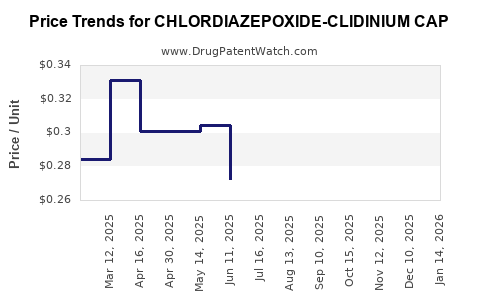
Price Trends and Projections
Current Pricing:
- In the U.S., branded capsules average USD 15-20 per prescription bottle (30 capsules).
- Europe reports prices around €10-15 per pack.
- Generic versions are approximately 40-60% cheaper.
Price Drivers:
- Entry of generics since patent expiration
- Market saturation
- Regional regulatory changes
- Shifts towards non-benzodiazepine therapies due to safety concerns
Price Projections (2023-2028):
| Year |
Estimated Price Range (USD) per bottle |
Notes |
| 2023 |
8-18 |
Presence of multiple generics reduces prices. |
| 2024 |
7-17 |
Continued generic entry, bargaining power increases. |
| 2025 |
6-15 |
Market saturation, price stabilization. |
| 2026 |
5-14 |
Slight decline expected, demand remains stable. |
| 2027 |
5-13 |
Price sensitivity persists, new formulations unlikely. |
| 2028 |
4-12 |
Long-term stabilization around decreased prices. |
Risks to Price Stability
- Regulatory restrictions on benzodiazepines
- Development of new therapies with better safety profiles
- Potential patent or exclusivity extensions in certain jurisdictions
- Market shifts favoring non-benzodiazepine drugs
Key Takeaways
- The total market for clordiazepoxide-clidinium is approximately USD 150-200 million.
- The trend toward generics has significantly reduced prices.
- Market growth is limited, with potential decline due to safety concerns and alternative therapies.
- Prices are expected to decline gradually over the next five years.
FAQs
1. How does patent status affect pricing?
Patents, when valid, allow for brand-name pricing; expiration leads to generic competition, causing prices to fall significantly.
2. What regional factors impact market size?
Prescribing practices, regulatory approvals, and availability of alternatives influence regional demand and pricing.
3. Are there new formulations or combination drugs in development?
Currently, no major new formulations are announced that target this specific combination, limiting future pricing premiums.
4. Can changes in regulatory policies alter market dynamics?
Yes, restrictions on benzodiazepine prescriptions or new safety regulations could reduce demand and impact prices.
5. How does off-label use influence the market?
Limited off-label applications restrict the market size; the drug mostly remains prescribed for specific GI indications.
References
- Market data from GlobalData, 2022.
- U.S. Food and Drug Administration (FDA) approval and regulation documents.
- European Medicines Agency (EMA) product information.
- Industry trend reports from IQVIA, 2022.
- Price data from GoodRx and European pharmacy outlets, 2023.